
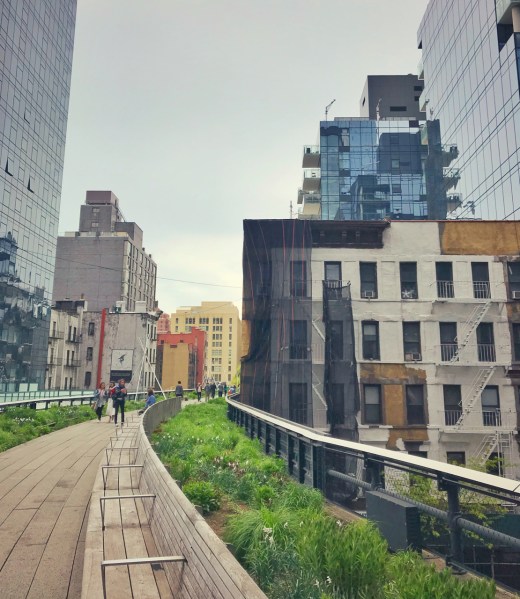
 In New York City, there was a train track that once felt important. And rightly so, as it was needed. Proudly it stretched its shiny steel tracks from the West into town, carrying loads and loads of freight trains every day between the city and a growing industrial area. Being ready for any kind of transportation was its sole purpose. For sixty years it felt necessary, and cared for.
Then, one morning just like any other morning, there were no more trains. No more light signals and no more buzz at the end station. Nobody showed up. Nobody showed up for such a long time that the shiny steel began to rust. Then nobody showed up to care for the always-ready, hard-working track. There were roads, you see. Alternate routes. Changes in urban planning. The poor track was not needed anymore. Nobody even needed the steel or the ground for anything, so people just forgot about it in a New York minute (snap).
Weed started to push through between the ballast and the wooden sleepers. Just a few curious herbs at first – followed by a bunch of others. And then, slowly, a sapling tree found itself growing in the middle of New York City, in a sky garden above the ground.
What to do with all that green in the middle of NYC? With campaigning and some luck, some spirited people converted it into a protected park. In doing so they did not uproot the tough little weeds and plants and trees, but kept much of the original flora. For kids growing up in the City it is inspiring to know that when Nature manages to push through, these are the plants and flowers and trees that grab foothold. And the old train track is proudly stretching itself again, covered in lush greenery.
I walked the High Line in its entirety: over 2 km of urban garden. If greenery is not incorporated into the original urban plan (like it wasn’t in most of NYC), creative rescue solutions like the High Line are probably the best second alternative. And I was happy to walk on the old rails and know they had a purpose once again – and this time hopefully for longer than just sixty years.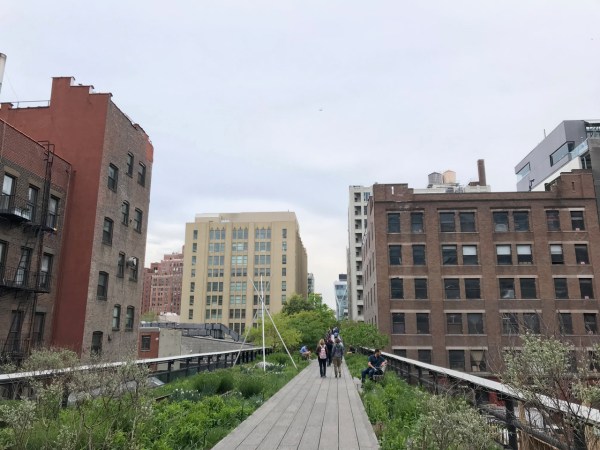 (New York City, USA; May 2018)
 I never saw the famous World Trade Center Twin Towers, except for in photos. They defined the lower Manhattan skyline – until the day they didn’t. I first visited Ground Zero in 2008. It was one big hole, part concrete and soil and part construction crews. Visitors were lead around on boardwalks and held back by ropes. There were only a few smartphones and certainly no selfies or selfie-sticks. The atmosphere was somber, even if the attack on the twin towers was seven years in the past.
 (9/11 Memorial Plaza, New York City, USA; May 2018)
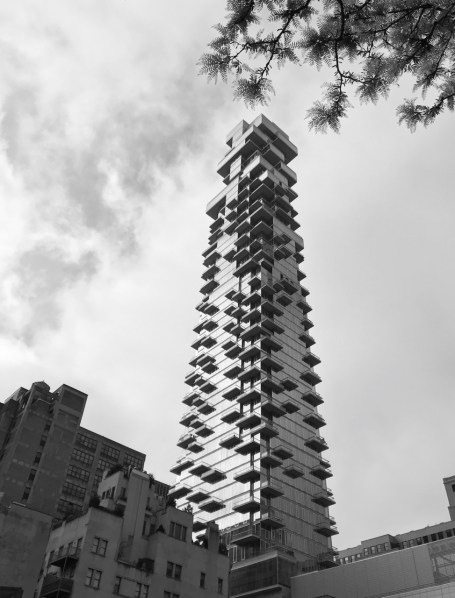 What are cities made of? What is the essence of a city? We humans are funnily egocentric: we like to anthropomorphize everything. We talk about the “beat” of a city or it’s “soul”. In a way we evoke a primeval streak of animism when we claim to sense the essence of a city as if it were inhabited by a spirit.
 (New York City, USA; May 2018)
 The
The  Most likely this scenario will not happen. But who knows if Florida or Singapore will still survive further than a couple of generations? And we humans and our cities is just one single species. The polar bears, the seals, the walruses, and the narwhals are the most obvious species in trouble. But because the ecosystem is a system, who knows what will happen if the currents change and the lowest levels of the food chain (think krill, plankton) disappear, too? No food for small fish means no food for big fish means no food for anything that lives on fish. And no krill for the whales, either.
 (Above Greenland; May 2018)
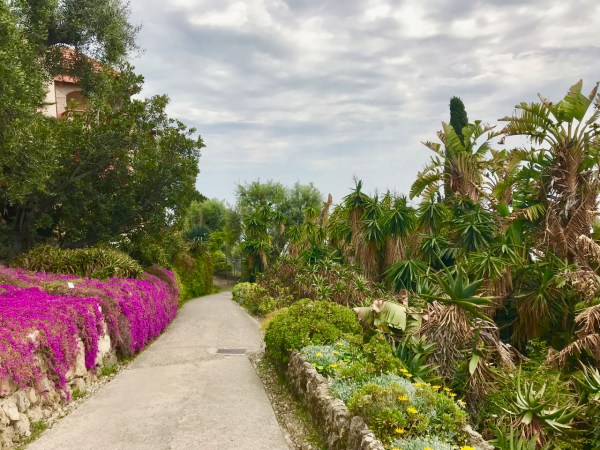 When one is 35 years old and wishes to establish oneself, one can either join the entertaining society or one can entertain oneself by building a fine garden from scratch. In this garden it is not enough for the visitor to love flowers to see them; here one must climb down a height difference of 100 meters to see the end of the garden by the ocean – and another 100 m up again to exit by the gate. When deciding to establish themselves, Sir Thomas Hanbury and his brother Daniel did not choose a garden site with step-free access.
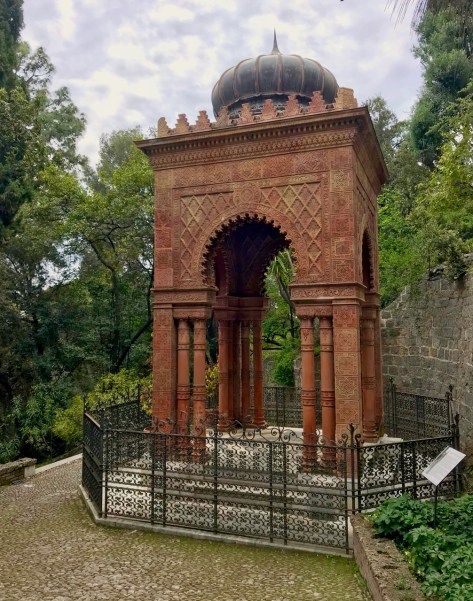 To compensate for the viewer’s labors, in the late 19th century the La Mortola garden was one of the most famous gardens in the world: nearly 6,000 different plants; many exotic and brought home from Asia by Sir Thomas himself.
 (La Mortola, Italy; April 2018)
 The owner of this place must have been ambitious. And quirky: she had gazelles, monkeys, and a mongoose in her garden.
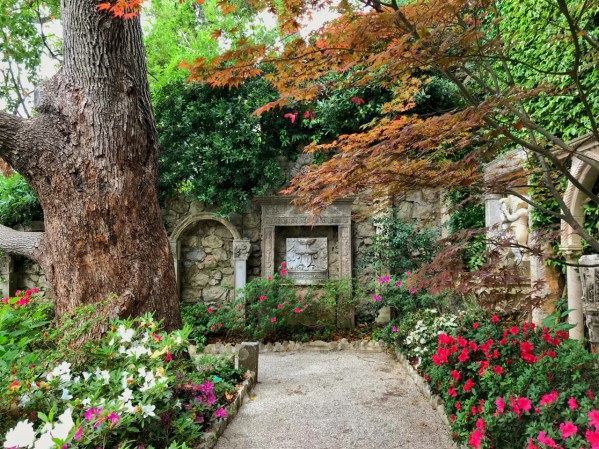 She was no angel either, because just as her husband, she liked gambling, too. Her gambling room in her pink (yes of course, pink) villa is quite something. And if she was not entertaining there, she was being entertained in a casino in Monaco.
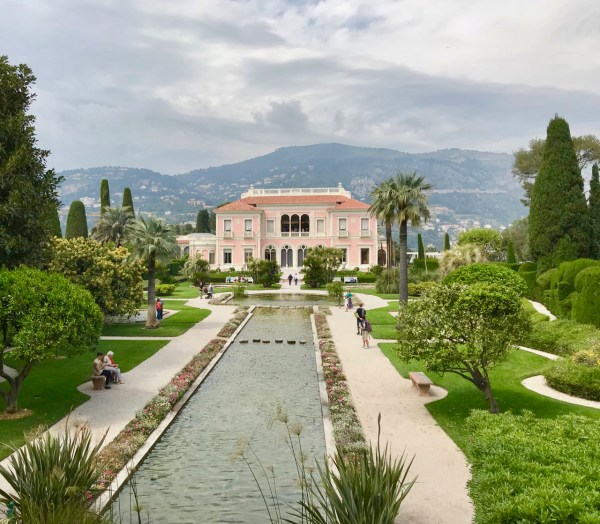 Béatrice Ephrussi de Rotschild lived the most extravagant life a divorced woman in the turn of the 19th century could. She commissioned an incredible villa and garden – not for herself but to see and to be seen. But was she happy? Perhaps she was in some ways. Women in those days found themselves unfit for any mold if they were divorced, unmarried, and wealthy. Perhaps she was shallow and happiest when entertaining. Or perhaps she felt lost in her role and happiest doing all the things she should not: play tennis, ride horseback on a man’s saddle, drive a car, and even fly a plane. Did she find meaning in her life? Perhaps. And at least one cannot blame her for not trying hard enough.
 (Cap Ferrat, France; April 2018)
 When I grow old I do not want to look at four walls. I do not want to become a person who is afraid to go out of the house. I do not want hospital food unless the hospital is my only option. When I grow old I do not want to endure long, dark winters. I do not care if I will remember things or not. Most likely I will not. That is fine, as that is how life goes sometimes.
 Saint-Jean-Cap-Ferrat: for those who have yachts to spare, or those who wish to take a lovely harborside stroll. The trick is to find parking, and most likely you won’t, so consider taking a bus here. While Nice and Monaco and the rest of the Riviera is becoming almost too developed, Cap Ferrat is still lush, with extravagant mansions hiding from view under much greenery and at cul-de-sacs. Because here one can pretend to be just anybody, many royalties and aristocracy have preferred this place. But who was (saint) Jean?
 (Cap Ferrat, France; April 2018)
 No need for a gym pass for those who live in Villefranche-sur-Mer. Their gym has either a sea view or a view of sunlight old houses nestled close to each other. Those who work at the city hall have the pleasure of a light cardio exercise as they walk through the citadel and enter the sunny courtyards on top of the hill.
  Villefranche-sur-Mer’s little alleyways have always been so narrow. The town just grew organically around the little fishing harbor. Rumor is Jean Cocteau used the back streets for a haunting scene in a film. What is known for sure is that he loved the place so much he painted the insides of the fishermen’s chapel in a lovely Picassoesque style.
 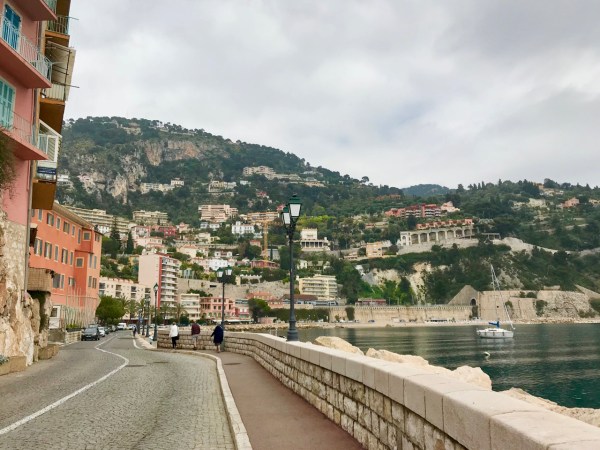 Many other movies have been partially filmed here: a James Bond, a Hitchcock movie, and others. Somerset Maugham had an apartment here as he much preferred the quiet waterfront to the busy Nice boardwalk.
 (Villefranche-sur-Mer, France; April 2018)
 This blue marble