

Photos are of Heaviside’s dolphins – obviously, as the bottlenoses did not feel like hanging around
It has been an eventful day. Those on the research boat were planning to biopsy bottlenose dolphins. One of our principal investigators was demo-ing the Hawaiian sling for Heaviside’s dolphin biopsy (why, I have no clue, as the target were bottlenoses), when he dropped it and it sank to the bottom of the ocean.
The team attempted to use the crossbow to biopsy bottlenoses, by shooting off a skin sample smaller than the scratches dolphins make on each other when they love or hate. This means much preparatory work: agreeing on one single animal as it surfaces for air, cross-referencing their dorsal fin ID with the database of identified dolphins, and then obtaining a new fin shot with the camera (not easy as the dolphin surfaces only for a moment). Only after all this is somehow completed, either methodically or in total chaos on the research boat, does one get ready for a biopsy shot with the crossbow. The tip of the arrow sinks into the skin and blubber layer of the dolphin, and as it is pulled back out it removes a little button of tissue. The team tried – and missed. A few times. Soon the dolphins removed themselves from an understandably unpleasant situation. It was impossible to work with them anymore, neither by shooting arrows at them nor shooting cameras at them. The team obviously got what they deserved. I heard most of that day was spent playing with the cape fur seals and a GoPro and a SoundTrap, both submerged underwater for the seals to have fun with.
I was on bird survey duty with another team mate. We had barely begun when we saw dolphins in the lagoon. As per new protocol, we abandoned the bird count and assembled the kayak, the hydrophone with recording equipment, and the data sheets. We then spent nearly 2 hours floating among a pod of dolphins, recording their underwater communication and above-water behavior. After a good hour and a half we, too, got the feeling that the dolphins did not want us around anymore. Like an unpopular kid at school, we noticed that they always moved a little distance away from us and resumed their behavior. It was pretty clear we had fallen from their graces, so we paddled home.
As a result, both teams managed to unfriend a pod of dolphins each. At least for the day. I guess we humans would unfriend any one anthropologist who would attempt to shoot at us with a crossbow or hang around observing our every move for hours. Dolphins are socially intelligent and bottlenoses have larger brains than humans. Why they should suffer fools gladly is beyond me, but they seem to do that most of the time. Just not today.
 (Walvis Bay, Namibia; July 2017)
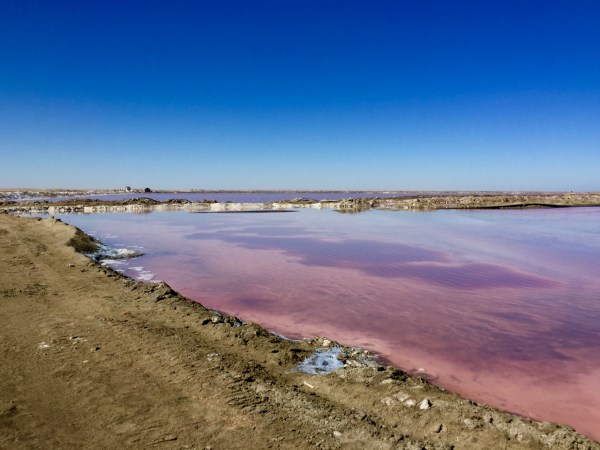 Pink “Himalayan salt” is sometimes Namibian salt, from Walvis Bay. In my understanding this is rock salt, not sea salt, and it is the color of algae (not Himalaya) that gives it a bright pink color. Some of the salt pans were a deep purple.
 2,500 avocets, 1,500 sandpipers, 3,000 flamingos, and several hundred stilts. In just our little section. I did not get the final tally for the entire lagoon and surrounding saltworks. Just take my word for that there were A LOT of birds. And so, why not spend my Saturday off counting birds with a lovely bunch of bird lovers?
 Two land days in a row. During the first one we emptied the old freezer in the garage. Too gross for photos, but try to imagine the smell of dead dolphin or sea bird carcass. Baby whale stomach contents. Or a dumpster used not for garbage but for natural rotting of dolphin skull flesh with the help of maggots loving horse dung, in order to bare the bones and create a beautiful skull for display.
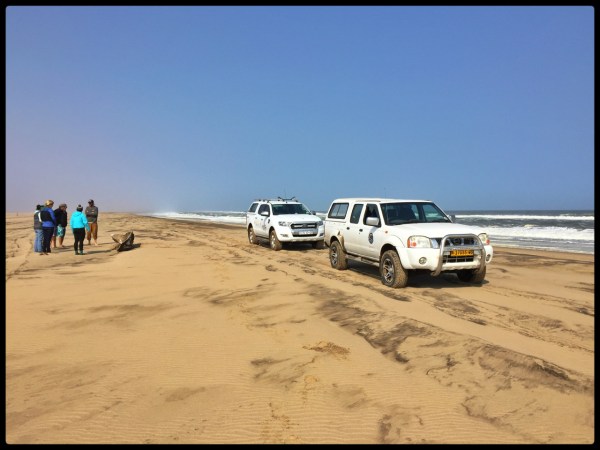
 Fortunately, the second land day was all about beaches and 4×4 driving and fresh air. Secretly I hoped we would not find a fresh stranding, alive or dead, because in the first case we’d be exhausted after a long, potentially dangerous rescue mission; and in the latter case we’d be exhausted from in situ necropsy, throwing all our clothes away by the end of the day.
 (Walvis Bay, Namibia; July 2017)
 Little gems of wisdom in the public bathroom in Walvis Bay. The toilets are used by guests frequenting the bars on the boardwalk, mostly either during sunny hours of the day or quite late at night. Mostly the message is a plea for morality, leaning towards biblical sources of wisdom. But sometimes there is humor involved, too.
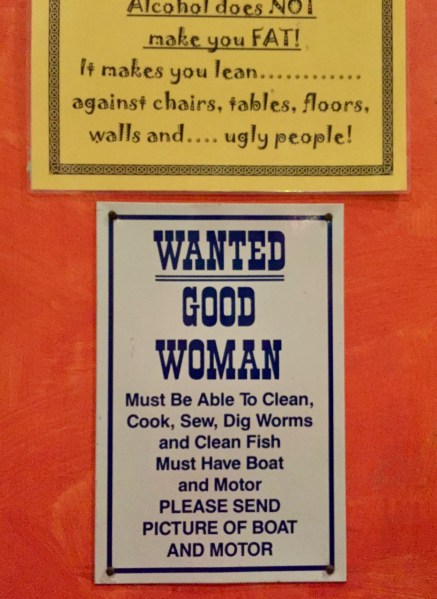 I can only imagine how frustrating it is to keep the one public bathroom of one’s little home town clean after a weekend night – every weekend.
 (Walvis Bay, Namibia; July 2017)
 Sesriem means “ses riemen” or “six belts” – the number of belts tied together required to reach the water on the bottom of the canyon with a bucket. Very practical. Very survivalist.
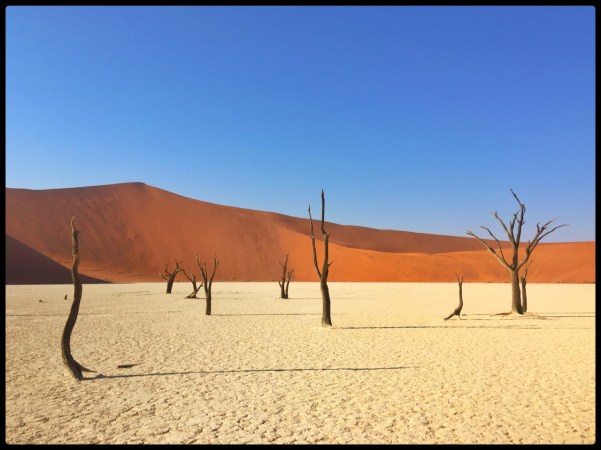 Once upon a time this was an oasis. There was a river flowing through, nourishing these 500-year-old acacia trees. But the river decided to go elsewhere, and the acacia trees could not follow. In the hot, arid desert climate they dried upright, like skeletons from better times.
 The dark scraggly trees against a white lake of salt and the red dunes and blue sky is one of the most photographed landscapes in Namibia. And at 7.30 am it is all mine. I am the only person on the entire salt pan.
 From time to time (not even once a year), the rains come and the dry white pan becomes a flooded lake. When an oryx walks across the mud, its footprints dry up like those of dinosaurs, waiting for the next rains to come.
 (Deadvlei, Namib-Naukluft Park, Namibia; July 2017)
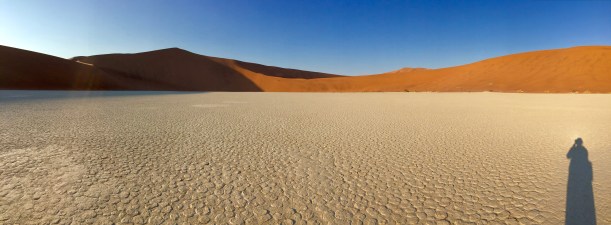 7.30 am on the Deadvlei salt pan. It is as if I am the only person on a foreign planet. A Martian on a red planet of sand, where water once existed but is now long gone. This must be how the space-age people of the 60s imagined walking on Mars to be like. It is quiet. Still. The air is chilly but strangely easy to breathe, even with the dryness. There are no sounds anywhere, except for my team mates and two other crazies trying to ascend the Big Daddy dune, far above.
 Standing in the still desert reminds me of the movie Truman Show, where Jim Carrey plays a man who has a lovely suburban middle class life – until he one day wakes up to realize his world is literally a stage and everything in it is scripted and televized. He begins to seek the boundaries of his physical world and comes to the end of it: at sea, outside of town, he touches the side of the dome which he always thought was the sky and the horizon. The water splashes towards it and all sounds are muffled, as if he were inside a room. Endlessness isn’t endlessness, but finite and staged.
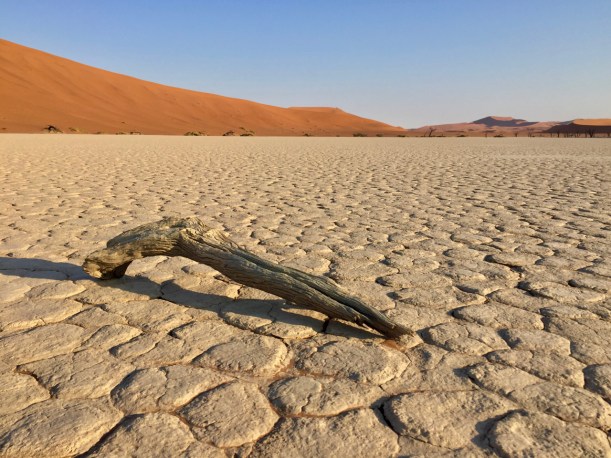 (Deadvlei, Namib-Naukluft Park, Namibia; July 2017)
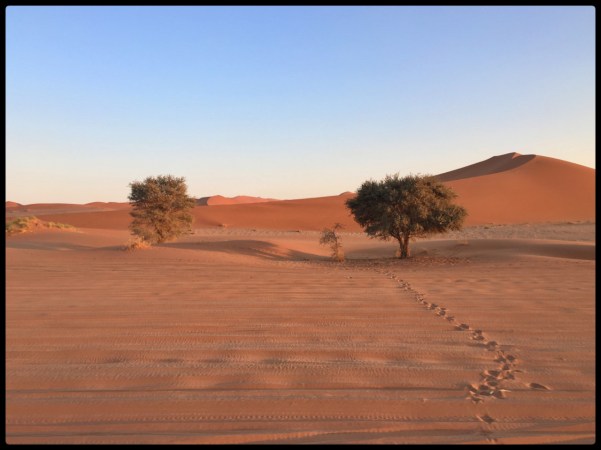 We camped under a full moon at the overflow site, away from tourist buses and noisy families. We lit the braai fire under the tree, under a full moon, with lizards keeping us company. At night as I walked the 200 m stretch from the tent to the bathroom facility, I needed no flashlight because the moon lit up the sand. Somewhere, not far away, I heard the agitated grunt of a grazer, maybe a zebra or an oryx. Either it had a quick disagreement with a herdmate, or it was very quickly killed. Only the moon knew which one was the case. The jackals were howling in the distance. Thank goodness each campsite in Namibia has guards patrolling the area day and night.
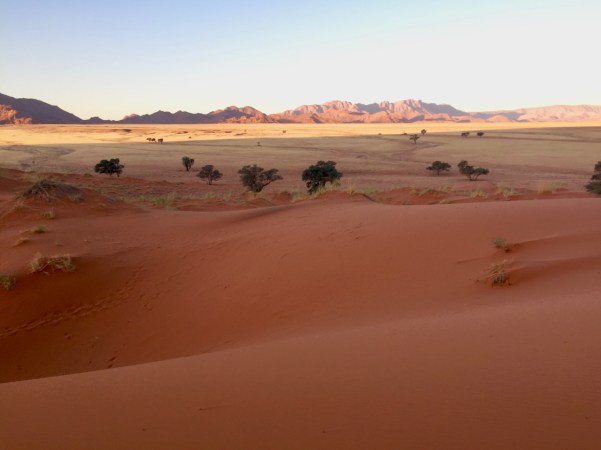
 The desert here is one of the oldest in the world. The red sand of Southern Namib comes from the Kalahari desert. When the Sossusvlei area was under the sea the Kalahari sand got washed in and stayed as the sea dried up to the desert it is now. The beaches became dunes. Some of the tallest dunes in the world are in Sossusvlei and the coast around Walvis Bay.
 (Sossusvlei, Namib-Naukluft Park, Namibia; July 2017)
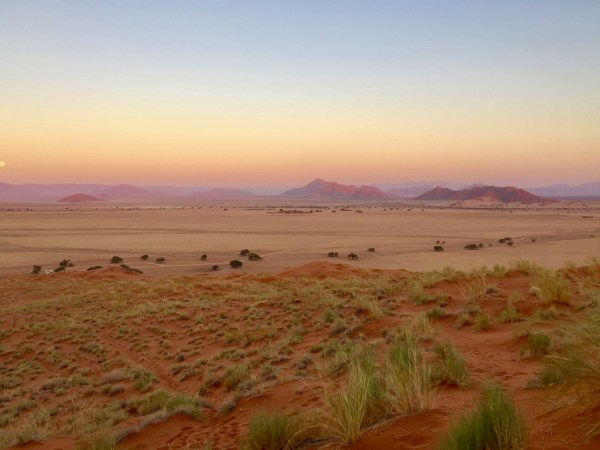 The colors of Sossusvlei and the Sesriem area at dusk and dawn are the colors of every Namibian travel guide. No, the photos of those guide books are not photoshopped: the colors are truly magical. The red and pink hues come from iron content in the sand.
 (Namib-Naukluft Park, Namibia; July 2017)
 This blue marble