 For a day tripper, Ubud most likely seems like a hot, loud, motorbike-exhaust-filled hell. How different it must have been when the first tourists came to Bali in the 1930s! A strip of street with a shop and a gas station. Women walking topless to the market, carrying baskets on their heads. No noise, few cars, no motorbikes. No big domestic animals, either, really: people did most of the carrying themselves.
Under the Dutch rule Bali had become a spice island, and one initially entered through Singaraja in the North. Miguel Covarrubias the artist describes ugly, cheap housing, gas stations, dirty shops, dirty people. Not really the picture postcard of lush, green banana trees and beautiful women. One must first endure a sweaty and tiring drive down south, over the cold mountains of Batur, until the air warms and becomes clear, the lush green forests appear, and the picture postcard becomes real.
In the 1930s Denpasar was the place to be. I have been to Bali twice and never seen Denpasar. In the 1930s, Kuta and Legian are described as miserable, malaria-infested lowlands. Today, they are miserable, drunk Aussie-tourist infested lowlands. In the 1930s, Ubud is described as a strip of street with a shop and gasoline station. Today, indeed, it is more shops and gasoline than streets, with strips of green.
In the 1930s, women began to dress in shirts and everybody understood that tourists can be a source of income. It was the end of innocence on Bali and the artists and etnographers residing there were sorry to see it go. Today, just 80 years later, the Balinese I see are Western on the outside and Balinese on the inside. There are still rice paddies and dancing and ceremonies, but no longer the old lifestyle, save for morning offerings.
As I was sipping on my post-yoga practice coconut, I thought of the basic etnographer’s theorem that by mere observational presence we change the object we try to observe. And tourists have never just tried to observe Bali – they’ve loved it so much they have tried to either become Bali or take a piece of Bali with them when they leave. Unfortunately, the reverse goes for the Balinese who meet Westerners. I hope that still 80 years in the future the Balinese would be proud to be Balinese on a unique island called Bali, even if people like me love their island and its soul to bits and crumbs. (Ubud, Bali, Indonesia; August 2016)

 One hot day we decided enough is enough. Enough heat, enough dust, enough bustle. Two of us hopped into a taxi, and one of us dared a crazy scooter taxi ride out, all the way through the rice paddies and into the jungle. Because (and this is a secret), there is a little patch of heaven hidden in the jungle. Like this:
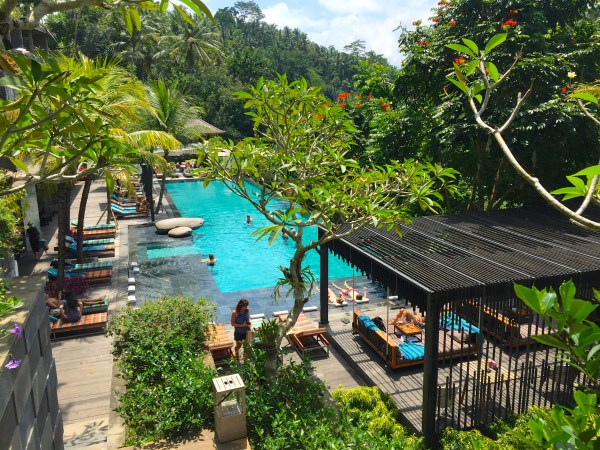 We threw ourselves down into a hanging bed – and to our delight they had sparkling wine on the menu. What a rare treat on Bali! And so were the lovely superfood salads. And so was the stretching and pummeling also called a “Balinese massage”.
  The fish swam in their little pond. We swam in our bigger pond, where the water spilled down over the edge, and the jungle crept close.
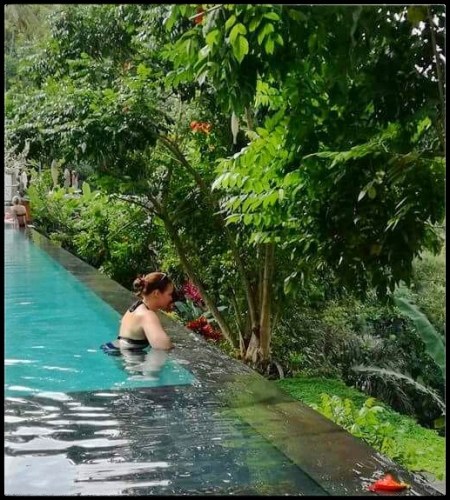 Not until sunset, when the lanterns in the trees were lit, did we get dressed and return to Ubud. And if you cannot muster the strength to leave this patch of heaven (we nearly didn’t), you can dine overlooking the jungle, and check into a room of your own. Yes please. Next time!
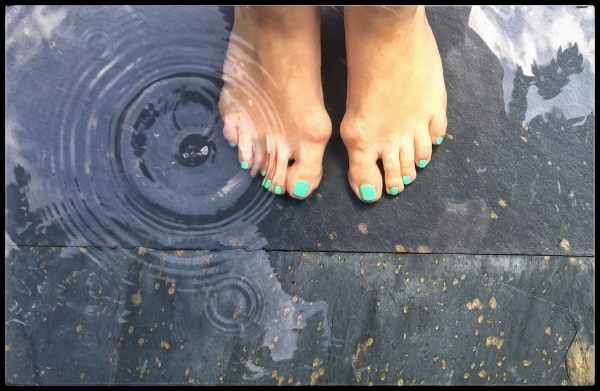 (Junglefish spa, Ubud, Bali, Indonesia; August 2016)
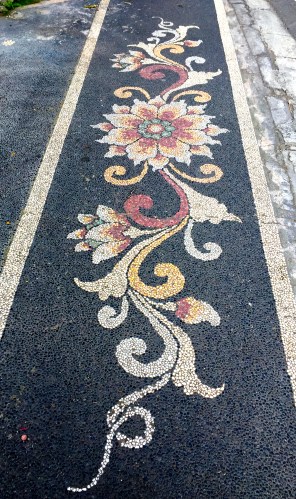 What a marvelous sense for beauty the Balinese have. Everything on Bali is beautiful, right down to the pavements. Why would anybody settle for boring asphalt or concrete, when one can scatter little flowers of beach pebbles here and there, or decorate one’s runway with an intricate flower mosaic pattern? Scandinavian simplicity my a**. I prefer flowers.
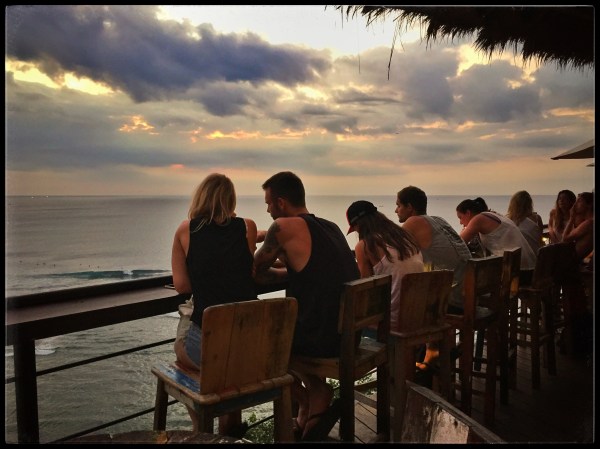 The Uluwatu beach community is built on the side of a rock: stairs crawling up and down, leading into little rural-style warungs serving simple dishes. Uluwatu is still just one inch on the backpacker/local-hangout side, if only for a few years to come.
 No surf today on one of the most legendary surf spots on this planet. When the tradewinds are right, I am told, one can keep on surfing in a seemingly endless, emerald-green pipe. It must be an experience of a lifetime.
 Today, Padang Padang beach was not for surfers but for children. And lazy sunbathers like us, sipping on coconuts and gnawing on freshly grilled corn cobs from the fire.
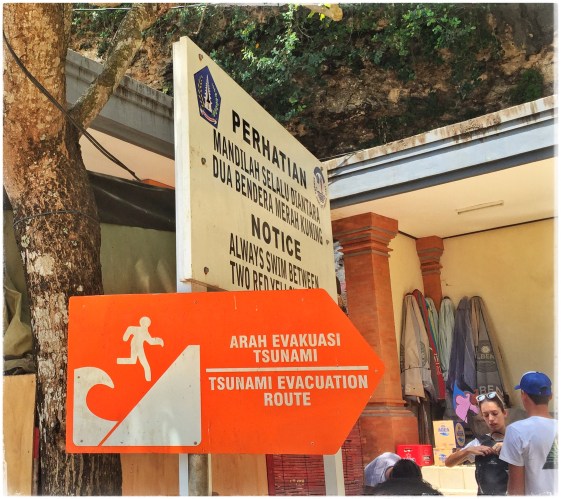 (Padang Padang, Bali, Indonesia; August 2016)
 After bustling Ubud, Uluwatu is silence, sea, and surfers. Hot, winding, dusty roads with bush and dry forest everywhere; a house here, a villa there. The air is steamy from the evaporating surf.
 The Uluwatu temple is one of the most sacred temples on Bali, alongside Pura Tanah Lot, the other temple ravaged by the sea and the wind.
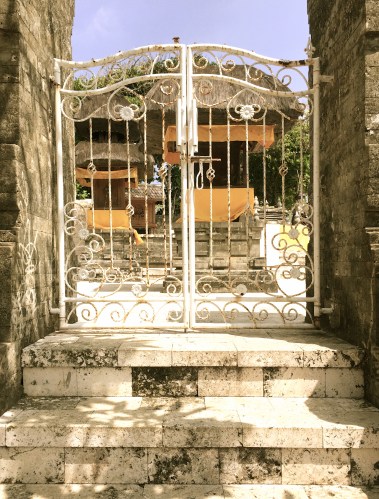 (Uluwatu, Bali, Indonesia; August 2016)
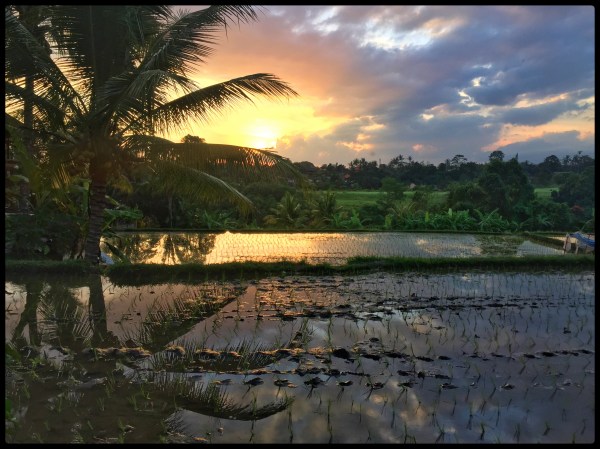 I could start like I did
  (Ubud, Bali, Indonesia; August 2016)
 Any given night in Ubud one can hear the insane, energetic beating of the Gamelan instrument. Follow the clear, metallic rhythm as it weaves out of a temple and you most likely come to a dancing spectacle. Young girls who dance with their eyes more than with their bodies. Ladies who dance with their fans and arms more than with their bodies. And men who grow into mighty warrior gods, darting here and there in the spotlight.
 (Ubud, Bali, Indonesia; August 2016)
 Stumbling over sleeping dogs and old morning offerings swept to the sidewalk, I amble the side streets of Ubud. It is a hot afternoon. I challenge myself to get lost in a town with 3 main roads. To discover the remains of village life.
 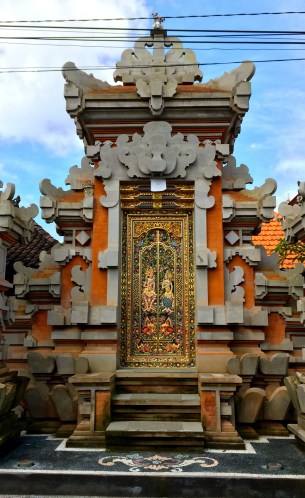 Is it a temple or a wealthy Balinese house? As a visitor to Bali I can usually never tell. Perhaps if the door is decorated it is that of a temple. But each wealthy Balinese house has a large shrine, so basically it is a temple within a house. Same same.
 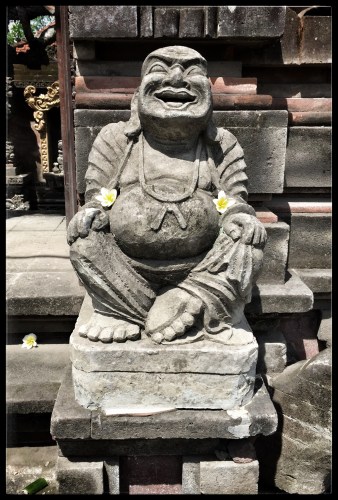 Every street has remainders of old ceremonies: bamboo poles with yellowed palm leaves, cut-out paper decorations in faded yellow and orange. As soon as the decorations become properly weathered, it is already time for a new village ceremony. The Balinese year is only 210 days long.
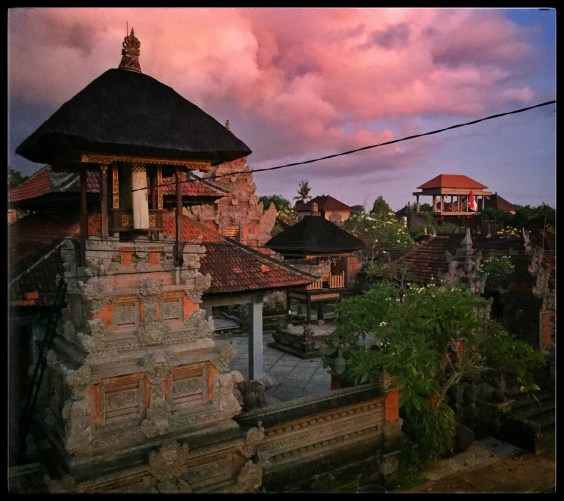 (Ubud, Bali, Indonesia; August 2016)
 “Massage is the simplest form of happiness” the sign proclaims. While I disagree and substitute “massage” with “sleep”, I concur that Bali is the place where one can become dizzyingly blissfully happy in the hands of a good masseuse. Not to mention the flower baths and foot washing and clay masks and jamu tonics sipped wrapped in fluffy bath robes, often in the middle of a lush garden or jungle.
 (Ubud, Bali, Indonesia; August 2016)
 This blue marble