
 Today I am in San Sebastián, writing about Salzburg. The photo above is a déjà vu of a scene in San Sebastián old town (mental note: go get a similar shot) but let us focus on Salzburg and its Salzburg Foundation project of designing and erecting new art every year fod a decade. Because it turned out to be funny, you see.
For a period of ten years, Salzburg Foundation invited an Austrian artist to design a prominent piece, which would then be erected somewhere in town on a prominent place. And each year, apparently, the debate ran hot: whether the artist was acceptable to design a prominent piece, and most certainly whether the piece itself was acceptable. Most of the times it was not – at least until the next piece came along.
But what better way to pepper a city with interesting objects for constant discussion? Like the Sphaera: a golden globe on the main cathedral square, with a man perched on top of it. What is its meaning? Nobody knows because the artist chose not to tell. What was going on in the artist’s head when he conjured up his first image of this sculpture? Nobody knows, because he won’t tell.
Is it a brilliant way to force adults to use their muscle for imagination? Or is it simply the arrogance of an artist who wanted to make sure he would be remembered? 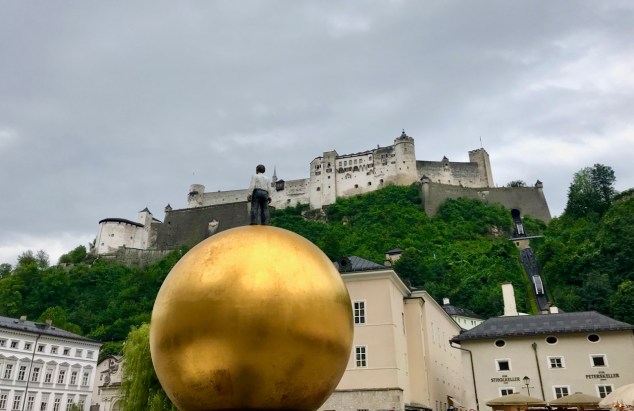 (Salzburg, Austria; July 2019)
 It is not easy to paint the personality of a human from his or her face. It must be even more difficult to paint the personality of a dog, underneath the fur and fluff. And yet this unknown lovely artist did manage to trace the outline of over 300 unique furry persons, all lined up on a concrete wall by a park in Alassio.
 Jean Cocteau sure did love the Riviera. His self-portrait is on the Muretto wall by in Alassio, and he self-handedly painted an entire fishers’ chapel interior in Villefranche-sur-Mer.
 (Alassio, Italy; July 2018)
 Why are painted renaissance naked newborns always boys? And why do they actually look more like old men than boys? Also, why do the women never look like they are in full possession of their wits? Thoughts as we tour the palazzos of via Garibaldi…
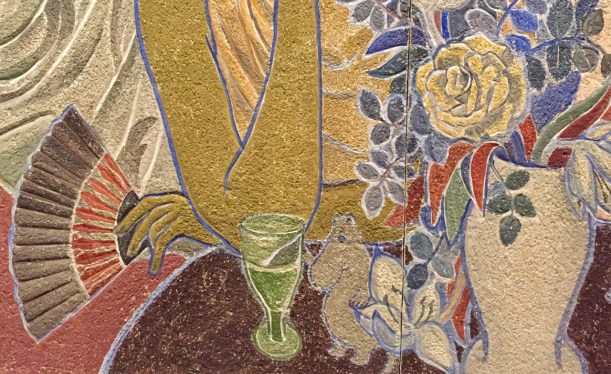 One bleak Saturday we stopped by at the Helsinki Art Museum’s permanent exhibition of Tove Jansson’s works. You know, the author and artist behind all things Moomin. There were two large frescoes, one showcasing a party on the countryside and another a party in the city. All very 1940s post-war joy. And then I saw a little moomin, hiding away behind flowers and a glass of champagne. Right there, in a quite seriously adult piece of art.
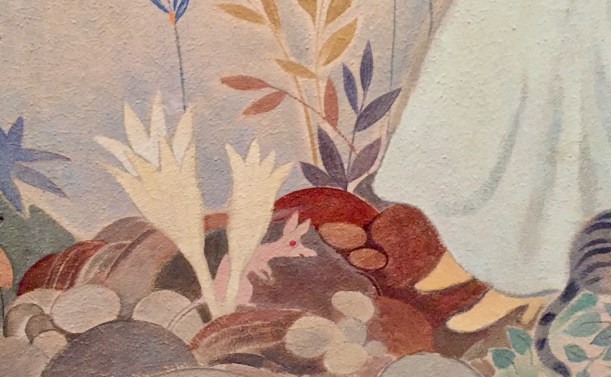 (HAM, Helsinki, Finland; March 2018)
 Being contemporaries, focused as much on style as on wit and critique of society, Oscar Wilde and Eduard Vilde could have met. But they never did. And so they were depicted having a chat on a bench outside of a pub in Tartu. Oddly, I learned that the exact same piece stands (or sits) in Galway, Ireland.
 The Cro-Magnon people of Europe drew mammoths, deer, and moose. The San people of Africa made giraffes, oryxes, and wildebeest. Both depict hunts, hunted animals, and the styles are quite similar. If you look closely you can even see an animal with double sets of legs,
  That is a Steinway. Upholstered, because black was apparently not stylish enough. This must be a prime example of 1890s kitsch.
 Imagine the splendor and style of Versailles – with original electric light fittings. The bustle of a country castle downstairs kitchen – with modern, white tiles stretching over the walls and the ceiling. And an electric kitchen elevator, and three water faucets: one for hot, one for cold, and one for rain water.
 This was all highly unusual in any wealthy, traditional-style house in Stockholm at the turn of the 20th century. But the Hallwyl couple seem to have been unusual, too: they built a palace with all the modern, sometimes experimental, luxuries of the turn of the century. They then proceeded to decorate it in the style of what can only be described as flitting from good taste to extravagant kitsch. During that time, who really chose their salon decor to mimic French gilded rococo?
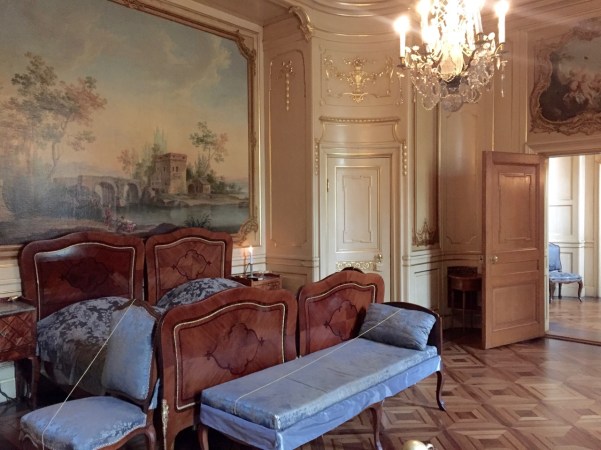 (Hallwyl House, Stockholm; April 2017)
 Finally, at the top floor or Royal Albert Hall. Impressed at the sight below me, I took some photos. “Do you know where you should be?” asked a friendly seating assistant. I pointed at a seat just below the ceiling – I had been late with booking my ticket. “Would you like a seat down there by the stage?” Goodness me, yes. I did. Fifth row from the stage. What an experience.
 And the best thing is, like those freak shows of old, Cirque du Soleil is always on the lookout for people with unusual skills. Talented skater, athlete, rope skipper, martial artist? Maybe you know of an ancient performing art only a few people remember? Perhaps you should join the circus.
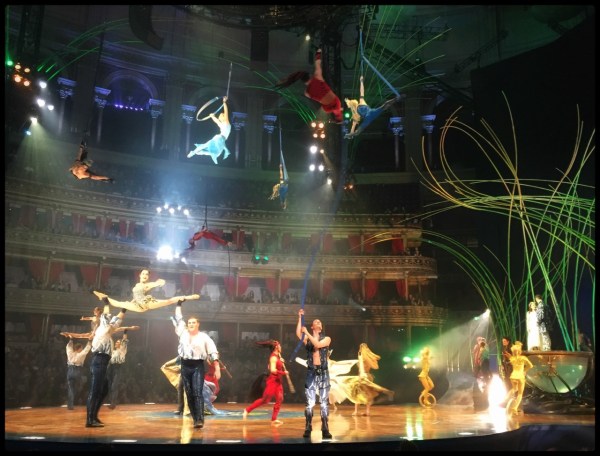 (Royal Albert Hall, London, United Kingdom; January 2017)
 This blue marble