
 The sun set over the Tiber and the Vatican, like it has done for thousands of years. For us this meant good wine with spaghetti cacio e pepe, a traditional simple wonderful Roman dish with cracked black peppercorns and cheese.
Did the “ancient Romans” from the times of the empire have black peppercorns? Probably not. Just like they did not have tomatoes, corn for polenta, nor eggplants – all staples today in Italian cooking. Instead of salt the Romans used a (probably terrible-smelling) fermented fish sauce, similar to today’s Thai fish sauce.
But there was honey, all sorts of nuts, bread, cheese, olive oil, and of course lots of wine. And in the best cases, some intellectual discussion in place of the never-ending war talk. (Rome, Italy; September 2018)
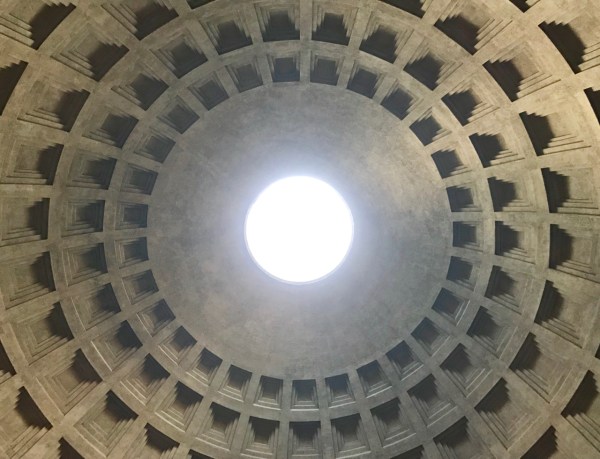 “Pantheon” means “of all gods”. Was this really a temple of all gods? Or many gods? One would like to think it was once a site of inclusion of faiths, not exclusion. But perhaps the Romans just had so many gods they built one to serve the most important ones?
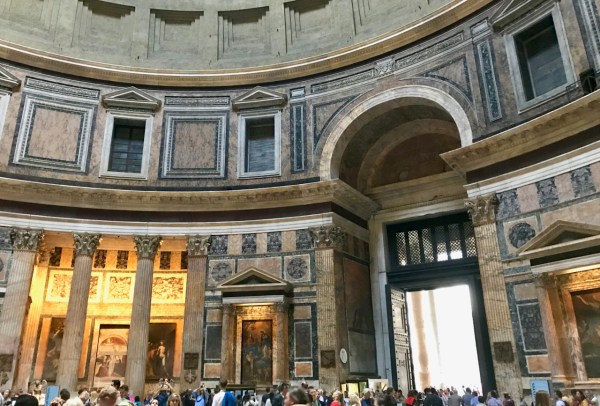 (Rome, Italy; September 2018)
 “Dress for the job you want, not the one you’ve got”, the (surprisingly effective) saying goes. If your career dreams include becoming a bishop, a cardinal, or even the Pope, this shop will help you fake it ’til you make it. If you can take the long stares from people you meet in the street, that is. And why not stare? This gear is absolutely fabulous.
 There was rain throughout our meeting. And right before our walking guide gave up the sky cleared up just a little, enough for a stroll around.
 At the age of eighteen I spent one day in Rome. During these two days I saw less of Rome than back then. And what I saw now was mostly the same sights as twenty years ago.
 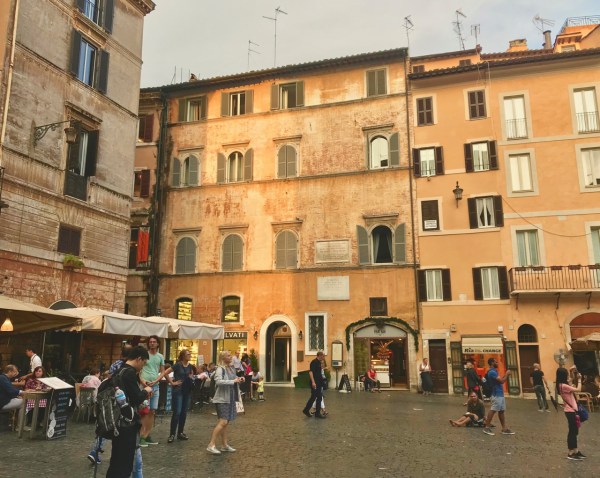 But twenty years is nothing for the Eternal City. Two hundred years may cause a few major collapses, such as the one of the Colosseum. Two thousand years is possibly half of the age of Rome, if one adds the Roman population we know from history books to the Etruscans and other tribes who originally inhabited the seven hills of Rome.
  Today many of the ruins are under scaffolds. Either Italy has cash enough or it just seems so as in the city of endless ruins there is endless restoration work to be done. And sometimes new buildings are erected, too, such as the monument for the first king of the unified Italy: the Vittorio Emanuele II Monument from 1935 (also more fondly known as “the typewriter”). Today this humongous monument looks nearly modern. Perhaps two thousand years in the future it will be a heap of pillars and ruins, and a virtual reality as good as new.
 (Rome, Italy; September 2018)
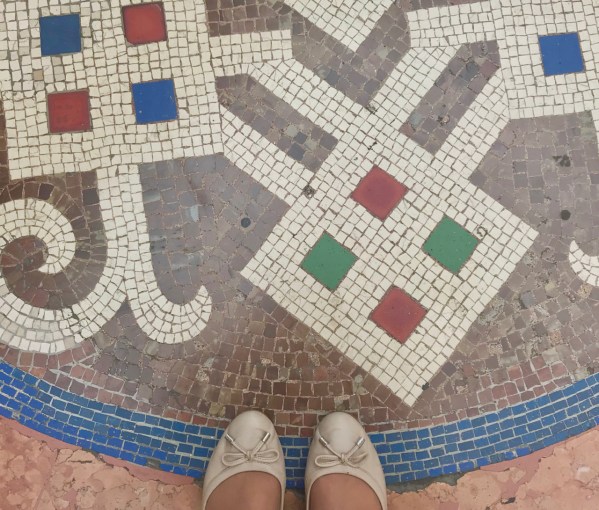
 How often do you look down when you walk? Probably every day. And how often do you actually see what is right down there in front of your nose? If you are in Italy, it is highly likely you are missing out on something much more beautiful than just asphalt and pavement. Italian floors are exquisite. The one above is in the Duomo but I walked over so many beauties outdoors in Genoa.
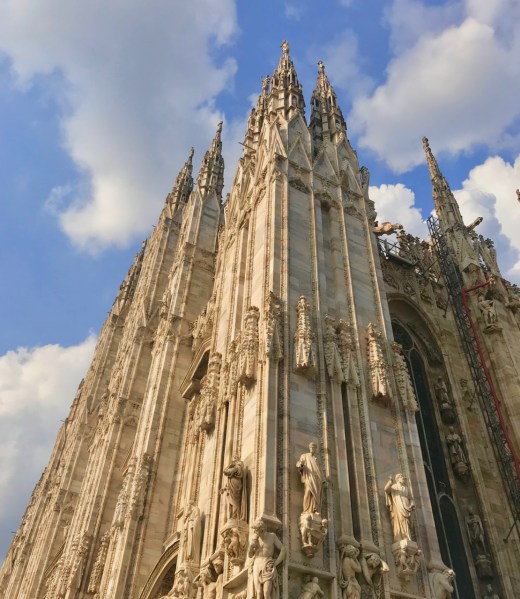 (Milan, Italy; July 2018)
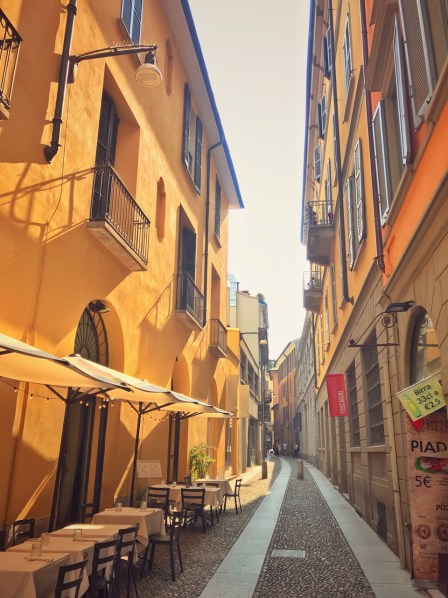 In the midst of showers there was a day without rain in Milan. A late afternoon where the tables were waiting for dinner decking and where the shoppers had already gone home for a quick siesta before aperitifs.
 (Milan, Italy; July 2018)
 Plastered, ochre and sand-colored houses with moss green window shutters. Stone slab pavement. A few potted plants. Sparrows chirping in the alleys. A group of locals having pasta with wine for lunch underneath a parasol. Bordighera must have been the same already centuries ago.
  A century ago one could reach Bordighera from Paris in “just” 24 hours, and London was not much further away. Claude Monet found much to paint in the stillness of hot, languid Bordighera summer days. George MacDonald came over to warm his Scottish bones and to write of fantastical, sometimes dark places while sitting in the shade from the scorching sun.
 (Bordighera, Italy; July 2018)
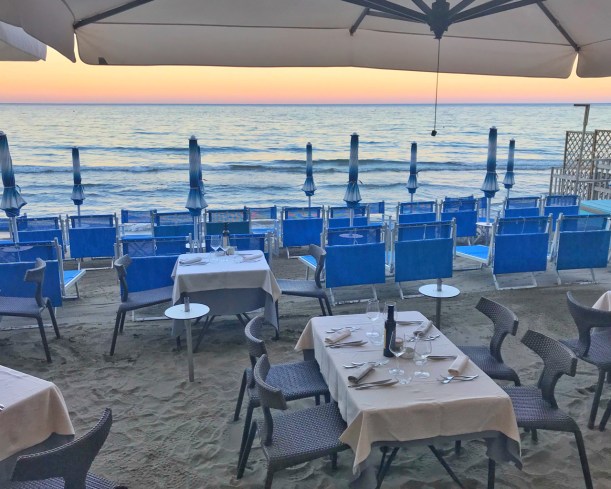 The Azure Coast is azure on the Italian side of the border, too. The towns are very Italian, though: attention to small esthetic detail, quite more chaotic roads, and more attention to beautifully paved boardwalks dotted by gelaterias. Dinner is not available anywhere before 7.30 pm, and only tourists choose to sit down before 9 pm. But the food is equally incredible, thanks to the abundant local produce. And in Italy, it is possible to dine on the beach. Naturalmente.
 It is not easy to paint the personality of a human from his or her face. It must be even more difficult to paint the personality of a dog, underneath the fur and fluff. And yet this unknown lovely artist did manage to trace the outline of over 300 unique furry persons, all lined up on a concrete wall by a park in Alassio.
 Jean Cocteau sure did love the Riviera. His self-portrait is on the Muretto wall by in Alassio, and he self-handedly painted an entire fishers’ chapel interior in Villefranche-sur-Mer.
 (Alassio, Italy; July 2018)
 This blue marble