
 And there it was: another of those unbelievably bright, long-lived shooting stars above the desert. The night skies over Namibia are remarkable. During a night drive between Windhoek city and airport one is bound to see at least two shooting stars. It is not because they are more common here, but because there is barely any light pollution, clouds, or humidity in the sky between us and the universe.
The first time in my life I truly saw (and paid attention to) the Milky Way was in a tiny village on the Kenyan coast. It seemed to me as a string of cloud and stars in the sky. But here in Namibia I have seen the Milky way in an entirely new resolution: as swirls of uneven, nebulous patches of light and dark. Here in Namibia it is possible to view other galaxies with the naked eye.
The sky is so densely speckled that I have to get used to the thought that this is what the night sky, anywhere on the planet, REALLY looks like. My perception of a sky full of stars has lacked about half of what my ancestors saw, before the invention of electricity. In fact, if anybody asked me to imagine a night sky, in my mind’s eye it would look completely different than if my ancestors were asked to do the same thing.
It saddens me to think that one needs to go to Africa or the deepest central Asia to see what the sky really looks like. My generation and further, younger generations, will probably not even know what the sky and space beyond really looks like. What was normal to my ancestors will be lost to them. Just like an extinct animal species.
Photo borrowed from Florian Breuer’s blog. Apologies Florian for the steal but there is no way I would have been able to photograph the amazing Namibian night sky with the iPhone I was carrying.
(Namibia; July 2017)
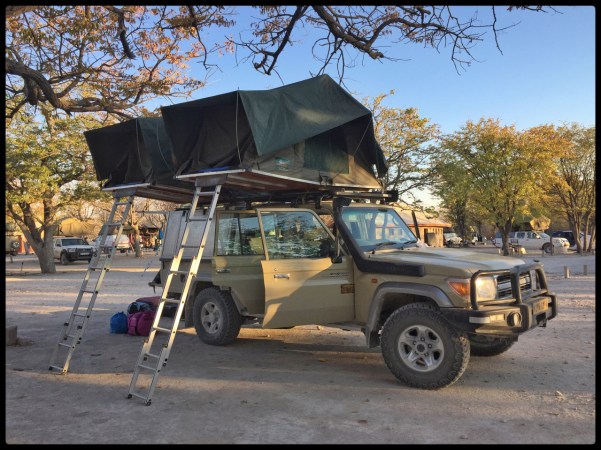 The Etosha campsites are busy villages: busloads of campers dine and sleep in tents and make incredible noise both late at night as well as at dawn. I had never seen so many cars so close to each other at a campsite where people usually seek privacy. No such concept at Etosha Halali Camp, which is not even the busiest campsite.
 (Etosha, Namibia; July 2017)
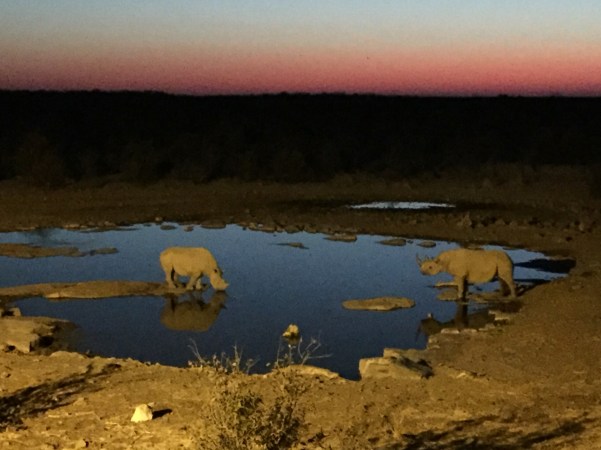 One word: rhinos. No need to justify the crappy quality of these photos. Because when rhinos are around, you take pictures with whatever equipment you have, in whatever lighting conditions.
 (Etosha National Park, Namibia; July 2017)
 Zebras, giraffes, kudu, oryx, antelopes, elephants, lions, marabou, secretary birds, rhinos, and a 2,000 square km salt pan visible from space. Etosha National Park is more than 200 km in width and we quickly realized we must properly plan our outings so as to not be stuck outside of the campsite gate after sunset. Driving at a speed limit of 60 km/hour means the return journey can be hours, depending on how far one has ventured.
  Etosha is mind-boggling in size, and yet small compared to its initial size of 100,000 square km. Today, only one-fifth remains, and at 20,000 square km it is larger than Kruger in South Africa (for comparison, the famous Masai Mara in Kenya is only 1,600 square km). It was created in 1904 by the Germans to put an end to hunting and poaching. Back then it stretched into Kaokoveld, across to Skeleton Coast and the Atlantic, and into Damaraland. Later it got reduced in size when native Namibian tribes were given land back, and everybody was given the opportunity to build a farm.
 Today the roads are all paved and one can drive around like on a Sunday outing, which is a very strange experience for the experienced safari goer. Only the area just south of the salt pan is accessible, and huge areas of land above and below are completely shut off from tourism. The animals are mostly a little way away from the road and compared to Kenya it is not possible to veer off on a dirt track to get closer. The distance also means binoculars are imperative.
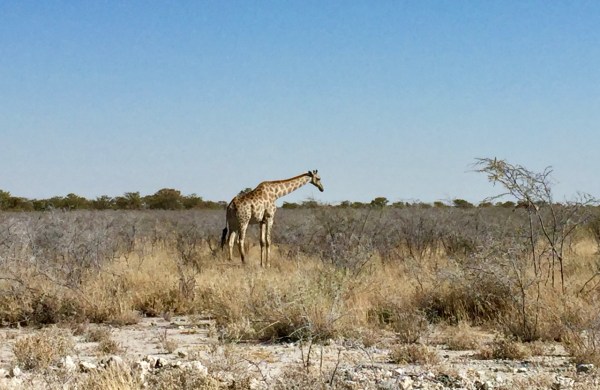 South Africa’s and Namibia’s national animals, the springbok and the oryx, are everywhere. The oryx looks like a graphic designer took a brushful of black paint and drew some defining lines on a goat-like large animal. Impala, kudu, steenbok, hartebeest, wildebeest, giraffe, elephant, and zebra – all the usual suspects are here, although they look a little different from the ones I’ve seen in Kenya. The zebra has more pronounced shadow stripes, and the hartebeest is more brown than ruddy. We also spent time admiring swanky secretary birds, prehistoric-looking kori bustard birds, jackals, and klipspringers. No baboons, but they were all over the campsite at night, heard going through the trash cans in search for leftovers.
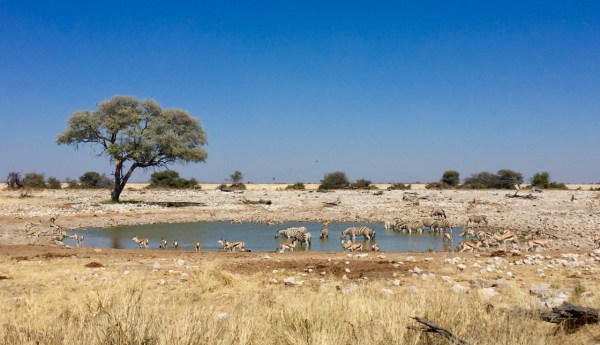 (Etosha National Park, Namibia; July 2017)
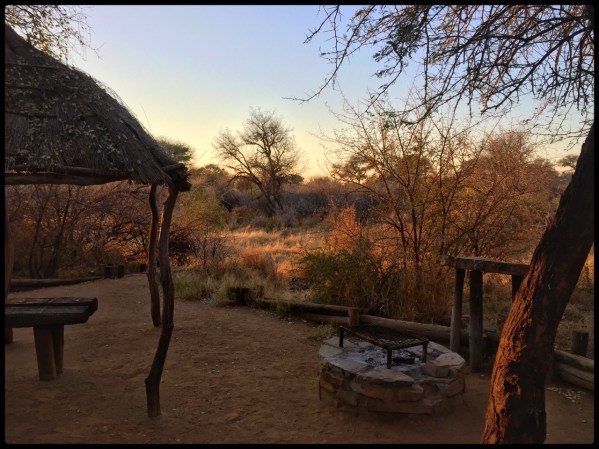 Pit stop between Windhoek city and airport, to re-stock and to pick up an additional passenger. At 1.7 km elevation we suspected the night would be cold, and the temperature dropped quickly after sunset. When we were ready for our tent beds at around 10 pm, the temperature had dropped to 12 degrees centigrade. I piled on woolly bottoms and top, PJ pants, trekking pants, two layers of fleece sweaters, a Nepalese down vest, hat, gloves, socks and woollen socks. And as a cherry on top I threw my hammam towel over my sleeping bag, as an extra blanket.
 The vast emptiness of Namibia is astounding. We have driven in landscapes where hours went by without us seeing a single human-derived shape. Gas stations are unheard of. Yesterday we were directed to a country lodge for gasoline. They directed us some 3 km down the road, and when we almost gave up hope and turned around, there in the middle of nowhere, was a car body shop and a fuel pump.
 Skeleton Coast. No need to try to find a more catchy headline for this post. And unfortunately for many, Skeleton Coast has during the centuries caught a lot of souls and ships in its traps. With dramatic consequences. This is the end of the world, you see.
 Skeleton Coast hides countless skeletons of ships and unfortunate crews. The wrecked ships are scattered along the shore: old wooden ships like the Seal, and more modern, metal-hull vessels. Even warships have met their fate in the sharp underwater rocks and neverending swells and rip currents. The most famous warship is the Dunedin Star which wrecked near the Angolan border in 1942. The rescue ship stranded, as well. The rescue plane sent to get the two crews out got bogged in the sand and could not take off again.
 How long, dark, cold, and scary must the nights have been for those hunkering down on the shore, waiting for weeks in makeshift shelters. Most sailors and crew did not know how to swim and getting to the shore from the breaking ship was a nearly impossible task: life rafts got lost and broken in the swells.
 (Skeleton Coast, Namibia; July 2017)
 Lifestyles of thousands of years are quickly forgotten in the turbulence of the past two centuries. In Africa, 200 years is some 8 generations, and thus it was about time that a group of Damara people began to research and recount for their old ways, before all was forgotten. Out of this came the Damara Living Museum: a traditional village made up for tourists, where Damara craft and life is put on display by people enacting their customs for work.
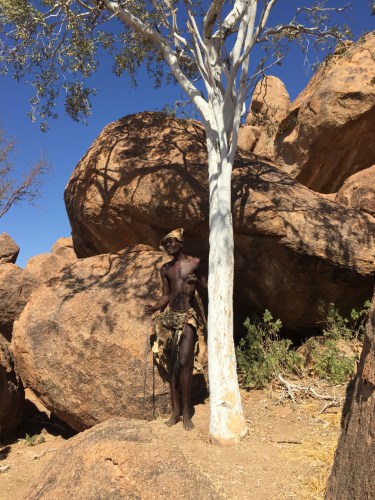 (Twyfelfontein, Namibia; July 2017)
 This is where all mankind is from. Deepest West Africa. A study claims that our common ancestors came from what we today call Namibia. The San people of Namibia and Angola still share the closest ties to our foremothers and -fathers and are most possibly the first people of Africa and part of a culture still alive today, to some extent. The San people are also the ancestral family of the people who migrated out of Africa some 40,000 years ago.
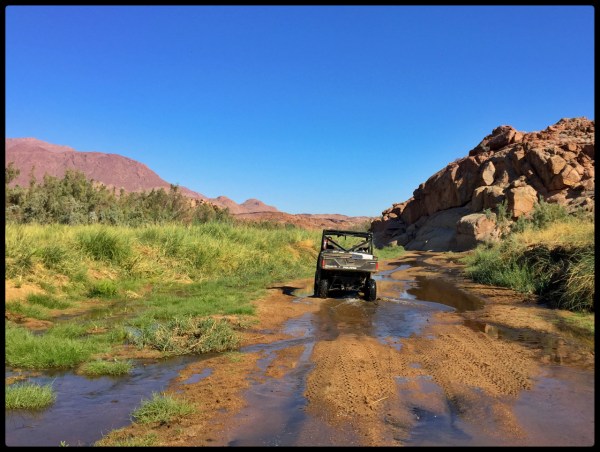 After driving through the dark we woke up in Brandberg. The rocks next to the campsite main buildings were actually the edge of the huge Brandberg rock. Last night we apparently had a desert elephant in camp. It was a lonely bull we were told, and this afternoon I saw a huge pile of elephant dung in the middle of the campsite. Unfortunately, most of the elephants are 150 kilometers away – and we explicitly came here to see them. In daylight, not sneaking around the campsite at night.
 (Brandberg, Namibia; July 2017)
 This blue marble