 Finnish, Estonia, Vepsian, Livonian, Hungarian, Mansi, Sami, Udmurt, Mari, Moksha. How many of these languages have you ever heard of? How about Nenets, Karelian, and Khanty? This is the language tree of the Uralic languages, including Fenno-Ugric languages where Finnish and Estonian belong (the top yellow-and-orange languages in the photo above).
In school I was taught that Finnish is an old language that stems from somewhere deep in Russian territory. It is not Indo-European, meaning Finnish is less related to Swedish than Sanskrit to German. I was also taught that the languages can be trailed backwards in tribes, along migration routes across the Siberian taiga, all the way back to the Ural mountains. Basically, people linguistically related to Finnish, Estonian, and Hungarian are a smattering of fur-trapping and reindeer-hearding tribes between Finland and Mongolia. Sami, or the language of the reindeer-hearding Lapps in the Nordic countries, is on a separate branch even if it is geographically close to Finnish. It has heavy influences from its geographic neighbors but is according to linquists also close to Mongolian. 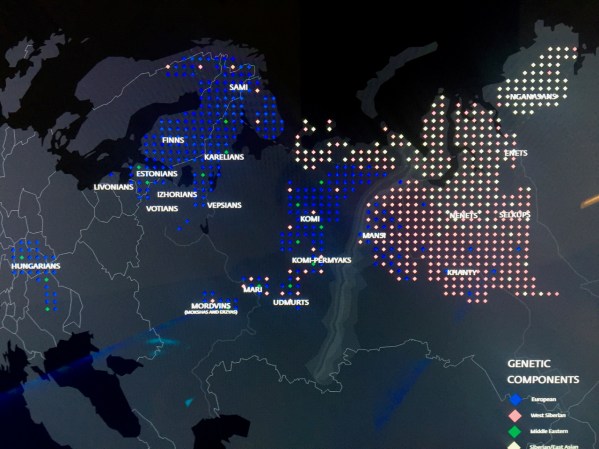 Today this model is challenged. Those who combine ancestry genetics with linguistics say that Finns have a mixed genetic heritage, Finnish came to Finland from Estonia, and as a language it is not really old at all: if you remove all influences of Baltic, Swedish, ancient Germanic, and ancient Russian languages, you are left with just a few words. Surely this is plausible because people adopt each others words when they spend time together.
Which ever way is the truth, it is a curious and often forgotten fact that we EU citizens who feel we belong with Western Europe, Ikea, beer-lovers, and a Christian cultural heritage, actually have close family links with tribes living in very cold climes, either in wooden huts or in yurts, trapping fur animals or herding reindeer for a living. We share the same words and partially the same culture of singing our stories through poetic verse (check out the Finnish national epos, the Kalevala. It was a huge inspiration for J.R.R. Tolkien in his youth). The soul of our ancestry lies in a mythical connection with nature, where everything from bears to trees to rocks have souls, too. We forget this, even when we pick seven kinds of flowers to put under our pillow at midsummer night so we dream of our husband-to-be; or when we retreat to our summer cottages, choosing to enjoy our holidays without power or running water, living and breathing Nature.
When you look at our past as well as the lifestyle of our linguistic relatives, is striking how much the Sami, Finnish, Estonian, and Hungarian “Europeans” have much in common with Native American heritage: hunter-gatherer living, respect for big prey, living in connection with Nature, animism, and shamanism. Sure, this is the backdrop of the stone age human, but we Fenno-Ugric people lived like this still as near as 1000 years ago. And what happened to these two cultures? Today the Sami have their own council, their own languages, their own schools, and a growing respect for their culture, while the Native Americans seem to be downtrodden, century after century. And the Finns and the Estonian keep their heritage alive only through subconscious, not-realized connections to their past, such as big feasts when eating big prey animals, and the summer cottage culture.
Interested to learn more about the mysterious folks of the North-Eastern taigas and steppes? There is an excellent, permanent exhibition on the Uralic peoples at the Estonian National museum in Tartu.
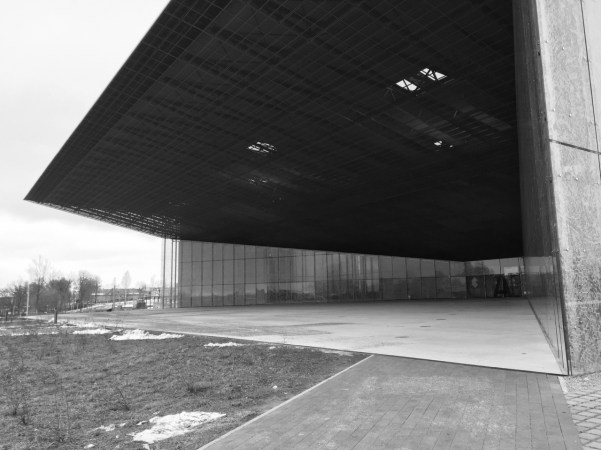 (Eesti Rahva Muuseum, Tartu, Estonia; December 2017)

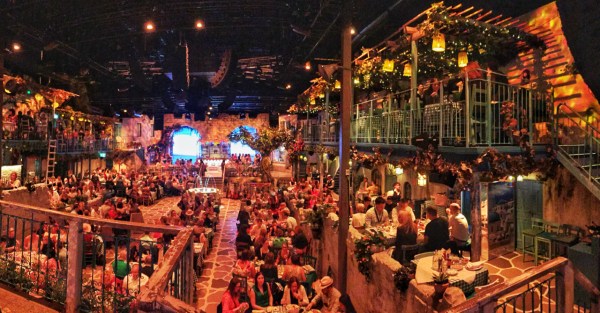 It could have been a Greek island. It certainly felt like it, and even the olives and the tzatziki had a tinge of sunlight in their flavors. I tried to forget it was Gröna Lund in Stockholm, Sweden. Because there was a Mamma Mia -inspired dinner show, followed by an ABBA-inspired disco, and so many happy people in summer dresses and light linen suits.
 Indeed, it was Greece all the way until the wee hours of dawn, when we stepped out of the wonderland into a freezing cold, snowy January night.
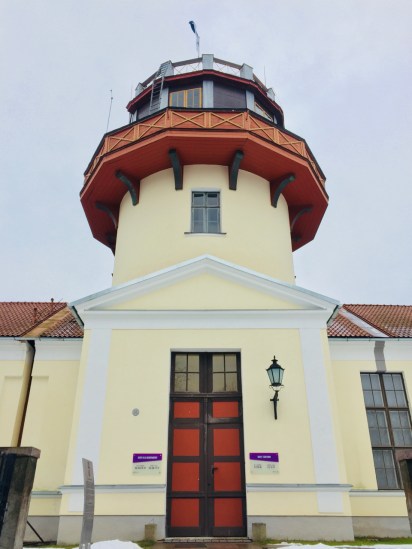 Scholars have been seeing stars in Tartu for over 200 years. The old observatory is crammed with equipment to view, measure, and analyze. And it is a cold place, even with the hatch closed. A non-astronomer never realizes how freaking cold it is to work at an observatory, because except for in late summer, the clearest nights also mean coldest nights. Yet once again,
  Being contemporaries, focused as much on style as on wit and critique of society, Oscar Wilde and Eduard Vilde could have met. But they never did. And so they were depicted having a chat on a bench outside of a pub in Tartu. Oddly, I learned that the exact same piece stands (or sits) in Galway, Ireland.
 There, unassumingly in the park, next to a currently acknowledged house of God stands a much older site of God. A million sacrifice ceremonies have worn out round indentations in the rock, like bowls carrying gifts to the Divine.
 (Tartu, Estonia; December 2017)
 (Tartu, Estonia; December 2017)
 Once it was a chapel. Then it was a university library. Now it is the university museum. Tartu used to be one of the grand university towns in Europe. It was founded 400 years ago under the Swedish rule in a country called Livonia. Neither Livonia nor its language Livonian exist anymore. Then it was opened under Russian rule by the Baltic Germans (Yes. There were Germans living in the Baltic countries. European history is confusing). And finally, some 100 years ago, it was again re-opened as an Estonian university. Obviously under Soviet rule for quite a while.
 The easiest way to get properly lost on Zanzibar: go to Stone Town. Or Zanzibar Town, as it is also called. Just walk in between the old Indian merchants’ houses and Arab palaces, beautiful wooden doors, and wooden lace-carved windowpanes. Notice traffic sounds exchange with laughter of children and shouts of local women and you will already be lost in the maze of alleys and tiny shopping streets.
  Some are enchanted by Stone Town, as a living monument to the eye of the vortex that Zanzibar was between gold and ivory trade, slave trade, and Indian, Arab, and Portuguese seafarers. While the palaces, the gruesome stories of the slave trade, and the little shops have their appeal, each time I visited I could not wait to escape the noise and the cramped streets for the turquoise blue waters of the beaches.
  But if you find yourself in Stone Town, do not miss these: the Anglican Cathedral standing on top of the slave market, housing a memorial; the Mnemba Spa shop for souvenirs; the Palace Museum for a peek into the life of a Sultan; the covered, souk-like food market; and the Forodhani Gardens for night-time street food fiesta.
 (Stone Town, Zanzibar, Tanzania; August 2017)
 Zebras, giraffes, kudu, oryx, antelopes, elephants, lions, marabou, secretary birds, rhinos, and a 2,000 square km salt pan visible from space. Etosha National Park is more than 200 km in width and we quickly realized we must properly plan our outings so as to not be stuck outside of the campsite gate after sunset. Driving at a speed limit of 60 km/hour means the return journey can be hours, depending on how far one has ventured.
  Etosha is mind-boggling in size, and yet small compared to its initial size of 100,000 square km. Today, only one-fifth remains, and at 20,000 square km it is larger than Kruger in South Africa (for comparison, the famous Masai Mara in Kenya is only 1,600 square km). It was created in 1904 by the Germans to put an end to hunting and poaching. Back then it stretched into Kaokoveld, across to Skeleton Coast and the Atlantic, and into Damaraland. Later it got reduced in size when native Namibian tribes were given land back, and everybody was given the opportunity to build a farm.
 Today the roads are all paved and one can drive around like on a Sunday outing, which is a very strange experience for the experienced safari goer. Only the area just south of the salt pan is accessible, and huge areas of land above and below are completely shut off from tourism. The animals are mostly a little way away from the road and compared to Kenya it is not possible to veer off on a dirt track to get closer. The distance also means binoculars are imperative.
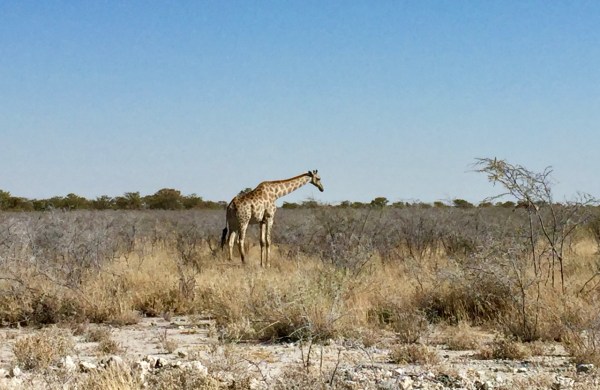 South Africa’s and Namibia’s national animals, the springbok and the oryx, are everywhere. The oryx looks like a graphic designer took a brushful of black paint and drew some defining lines on a goat-like large animal. Impala, kudu, steenbok, hartebeest, wildebeest, giraffe, elephant, and zebra – all the usual suspects are here, although they look a little different from the ones I’ve seen in Kenya. The zebra has more pronounced shadow stripes, and the hartebeest is more brown than ruddy. We also spent time admiring swanky secretary birds, prehistoric-looking kori bustard birds, jackals, and klipspringers. No baboons, but they were all over the campsite at night, heard going through the trash cans in search for leftovers.
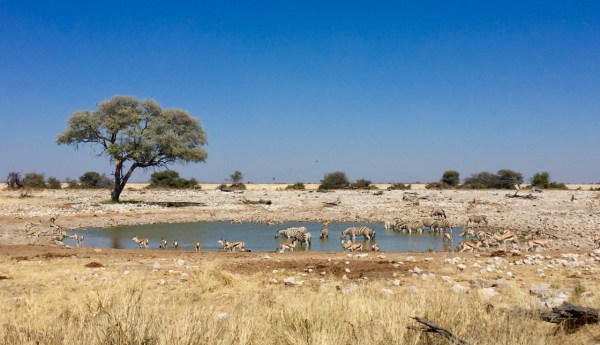 (Etosha National Park, Namibia; July 2017)
 Skeleton Coast. No need to try to find a more catchy headline for this post. And unfortunately for many, Skeleton Coast has during the centuries caught a lot of souls and ships in its traps. With dramatic consequences. This is the end of the world, you see.
 Skeleton Coast hides countless skeletons of ships and unfortunate crews. The wrecked ships are scattered along the shore: old wooden ships like the Seal, and more modern, metal-hull vessels. Even warships have met their fate in the sharp underwater rocks and neverending swells and rip currents. The most famous warship is the Dunedin Star which wrecked near the Angolan border in 1942. The rescue ship stranded, as well. The rescue plane sent to get the two crews out got bogged in the sand and could not take off again.
 How long, dark, cold, and scary must the nights have been for those hunkering down on the shore, waiting for weeks in makeshift shelters. Most sailors and crew did not know how to swim and getting to the shore from the breaking ship was a nearly impossible task: life rafts got lost and broken in the swells.
 (Skeleton Coast, Namibia; July 2017)
 This blue marble