
 Lifestyles of thousands of years are quickly forgotten in the turbulence of the past two centuries. In Africa, 200 years is some 8 generations, and thus it was about time that a group of Damara people began to research and recount for their old ways, before all was forgotten. Out of this came the Damara Living Museum: a traditional village made up for tourists, where Damara craft and life is put on display by people enacting their customs for work.
The sun was hot in the desert and everybody wore loincloths. Only a couple of women covered their breasts. Our guide was a young, pregnant woman with full, beautiful pregnancy breasts. She was a gorgeous creature. Men were dangling bones and what looked like donkey or oryx tail hair from their loincloths. Some had leather headwear, to protect from the sun. In summer, the day temperature can climb up to 50 degrees centigrade, thus one may wish to concentrate one’s garments over the head. But the nights are still freezing cold. Fortunately these modern Damara people probably went home to a hut with proper blankets, but how did their ancestors manage all those tens of thousands of years previously? With furs? It is not as if the animals around here are donned with insulating pelts.
We were also taken for a bushwalk to learn about local medicinal plants. Surprisingly many bushes that I recognized actually have known medicinal uses! Even oryx dung was used as a strong potion to stabilize a woman’s menstrual cycle. The ladies explained that it is strong enough to kill an unborn baby. In addition, we were shown how to hunt oryx, and how to trap dassie-rats. Although it was taboo for women to hunt in the Damara culture.
This type of tourism is the best kind: it keeps old traditions alive and feeds local people. It is sad, however, that the only reason the beautiful age-old culture of the Damara exist is for tourists, or in some protected, often distant, areas. “Progress” wipes out so much knowledge, craft, and time-tested ways of life. 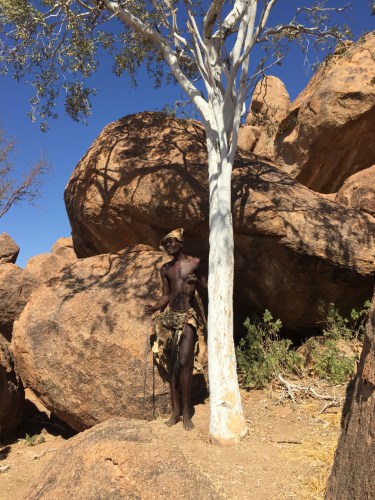 (Twyfelfontein, Namibia; July 2017)
 This is where all mankind is from. Deepest West Africa. A study claims that our common ancestors came from what we today call Namibia. The San people of Namibia and Angola still share the closest ties to our foremothers and -fathers and are most possibly the first people of Africa and part of a culture still alive today, to some extent. The San people are also the ancestral family of the people who migrated out of Africa some 40,000 years ago.
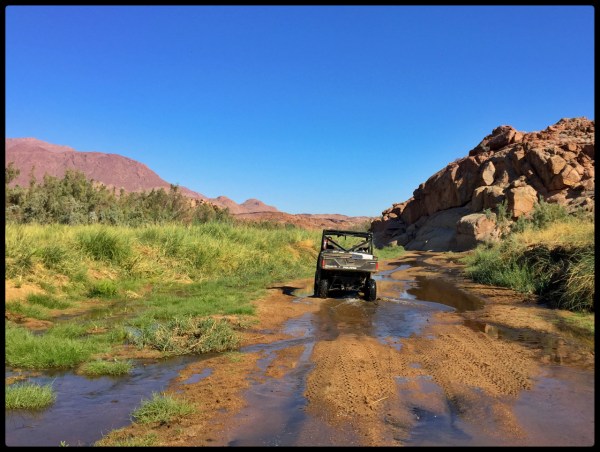 After driving through the dark we woke up in Brandberg. The rocks next to the campsite main buildings were actually the edge of the huge Brandberg rock. Last night we apparently had a desert elephant in camp. It was a lonely bull we were told, and this afternoon I saw a huge pile of elephant dung in the middle of the campsite. Unfortunately, most of the elephants are 150 kilometers away – and we explicitly came here to see them. In daylight, not sneaking around the campsite at night.
 (Brandberg, Namibia; July 2017)
 The Cro-Magnon people of Europe drew mammoths, deer, and moose. The San people of Africa made giraffes, oryxes, and wildebeest. Both depict hunts, hunted animals, and the styles are quite similar. If you look closely you can even see an animal with double sets of legs,
  Three ladies and a monster Land Cruiser. Four-wheel driven, stick shift, and to be driven on the left side of the road. Requires two people to get it into reverse gear. With two (in principle) pop-up tents on the roof, which in practice require two tall, strong people to pop them up or fold them down – or three ladies climbing all over the car for 15 minutes to do the same job.
 (Namibia; July 2017)
 Last night at Walvis Bay. After one month I still have trouble with how strong the segregation is here. Last Friday we went to a bar and talked to the black bartender we knew. We wanted to go clubbing for once, and thought it was a great idea that he’d come with us to show us the local nightlife hotspots. But most of our team wanted to be within walking distance of the house (on the “white” side of town, mind you), and so the vote fell on another bar in the marina. Our bartender was very sorry but could not join us as he would not have felt welcome in that bar.
 How to have fresh mussels on the beach: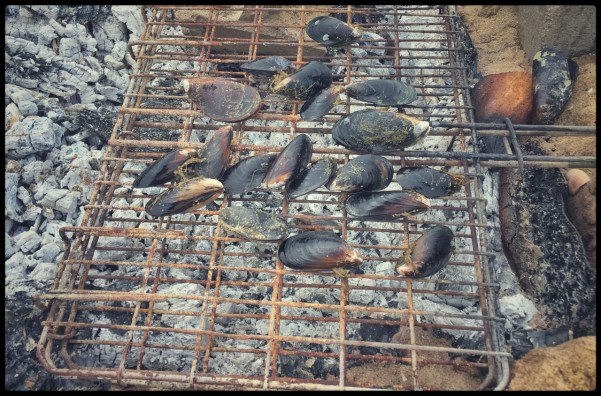
 (Pelican Point, Walvis Bay, Namibia; July 2017)
 For a month we’ve been cruising around and past Pelican Point, viewing the desolate, 10 km long sand bank with its millions of noisy seals from the sea. Today we off-roaded through it, all the way to the seals at the northernmost tip. 2 cars, 12 people, 1 kayak, and lots of food for a beach barbecue.
  We could naturally not do a beach outing without gathering some data, too. The kayak was brought along not just for fun, but also to record Cape fur seal sounds. The seals often move with the dolphins when feeding, and so it is good to understand the noises they make. Two from our team also snuck up on the seal mothers and their pups in the nursery on land, crawling as close as they possibly could, and leaving a SoundTrap behind.
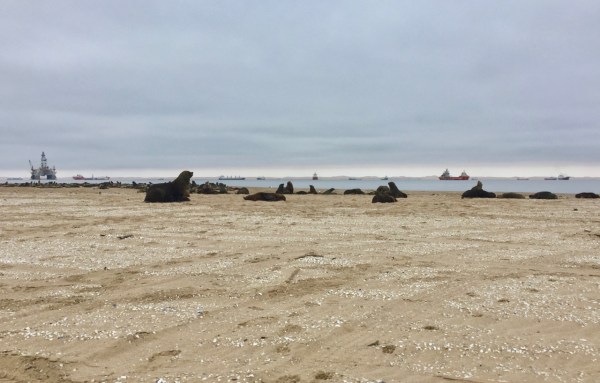 I crawled close to the seals, too, just to watch. On all fours, we three people ultimately got about 10 meters from the “gentlemen’s club” of male seals, lying away from the big group of mothers and pups. The furry, almost shaggy large males sat proudly with their noses in the air, as if they owned the world. And from their point of view, they probably did.
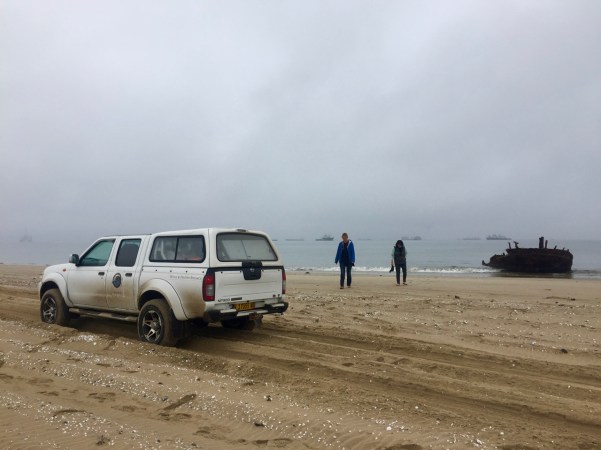 The seals and the jackals inhabit a long, lonely stretch of the world. If the wind picks up, there is no way for the jackals to go except for to trot ten kilometers back towards mainland. Or to burrow themselves down into the 4WD tracks. Because this is Namibia and it is full of desolate places.
 (Pelican Point, Walvis Bay, Namibia; July 2017)
 Dinner time, both for us and for the fish. The lucky wish were hand-fed squid fillets, by scuba divers. Except for the one scuba diver who was mainly filming with his GoPro, never-minding the poor starving fish.
 (Swakopmund, Namibia; July 2017)
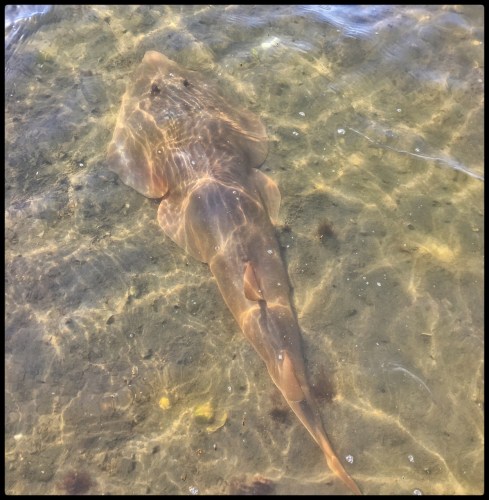 These weird things hang around in the lagoon. Why they are called guitarfish is kind of evident, at least with a little imagination. Although this individual was quite slim.
 This blue marble