
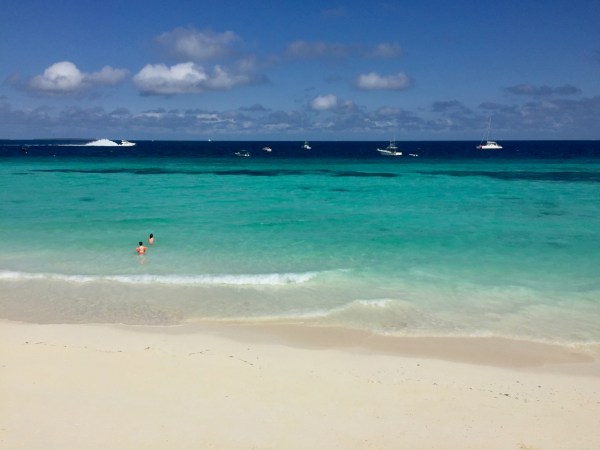
 A beach boy sauntered down the beach carrying a wood-jacketed book (the Quran? The Bible? A voodoo spell book?), stopped by me and said “Hi, can I ask you a question? What do you think of black people?” Perhaps he was provoking an argument, or just wanted to make small talk. He kept talking and slurred so I barely understood half of what he said. His eyes spun in his sockets as he explained to me that he had a Norwegian girlfriend and encouraged me to be friendly to every person I met. And every half a minute I had no choice but to do the African male handshake of bumping knuckles with him.
Zanzibar has a dark underbelly, like most tourist paradises. I have heard stories of drugs and drug-related crimes here, too. Most locals (and possibly tourists) choose to go for heroin. Or maybe it is heroin that is best available. Since I get up early I have never stayed up very late, but I hear people get drugged and in trouble at large parties such as the Kendwa full moon party.
The beach boys hawking snorkeling trips and coconuts hawk pretty much anything if you ask the right individual. Including drugs. Yet, unlike many other (Muslim) tourist destinations, there are no signs at the airport warning for zero tolerance with regard to narcotics. I have also understood that here it is most often not the user but the peddler who gets into trouble. And the drug lords can bribe their way out of most trouble.
But none of this is visible in daylight. Although I have rarely been out past 11 pm, I have always felt safe walking in the dark, too. However, as noted above, there are strange people on the beach here. A beach boy stuck to me like a leech a few days earlier. He thought it was his prerogative to demand conversation, and I was rude for preferring to write undisturbed. Another beach boy had alcohol on his breath at 11 am and wanted to sell a coconut for 10,000 TSH, whereas I know 1,000 is a good price and anything above 3,000 is a rip-off.
Last night I ran into a few guys smoking pot outside of the restaurant I wanted to dine at. They yelled after me, saying they wanted my company afterwards and that they would wait. They actually did wait – and as they never asked me what I thought of their wish I slipped out through the back door.
The islanders here have their own friendly way of living, different from mainland. Perhaps crime is lower, too? I do not know of the facts. And in case one should forget in the dazzling sunlight on the white beach sand, Zanzibar is not Paradise but a real place, with real people. Where ever there is light there will be shadows. (Nungwi, Zanzibar, Tanzania; August 2017)
 Zanzibar and its surrounding islands are also known as the Spice Isles. Curiously, this is a wholly imported conception, as there was no real concentration of spices growing here until the Arabs and the Portuguese came and planted spice and fruit varieties they had encountered on their travels around the world. Everything seems to grow on Zanzibar, and so now the farmers grow peppercorn from India, lemongrass from Southeast Asia, avocado from Peru, cloves from Indonesia, and vanilla from South America. In essence, the ecosystem of Zanzibar changed completely with the settlement of the Portuguese.
  And yes, cloves come from red flowers on a tree and peppercorn grow on a vine. Cardamom comes from overground root-like pods produced after flowering, and pineapple takes 6 months to mature (and one can only harvest one fruit per plant per year). All of these, as well as cinnamon, turmeric, and other spices are now an integral part of the Swahili diet and kitchen. I would love to know what food tasted like before the Portuguese came.
 (Zanzibar, Tanzania; August 2017)
 Went to Stone Town to fix my broken iPhone. The driver’s car broke too so we got it fixed at a mechanic in the scorching sun. Then this guy called Abdullah unscrewed the dozen miniature screws of my iPhone 6 display, inserted an authentic-looking but Hong Kong copy touch screen display, added a tempered glass cover, and charged a whopping 70 euros in Tanzanian shillings, cash: a wallet-thick wad of money I first extracted out of an ATM.
 Switching gears: from diving to yoga and one last week back in Nungwi. For this very week I have hauled my yoga mat around Africa for nearly two months. I could (and should!) have practised during those months, but either the room was too small or the schedule was too packed or the company was too good, or [insert other well-curated excuses here].
 (Nungwi, Zanzibar, Tanzania; August 2017)
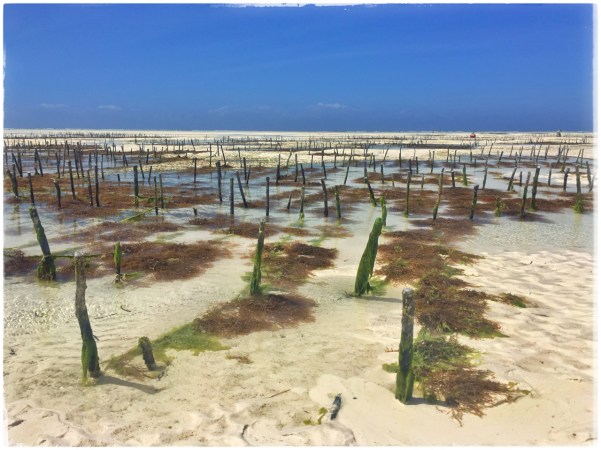 In Paje there is a seaweed plantation, just like on Nusa Lembongan off Bali. Here the seaweed is grown on ropes tied to poles and left dry with the receding tide, twice a day.
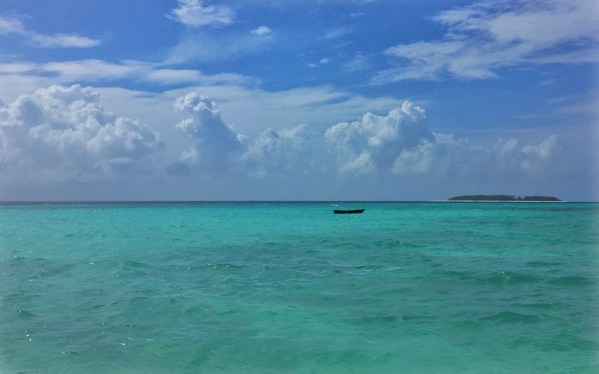
 Imagine an empty stretch of beach. The palm trees curve over the fine pale sand, like in those travel bureau brochures. Turquoise water gently froths the edge of the beach sand. Clouds crawl across the blue sky, rolling as if in slow motion. Not a soul in sight.
 (Paje, Zanzibar, Tanzania; August 2017)
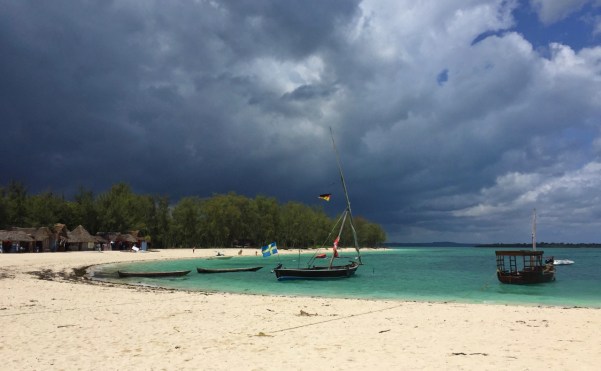 The rains are soon here. It is August and we get a few drops every day, but the clouds look more menacing than what they are. Thank goodness the tiny Swedish (?) boat made it back in time.
 (Paje, Zanzibar, Tanzania; August 2017)
 Back to school. Obtaining the Open Water Diver certificate was a lot of work. Fortunately I had plenty of time here in Paje.
  (Paje, Zanzibar, Tanzania; August 2017)
 The first time I dove I felt a tinge of panic: “what if I would just lose my head right now, remove the regulator, breathe in a gulp of water, and die? It would be so easy to die.” Indeed it would. And I am still trying to get used to the idea of the PADI buddy system: you travel anywhere on the planet, seek out a reputable dive center, get paired up with a stranger you’ve never met in your life and will probably never meet again, and then place your trust in this person; that he or she is going to stick nearby you during the entire dive and is willing to give you his/her alternate regulator should your air supply fail. And that he or she will stick with you and leave the beautiful scenery behind, should you need to return to the surface, far away from the boat.
 (Paje, Zanzibar, Tanzania; August 2017)
 This blue marble