
 I stumbled into a beach club this morning and bought access for a day. The staff must have felt they had to emphasize on me how exclusive my experience would be. Everyone is very nice and yet, as a walk-in, I feel like a hobo. Two guards patrolled the beach front and when I asked for a day pass both the hostess as well as the beach boy asked if I was aware of that the minimum spend was 500,000 IDR (in addition to the sign stating the same, at entry where i stood).
This hobo clearly did not look like she had credit. In addition to pointing out cost they also asked for my card before I had ordered a thing. It was confiscated and the staff intended to keep it for the entire day, handing me a slip with the number 19. I asked if I could just get the card back and pay whenever they wished me to, but this was not a preference. I negotiated if they could charge the minimum spend of 500,000 IDR to my card and I’d order something later, on that credit. This was also not possible. Finally I had to insist that I felt uncomfortable with handing them my card for the entire day as it was also not necessary. After some exchange via headsets, I got my card back and very politely indeed. Uncharged.
I must assume there is a reason for such mistrust. People walking in without means to pay. Or else I do look like a Homeless Bohemian on holiday.
But it is quiet here: one of the few places in Canggu with no blaring music during the day. The sea is roaring up front: heavy surf crashing into black lava rocks scattered like huge lego bricks on the beach, or rolling onto the nearly black sand. The pool is turquoise and fresh and peaceful, and the lawn is barbered to perfection, especially around every round stepping stone. And the best thing is the cabanas: huge platform beds with a sun cover, fitting three people. And I have one just to myself.  Canggu, Bali, Indonesia; August 2018)
 Enjoying the sunset with two lovers. They do not even know I exist. It does not matter. We all look at the ocean, where surfers float on their boards in the last light of day like a colony of seals. It is a beautiful night, and yet I drift into thoughts less beautiful.
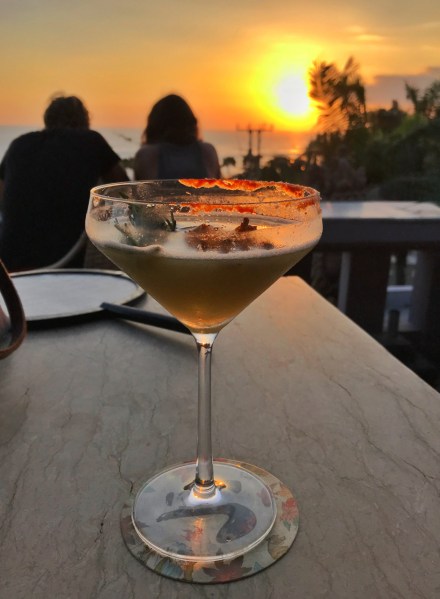 (Canggu, Bali, Indonesia: August 2018)
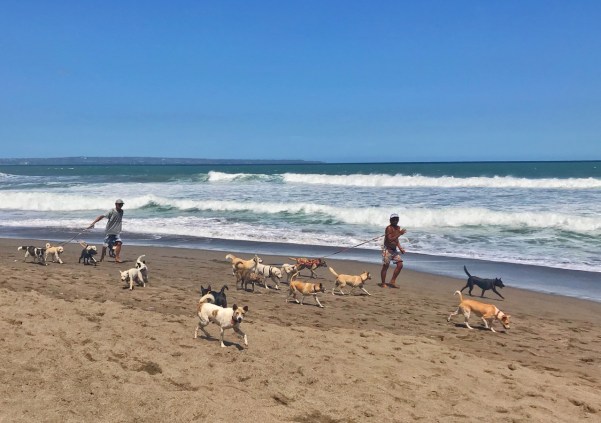 Two very tanned men passed me on the beach today, along with about a dozen Bali dogs. Each had perhaps four dogs on a cluster leash, and both were surrounded by free-running, collared dogs. Many looked mangled and scarred, but all were filled with joy to the brim: running around in the sand, goofing. If dogs could smile, all of these most certainly did. People photographed them as they went, and the whole bunch got much attention from beachgoers. What a life. And what a job for the dog walkers.
 The waves on Canggu beach are so powerful and foamy one needs a surf board to join them – and one must know how to use it. Many do not, and it is entertaining to see the surfing students tumble in the breakers like colorful seaweed, arms and legs flailing.
 (Canggu, Bali, Indonesia; August 2018)
 Apologies for the food photo, but I am on Bali (yes, again). Thus this will not remain as the only one from my stay. You see, the healthy, locally produced (and mostly raw) food trend is on another level here.
 European cities may have a few large, designated parks and many small green patches squeezed in later between the houses and streets. In Singapore, urban greeneries and jungles are not inserted here and there after the city is planned and built. Instead, since 1967, they have been consciously included in the plan as the city grew. Surprisingly large areas of green have been retained, such as the Botanic Garden and the Gardens by the Bay. Access is free from dawn until late, in some cases until midnight. My local friend spends most of his weekends in the Botanic Gardens with his wife and baby, discovering new things every time.
 (Gardens by the Bay, Singapore; July 2018)
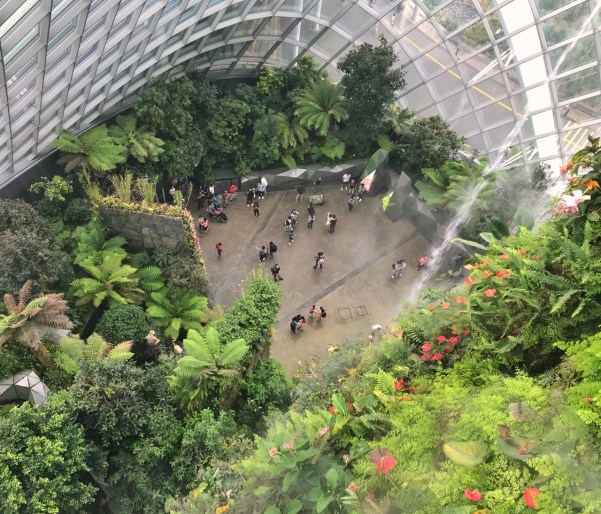
 If it is too hot to enjoy gardens outside, why not build a hollow mountain with a cool cloud forest on the outside, complete with mist, underneath a huge glass dome?
 The Cloud Forest consists of a large, hollow, man-made “rock” planted with flowers, ferns, mosses, and climbers. The entire construction is misted every two hours, and this is the main attraction: visitors time their visit to enjoy the cooling sensation of mist on their skin while strolling the 6 stories of criss-crossing walkways in the skies. Because this is Singapore, one can naturally ride the elevator all the way up.
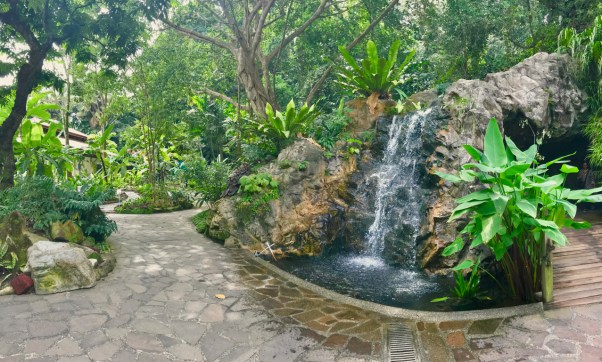
  But the best surprise awaits the one who makes it all the way down and still has eyes for more beauty: the waterfall cascades down into a clear pool lined with the most interesting ferns, mosses, epiphytes, and climbers. Oh if only I had a private garden in a cool, shady area – this and a few trees would be the gorgeous landscape. Who cares if there was no sun, as long as there are ferns, mosses, and no mosquitoes?
 (Marina Bay Sands, Singapore; July 2018)
 On a whim I took the metro to the Botanic Gardens. I had no idea it was famous – until I entered and realized it probably must be. I have visited many botanic gardens in my life but nothing comes close to the one here in Singapore. The garden is easily 2-3 kilometes long and 1 kilometer wide. It contains two lakes, several ponds, a rainforest (large enough for a proper stroll!), a palm tree valley, an orchid garden, a symphony orchestra stage in front of a lawn – and approximately 20 themed gardens.
 It strikes me that still 150 years ago we Europeans too knew all about the properties and uses of our plants and trees: which wood is pliable, which is durable like steel, which plants are medicinal, and how to weave bowls and from what. All this knowledge here on the Malaysian peninsula will be lost soon, too, unless it is specifically conserved. Even here in Singapore I would wager to claim it is already lost from the collective mind of commoners and preserved only among few with an interest in herbology and healing.
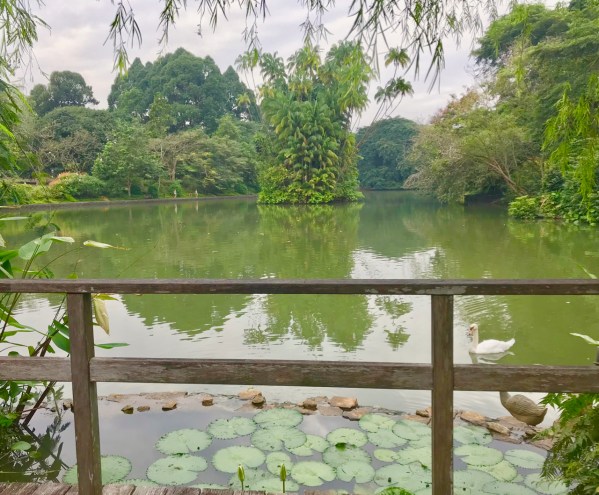 (Singapore; July 2018)
 It is a sobering reminder to have the text “DEATH for drug traffickers under Singapore law” written on my visitor pass. How ironic it is, then, that much of Singapore’s past is linked to hard drugs: opium trade between China and the British Empire.
 In the hubbub of Chinatown, stepping into a temple is like stepping sideways out of life.
 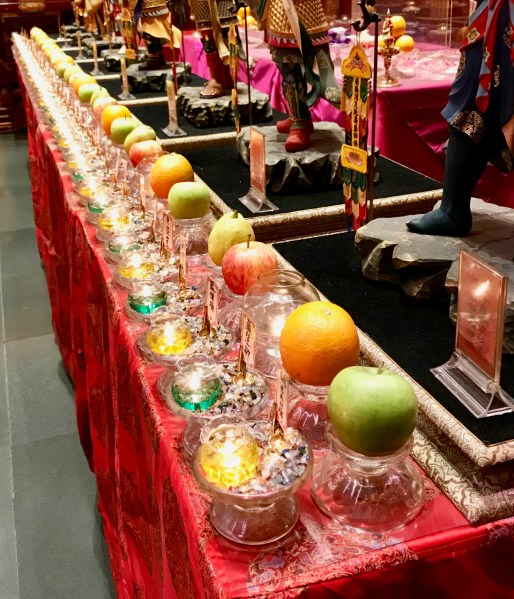 It must be lunch hour here, too, both for gods as well as for scholars: fruits in a row for those on higher planes, and half-empty thermoses left behind by those who needed more tangible nutrition than loving kindness.
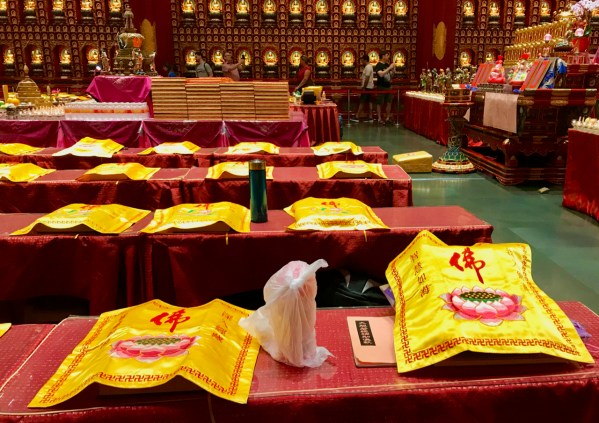 (Singapore; July 2018)
 This blue marble