
 As our bungalow driver drove me to Stone Town he told me he had just driven his son to see the witch doctor, with pains in his stomach. It happens from time to time, he said, and the doctors at the hospital cannot find anything wrong. The boy has been helped by the witch doctor every time, with potions, magic, and by recognizing that someone wants to hurt the family by causing the boy to be sick.
According to other stories I have heard, too, this witch doctor seems to be famous and receives patients from far away African countries. It is said he can raise people from the dead. Somewhere on Zanzibar there is a forest of the dead. When you go there properly prepared by the witch doctor, taking a potion, you can see a dead friend or relative. Perhaps you have unfinished business, or simply want to wish goodbye. The witch doctor also has the ability to bring the dead person back, completely so she or he can continue life as if it never ended. This of course costs money, some 5 million TSH (approximately 1,700 EUR). The best proof of this medicine is the story of a local man who should be dead many times over, but always returns to his home.
Voodoo is still common on Zanzibar and nearby islands. Pemba is a globally known center of black magic, so famous that practitioners from Haiti do pilgrimages to the little island to learn. My knowledge of voodoo is limited, and so I listened with a growing perception that in voodoo the main reason for ailments is not disease or bad spirits, but that someone, a specific person, wishes to harm the sick person or his or her nearest family. Evil spirits or djinns may occupy a person, but most often an unexplained illness is due to ill-will of a person known to the victim, who sets the evil spirits after the victim. The witch doctor is able to both point out who this person is, as well as cure the illness.
Is this just the viewpoint of a successful, envied businessman? The underlying attitude is alarming to a European. On Bali, disease is seldom caused or wished by one single individual. The Balinese believe everything is a struggle and balance between good and evil, and that diseases are caused by bad spirits. They are typically not the fault of a human being. Here on Zanzibar the view portrayed by the driver is that most unexplained illness stems from people wishing to harm other villagers or relatives they know well.
There is scientific evidence for that illness can be propelled by our own minds: depression causes inflammation in the brain, and many difficult-to-diagnose pains and aches end up as psychosomatic, meaning they are caused by the patient’s mental pain and unwellness. But there is something more alarming to the concept of illness in voodoo. I could not help but follow the trail of my European-conditioned mind: if the reason for illness is inflicted by other people there must be much anger, envy, and hate around. After all, people do get sick from time to time, and every time they do they get to hear of a person who has something against them. Such a contrast, then, to the impression I have of the Swahili people: friendly, caring, people with a strong community feel. Kindness and charity are important aspects of Islam. None of these attitudes fit what I am now hearing: of a society where blame is easily pointed and many personal problems explained by ill-will by a community member.
But then again, I am not an African and am possibly missing about 99% of the cultural context of voodoo. Lovely ones, if anybody of you know better, please educate me!
(Nungwi, Zanzibar, Tanzania; August 2017)
 Sitting in the shade of coral rocks on the beach. A crab is cleaning out its dwelling in the sand, after the receding tide swept its front door shut. My dwelling is a simple bungalow with wood worms eating out my bed from the inside. Nature is (still) everywhere on Zanzibar.
 Somehow this holiday also became a holiday from ashtanga Mysore practice. I am exploring new things in yoga after a challenging experience last year on Bali that subconsciously dragged down my willingness to adhere to the practice. I confess I have practised very little since then. And before this week, I have only two (very unpleasant) lead vinyasa flow experiences under my belt. Performed in a gym with instructors who lead us like we’d be doing aerobics. But now I am signed up for a week’s vinyasa flow, once in the mornings and once in the evenings.
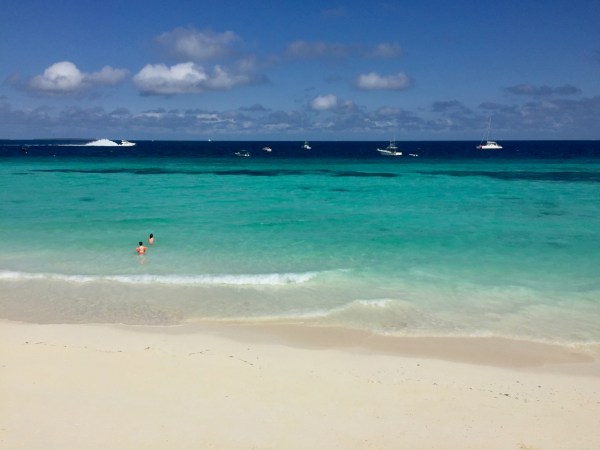 A beach boy sauntered down the beach carrying a wood-jacketed book (the Quran? The Bible? A voodoo spell book?), stopped by me and said “Hi, can I ask you a question? What do you think of black people?” Perhaps he was provoking an argument, or just wanted to make small talk. He kept talking and slurred so I barely understood half of what he said. His eyes spun in his sockets as he explained to me that he had a Norwegian girlfriend and encouraged me to be friendly to every person I met. And every half a minute I had no choice but to do the African male handshake of bumping knuckles with him.
 (Nungwi, Zanzibar, Tanzania; August 2017)
 Zanzibar and its surrounding islands are also known as the Spice Isles. Curiously, this is a wholly imported conception, as there was no real concentration of spices growing here until the Arabs and the Portuguese came and planted spice and fruit varieties they had encountered on their travels around the world. Everything seems to grow on Zanzibar, and so now the farmers grow peppercorn from India, lemongrass from Southeast Asia, avocado from Peru, cloves from Indonesia, and vanilla from South America. In essence, the ecosystem of Zanzibar changed completely with the settlement of the Portuguese.
  And yes, cloves come from red flowers on a tree and peppercorn grow on a vine. Cardamom comes from overground root-like pods produced after flowering, and pineapple takes 6 months to mature (and one can only harvest one fruit per plant per year). All of these, as well as cinnamon, turmeric, and other spices are now an integral part of the Swahili diet and kitchen. I would love to know what food tasted like before the Portuguese came.
 (Zanzibar, Tanzania; August 2017)
 Went to Stone Town to fix my broken iPhone. The driver’s car broke too so we got it fixed at a mechanic in the scorching sun. Then this guy called Abdullah unscrewed the dozen miniature screws of my iPhone 6 display, inserted an authentic-looking but Hong Kong copy touch screen display, added a tempered glass cover, and charged a whopping 70 euros in Tanzanian shillings, cash: a wallet-thick wad of money I first extracted out of an ATM.
 Switching gears: from diving to yoga and one last week back in Nungwi. For this very week I have hauled my yoga mat around Africa for nearly two months. I could (and should!) have practised during those months, but either the room was too small or the schedule was too packed or the company was too good, or [insert other well-curated excuses here].
 (Nungwi, Zanzibar, Tanzania; August 2017)
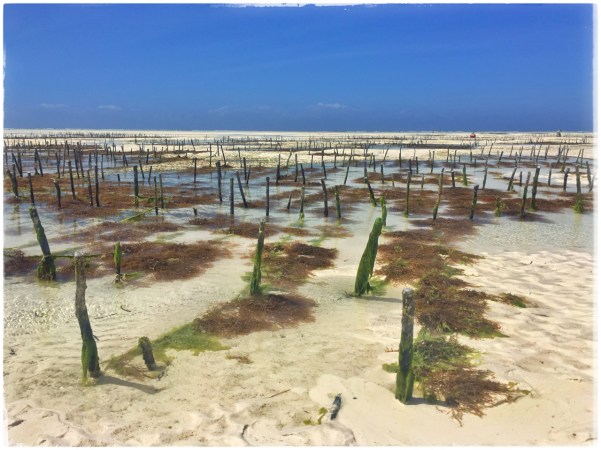 In Paje there is a seaweed plantation, just like on Nusa Lembongan off Bali. Here the seaweed is grown on ropes tied to poles and left dry with the receding tide, twice a day.
 Imagine an empty stretch of beach. The palm trees curve over the fine pale sand, like in those travel bureau brochures. Turquoise water gently froths the edge of the beach sand. Clouds crawl across the blue sky, rolling as if in slow motion. Not a soul in sight.
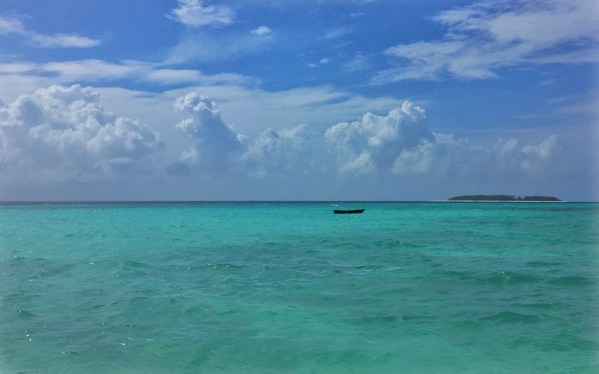 (Paje, Zanzibar, Tanzania; August 2017)
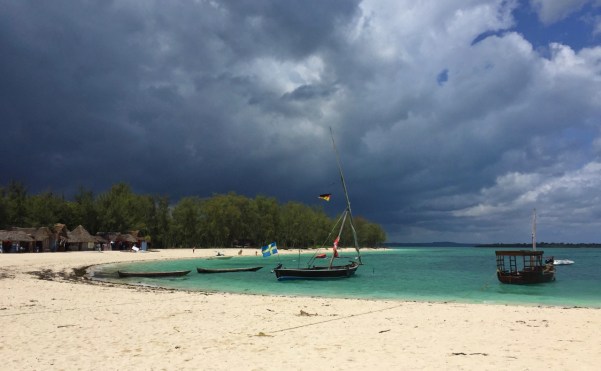 The rains are soon here. It is August and we get a few drops every day, but the clouds look more menacing than what they are. Thank goodness the tiny Swedish (?) boat made it back in time.
 (Paje, Zanzibar, Tanzania; August 2017)
 This blue marble