
 Back to school. Obtaining the Open Water Diver certificate was a lot of work. Fortunately I had plenty of time here in Paje. Learning how to equalize my demanding, small ears means I crossed a significant hurdle, too. And Buccaneer Diving gave me a friend price and a fantastic instructor.
I am well bruised on my arms now: a dozen bruises at least, from working the scuba unit on and off in the water, weight belt off and on both in the pool and in the sea, and preparing the air cylinders which are heavy. Additionally, I have a sore bump on the back of my head from jumping in with a loose air cylinder on my back (due to all the de-kitting and re-kitting in the water).
Recreational diving relies so much on technology that the Open Water course assumes that a dive computer will be used. The planning tables and calculations are taught as a back-up. Modern dive computers can connect to the air source, in addition to instructing on surface interval time between dives, ascent rate, and dive time. I do not even own a waterproof watch and so learning the basics behind the dive computer functions was interesting to me and probably boring to most.
The exam in itself was surprisingly time-consuming: lots of questions and calculations. The book has a number of self-quizzes but also quizzes to be corrected and discussed with the instructor. Because I never accept any claim without questioning it, I ended up spending a few days debating with my instructor and my divemaster friend on various unnecessary details, before taking the exam. Because of their patience that never seemed to run out, I actually passed the exam, too. Hello fish, here I come.
 (Paje, Zanzibar, Tanzania; August 2017)
 The first time I dove I felt a tinge of panic: “what if I would just lose my head right now, remove the regulator, breathe in a gulp of water, and die? It would be so easy to die.” Indeed it would. And I am still trying to get used to the idea of the PADI buddy system: you travel anywhere on the planet, seek out a reputable dive center, get paired up with a stranger you’ve never met in your life and will probably never meet again, and then place your trust in this person; that he or she is going to stick nearby you during the entire dive and is willing to give you his/her alternate regulator should your air supply fail. And that he or she will stick with you and leave the beautiful scenery behind, should you need to return to the surface, far away from the boat.
 (Paje, Zanzibar, Tanzania; August 2017)
 I have a love-hate relationship with diving underwater. On the one hand I love the sea and looking at the underwater world. On the other hand, my ear canals are small and I have problems flying with the smallest symptoms of cold, or freediving deeper than 3 meager meters. But together with an instructor from Buccaneer Diving, a divemaster friend, and a lot of technique rehearsing, in Paje I found a way to equalize my ears. My goodness. I also found a way to work with my sinuses pre-emptively so that my ears would also not crackle and pop the next day after the dive.
 Hello fish, here I come. Even if I now go through the following routine every single minute: equalize by blowing against my nose, get water in mask so I can’t see, stop to clear water from mask by blowing bubbles. Hence, I need to become masterful in buoyancy control and level-diving to minimize pressure changes and the need to equalize. But hello fish, here I come!
 (Paje, Zanzibar, Tanzania; August 2017)
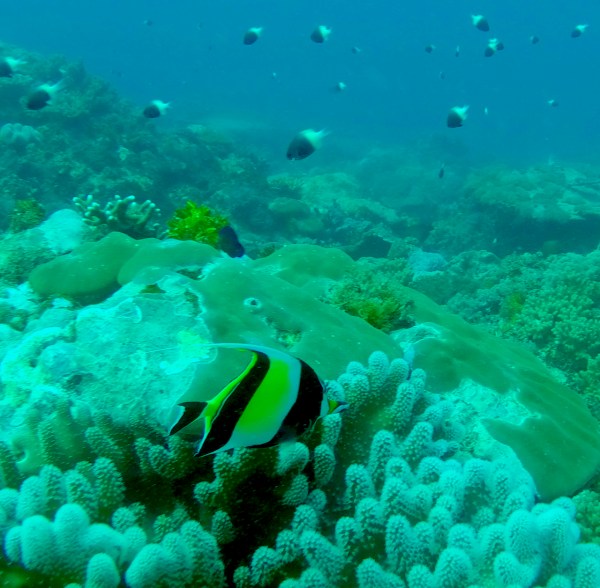
 It turned out that the beach hut in Paje was next door to a 5-star PADI dive center. And on Paje beach, every 200 meters there is either a kitesurfing school or dive center. Not going out and underneath the waves was obviously out of the question. And what an amazing reef, outside of the lagoon.
 Paje is a windsurfing hotspot because of the wind, of course. This means that getting into the dive boat (and changing air cylinders) was – well, choppy, to say the least. On some days, positively “swell”.
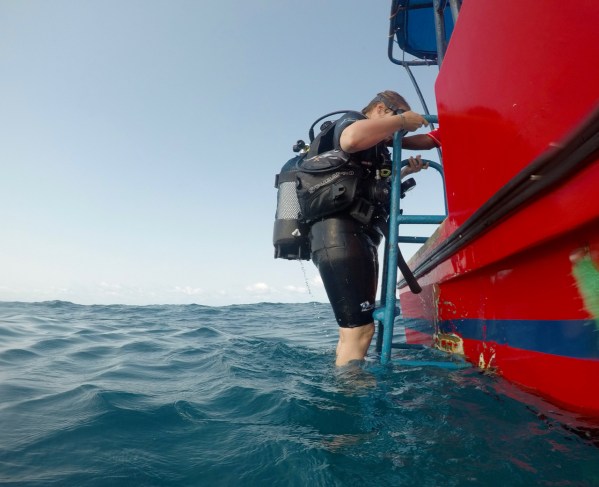 (Paje, Zanzibar, Tanzania; August 2017)
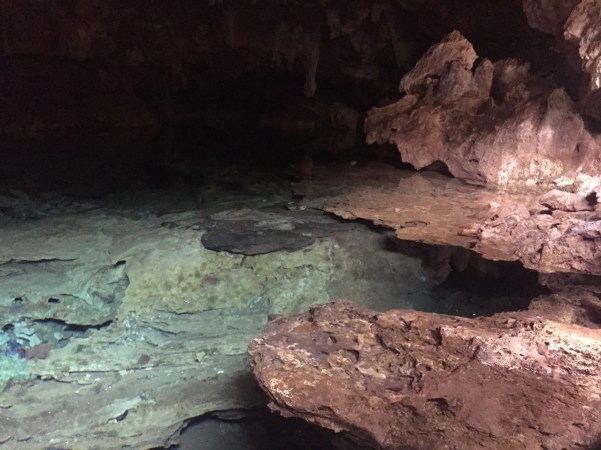 Underneath the surface, Zanzibar is a maze of coral rock caves. We stood on the beach near the Fukuchani ruins and felt the hollow ground shake beneath our feet: the waves crashed into subsurface holes in the coral rock. Oh the joy of baby fish, to play hide-and-seek in such a labyrinth!
 No regrets for a very expensive dinner at the Hilton DoubleTree, so I could use their fast wifi for photo and video transfer. It cost me 79,000 TSH, which is about four times the price of a low-end tourist dinner, and about sixteen times a village dinner. In euros it is only about 30€, though. Cost is more culturally bound in Africa than anywhere else I have been, including Southeast Asia.
 Sunbathers, cows, kids playing soccer, maasai touting safaris, others touting coconuts, and ladies fishing in colorful robes. This is the Africa I know, and expected but never encountered in Namibia. On the flipside, it is an odd shift to go in an instant from well-watered lawns and white-washed houses to bare concrete, trash on the ground, chickens running everywhere, and no imminent beauty in design. The people here live well it seems, but they just do not appreciate the same things we do.
 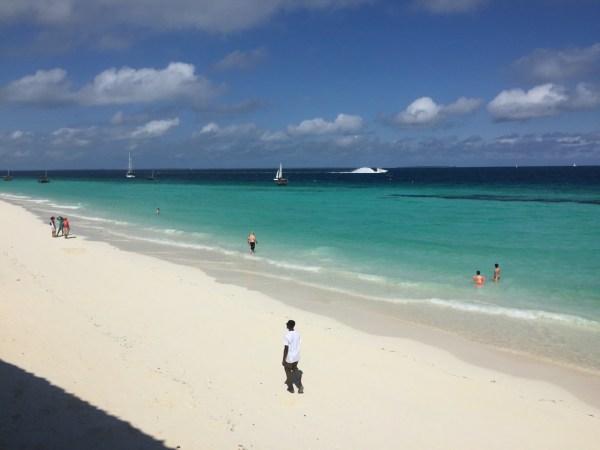 During the day, kids crowd the beach: boys, big and small, play soccer in the sand; while girls, already draped in hijabs, walk on the beach giggling. It seems that the fashion here is very tight jeans or leggings and a looser, flowing top plus a beautifully colored headscarf.
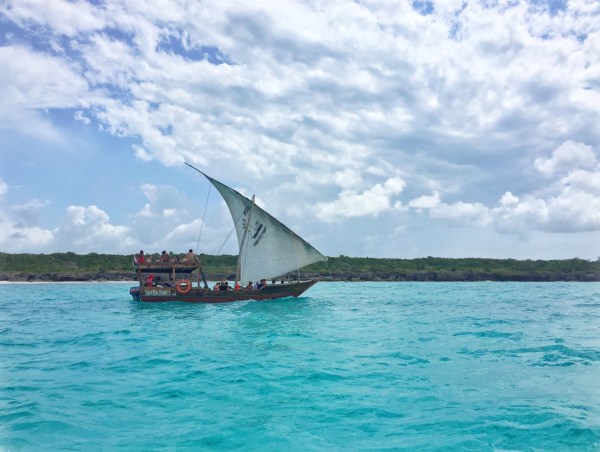 (Nungwi, Zanzibar, Tanzania; August 2017)
 Our boat was freshly made, out of mangowood. The finishing touch was given by a fire just the night before. Burning the surface with a hay fire made it more seaworthy. I was glad it floated.
 Our fisherman guide said he would not normally take his own daughters or wife out in the boat. It is not done. Women are considered to be too weak to manage the seas. He laughed when I said I pretty much grew up spending my summers on boats, home-made rafts, and other floaters. Local women do fish, but from the shore, wading in the water. Honoring the women, a boat may be named by other villagers after a man’s daughter. This boat was only proving to be seaworthy on this very voyage, so it had not yet earned a name.
 (Nungwi, Zanzibar, Tanzania; August 2017)
 The reef around Pemba island is in bad shape. I thought it was because of us tourists, but apparently the water has been unseasonably warm for too long. The fish were plentiful though – and so were the jellyfish! I felt many baby jellyfish sting me, and kept looking around for the grown ones but never saw any. Later I met a girl who had been stung so badly her entire skin was prickled red like a fit of hives. Holiday experiences can be rough.
 (Pemba Island, Zanzibar, Tanzania; August 2017)
 In Nungwi the location displayed in the iPhone weather app is “Indian Ocean”. How suitable. We really are on a bank of coral rock and beach sand the middle of the Indian Ocean. And it never gets cold at night.
 This blue marble