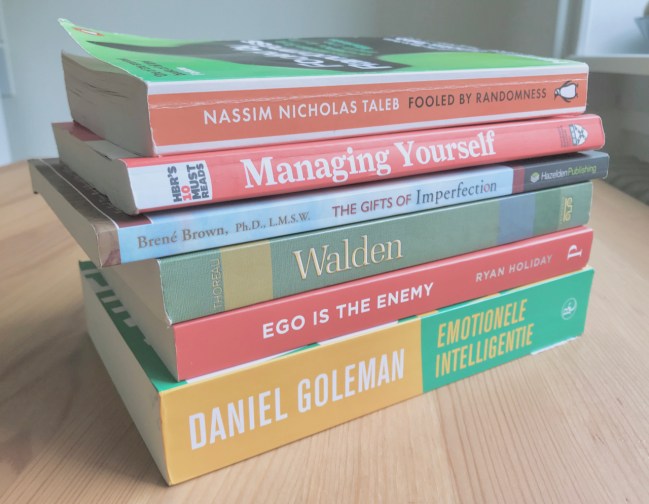
 Let’s talk about reading lists (I am assuming you are interested in books!). No, not the reading lists one is forced to survive through in school, but reading lists we choose to plow through. I chose to spend 10 years plowing through my previous reading list of 106 books of pretension. It was a major classics binge and worth at least 100 books out of the 106.
And so, last year I found myself in the luxury situation of compiling another reading list. What would be a good topic for a 30-something person to delve into? More classics? Books on naturalism? Meditation? Biographies? Or just some freaking great modern novels? What do we all do when we need an answer? We google.
I googled “books with wisdom”. I thought if I start now, I might just be able to improve how I live my life so that it would have a significant impact on the remaining half a century I (might) have ahead of me. And google did not fail. It pulled up three lists of three blogging individuals, which I have compiled into one long reading list called Books of Wisdom.
This is not my list. I intend to make my own once I am through these recommendations. Some of these, like Suzuki and Aurelius, will definitely be on that list. Others, like Kaufman and Pirsig, are not for me as much as they might be for you. I am nearly half-way through. Here, take a dive into the below. And come back for my own Books of Wisdom list in one or two years’ time.
Philosophy & meditation
- Brian Johnson – A Philosopher’s Notes
- Marcus Aurelius – Meditations
- Epictetus – Manual for living
- Henry David Thoreau – Walden
- Shunryu Suzuki – Zen Mind Beginners Mind
- Seneca – Letters from a Stoic
- JunPo Dennis Kelly Roshi – The Heart of Zen
- Ryan Holiday – Ego Is The Enemy
- Hugh Prather – Notes To Myself
- Alan Watts – Become What You Are
Mastering the body and mind
- Haruki Murakami – What I Talk About When I Talk About Running
- Danny Dreyer – Chi Running
- Gay Hendricks – Conscious Breathing
- Daniel Goleman – Emotional Intelligence
- Steven Levitt & Stephen Dubner – Think Like a Freak
- Ryan Holiday – The Obstacle is the Way
- George Leonard – Mastery
- Dan Ariely – Predictably Irrational
- Daniel Kahneman – Thinking Fast and Slow
- Malcolm Gladwell – Blink
Productivity & creativity
- Tim Ferriss – The 4-Hour Chef
- Josh Kaufman – The First 20 Hours
- Keith Johnstone – Impro: Improvisation and the Theatre
Business
- Harvard Business Review – 10 Must Reads on Managing Yourself
- Josh Kaufman – The Personal MBA
- Peter Drucker – The Effective Executive
- Mark H. McCormack – What They Don’t Teach You at Harvard Business School
- Ray Kroc – Grinding It Out
- Ray Dalio – Principles
- Jonathan Fields – Uncertainty
- Nassim Nicholas Taleb – Fooled by Randomness
Happiness psychology
- Dalai Lama – The Art of Happiness
- Sonja Lyubomirsky – The How of Happiness
- Brene Brown – The Gifts of Imperfection
- Karen Beaumont – I Like Myself!
- David Foster Wallace – This is Water
- Tal Ben Shahar – The Pursuit of Perfect
History, science, society
- Yuval Noah Harari – Sapiens: A Brief History of Humankind
- Will & Ariel Durant – The Lessons of History
- Ken Wilber – A Brief History of Everything
- Stephen Hawking – A Brief History of Time
- Neil Strauss – The Game
Novels
- Robert Pirsig – Zen and the Art of Motorcycle Maintenance
- Hermann Hesse – Siddhartha
- Richard Bach – Jonathan Livingston Seagull
- Robert Heinlein – Stranger in a Strange Land
- Paulo Coelho – The Alchemist
- Antoine de Saint Exupery – The Little Prince
Compiled from the lists of James Clear, Michael Balchan, and Darius Foroux.
(Brande, Denmark; May 2019)

 One random wing shot in my smartphone camera roll. I cannot remember where I was going, or where I came from. Helsinki, Copenhagen, Billund, London, Stockholm – could be any of them.
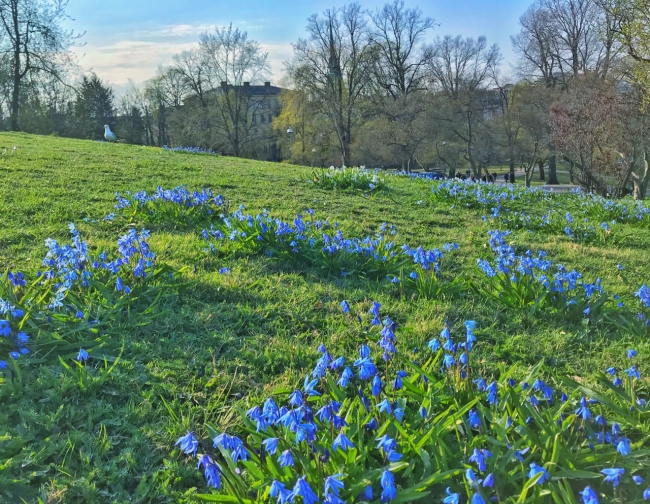 Spring in Helsinki means carpets of blue scilla. Someone must have started importing these plants from the Middle East and Caucasus, and now they claim their own space in every garden and park.
 In my hotel room there is an old aerial map of the London docklands, the way they were when the Port of London was the largest port in the entire world. The Thames river winds across the land, out to the sea, and Londoners built basins between the zigzags of the river. In the late 19th century dozens of docks, basins, and ponds created a mosaic map with exotic names such as Lavender Dock, East India Dock, and Canada Pond.
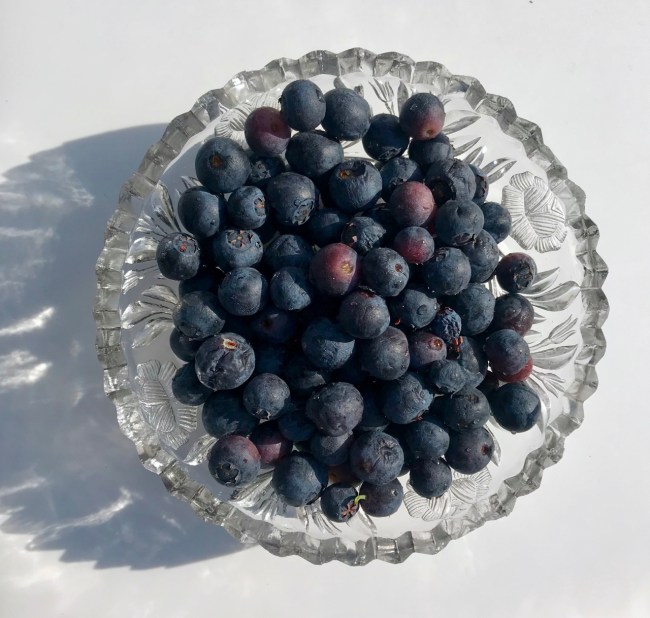 Blueberries and bilberries are the same, right? Wrong. Blueberries found in our European supermarkets all-year round are cultivated highbush blueberries, juicy and light or green inside. The blue berries found in the Northern European forests are bilberries. These are the ones that stain your fingers and tongue when you eat them straight from the bush.
 As I stood by the DUMBO waterfront I tried to calculate how many people these huge boxy buildings on the opposite shore would contain, any given moment in time. This is the Manhattan skyline as as we know it. “As WE know it”. Because really, just 150 years ago it was like any old town. And just 500 years ago, when Europe was restless because of religious reformations against the Catholic church and Shakespeare wrote his famous plays, Manhattan was mostly swampland. With mosquitoes.
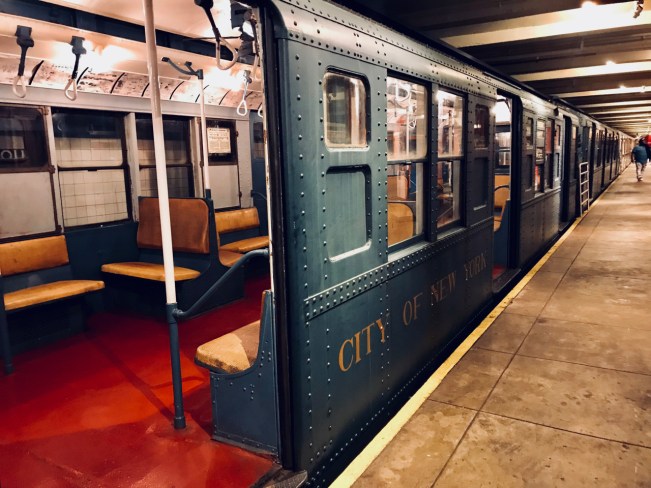 When learning about a foreign city, one can go to history museums. Or art museums. Or the more random museums, like the New York transport museum, hosted in an old unused subway station. And learn how, long ago, subway trains had nearly stylish rattan imitation seats.
 The most interesting detail of the Transport Museum is the advertising on the walls of old train cars. Much of it is from WWII, and the strangest references were made to the war. It is also a reminder of how the government raised its own citizens’ money to fight a war outside of US turf by issuing war bonds yielding less than the market rate of other reasonable investments.
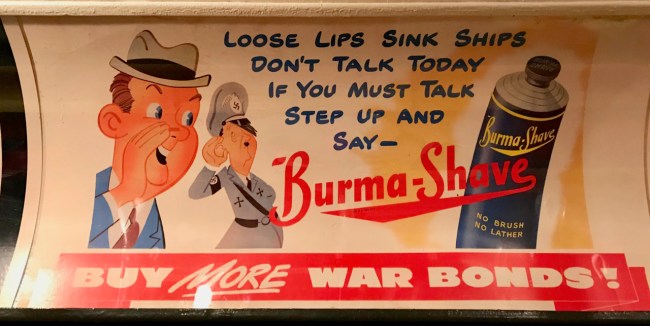 (NYC Transport Museum, Brooklyn, NYC, USA; April 2019)
 There are photos of the Brooklyn bridge. And then there are photos of people taking photos of the Brooklyn bridge. Same goes for DUMBO beach and the Manhattan skyline. Some heavy cropping was required to weed out tourists in red and orange jackets, absolutely not suitable for being in the frame.
 (Brooklyn, USA; April 2019)
 Brownstone buildings, quiet streets, tiny low-fenced gardens with wisterias and greens just like in small European towns, and people playing soccer in the park. Brooklyn is more like Europe than any other American place I have visited. And yet it is just a bridge away from the most American of them all: Manhattan.
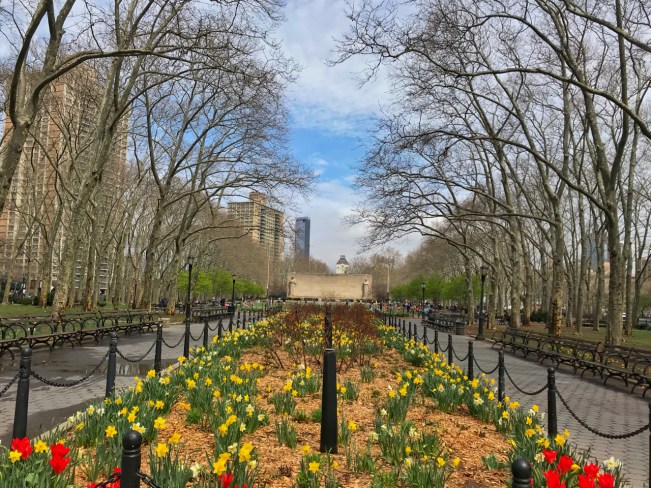 But here, among the tulips and the hipster cafés and people walking dogs, I forget I am in the USA. If only for a brief while. Brooklyn, as an old Dutch colony, even still has a Dutch slogan on its city arms.
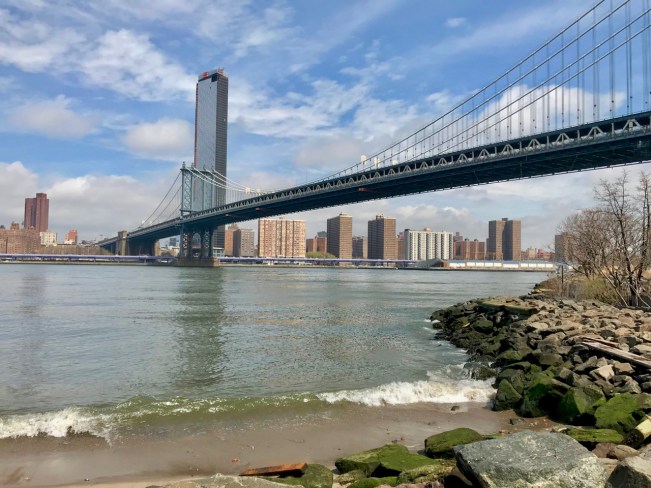 (Brooklyn, NYC, USA; April 2019)

 This blue marble