
 In places the Benguela current is like a thick soup, with swirls of orange or yellow plankton. There are patches with 5 jellyfish per square meter, just as far down as one can see from the boat. And lots of live jellyfish mean lots of dead, stranded jellyfish. Everywhere. Every day. People slip on them on the boardwalk like on banana peels.
Today, the following question harassed my mind: if a blue whale eats 4 tons of krill per day, how many shrimps is that? Our team did some quick calculations and arrived at the following answer: 40 million krill lose their lives every day so that one blue whale can get its belly full. That is more than the population of the Nordics combined. Actually, it is 8 times the population of Finland. All in 2 big feeds, if the whale is lucky.
Krill apparently live up to 10 years of age, with an average lifespan of 6 years. Say that the average age of the krill population swallowed by a whale is 4 years, corrected for any young (unfortunate) krill. That means that during one day, a single blue whale obliterates 160 million life years. That is a whole lot of life experience lost. Even if it is only the life experience of a lowly krill.
(Walvis Bay, Namibia; June 2017)
 Walvis Bay on a Sunday is like an American suburb, except for the desert all around: the streets are empty, with wide avenues and watered lawns, and no white people walking anywhere. The houses are neat, modern, and boxy; and all are fenced off with cameras and security guards. Cars are mostly white (yes, but why?); and new, apparently because everything rusts quickly due to the fog rolling in from the sea.
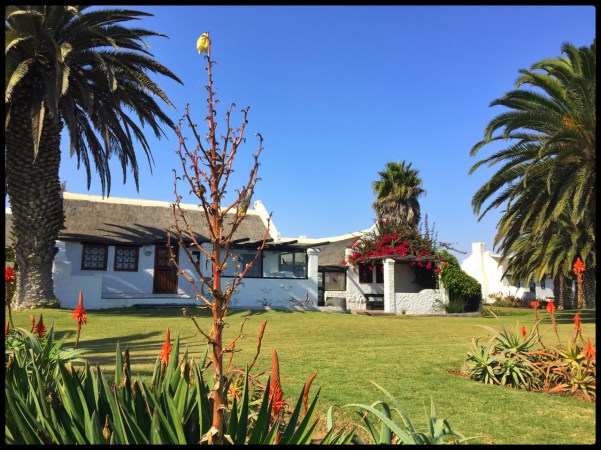 Our house is part of a beautiful, lush compound right by the lagoon. It is locked from the street but open from the lagoon side, via a little picket fence gate. Our house is installed with alarms due to burglars in the past. We are not allowed to bring our laptops into the back yard, lest they be seen and desired. We have been advised to hide our valuables in several places, preferably more creative ones like under the mattress or a pile of clothes in the wardrobe. And we pull the curtains down when we leave.
 (Walvis Bay, Namibia; June 2017)
 Back on a boat – and with dolphins. This time with bottlenose and Heaviside’s dolphins, in the cold plankton and jellyfish soup that is the Benguela current. Walvis Bay has a large industrial port, which means dolphins often zigzag between ships and oil platforms. And we, too, alongside of them.
 (Walvis Bay, Namibia; June 2017)
 Hello from the Atlantic coast, but quite much further down than usual. I am still experiencing a reverse culture shock: where is the Africa I know? Was it all ordered up by the German colonialists? Everything simply works. The only confusion so far has been withdrawing money from the ATM: instead of Namibian dollars I got South African rands. Turns out it does not really matter here. How odd.
 In confusion, in Windhoek. Why is everything spotless, scrap-less, in straight angles, and surrounded by watered lawns? Where are the scooters, the rusty cars, the peddlers, the fruit stalls, the people living their lives on the streets; and the smells and the noise?
 From above, the Kalahari desert looks positively negatively habitable. This is not a place to run out of fuel or water on one of those spindly, straight roads. Unless one is an oryx and can live for weeks on desert shrubs and the abstract idea of water and shade.
 (Above Namibia; June 2017)
 “Just sit”, the late meditation teacher Michael Stone used to say. “Just sit, once a day, every day. That is all it takes”. But what if there are early morning flights? I am not good at sitting at 4.30 am. And what if when I get home and sit, the cats sit all over me – or alternatively break into mutiny on the other side of the door? What if, when I finally sit, I almost fall asleep? There are days when just sitting is fine. And then there are those other kind of days.
 This is what we in Finland call a “nightless night”. 10.45 in pm in mid-June, and getting lighter still, until the old pagan festival of midsummer in the third weekend of June which falls on or a few days from summer solstice. In Helsinki, the sun sets at 11 pm and rises again at 4 am. In the northern one-third of Finland it never sets until later in the summer.
 The Brits are invading. With Red Arrows. Shooting…um…. arrows.
 Madame Cassandra, 13 years and counting. She has left a piece of her right earlobe somewhere along the path of life. It is a mystery.
 This blue marble