
 Dear guesthouse, thank you for proving yourself earthquake-worthy. Dear Canggu beach, thank you for no tsunami. Dear Bali, thank you for softening the shockwaves shooting off your sister island. We had a proper scare here on West Bali, but it was nothing compared to those in Ubud and on the East Coast. Not to mention the unfortunate ones on Lombok and Gili Islands, who bore the main burden of our planet rearranging its scales.
After less than five hours of sleep (fully dressed, the door to my apartment unlocked and key in lock) I gave up on the idea of rising with the sun to go to mysore class at 7 am. Instead I chased slumber for another hour and a half, when I began to feel I have an earthquake in my head: surely the bed and my hands holding my iPhone were not shaking. Ridiculous, I told myself, and got up. It turned out to be yet another aftershock all the way from Lombok, over 12 hours after the primary quake.
Nothing broke here in Canggu but locals thought the quake was bigger than anything felt on Bali in the past 13-15 years. Yet by 10 pm last night, two hours after the primary quake, the bars were booming with music and people again. This morning the shops were open like no window glass would ever shatter. Surf school was on, like no tsunami warning ever was last night. And people lived on, like nearly a hundred people never died last night on Lombok.
It is not our adaptability that is our greatest salvation; it is our short memory and our quick ignorance of danger that passed. Unless we witness true direct horror and trauma, it is as if our minds are like those of children: we forget so quickly and go about playing again. Or sleeping. Or doing what we always do. Perhaps this is how we stay alive: not remembering all the dangers that might occur? Especially, if one lives on the Ring of Fire, with a handful of moderate earthquakes felt every year.
I truly hope those who lost their loved ones and their houses on Lombok will be remembered long enough to be helped on their feet again.
 (Canggu, Bali, Indonesia; August 2018)

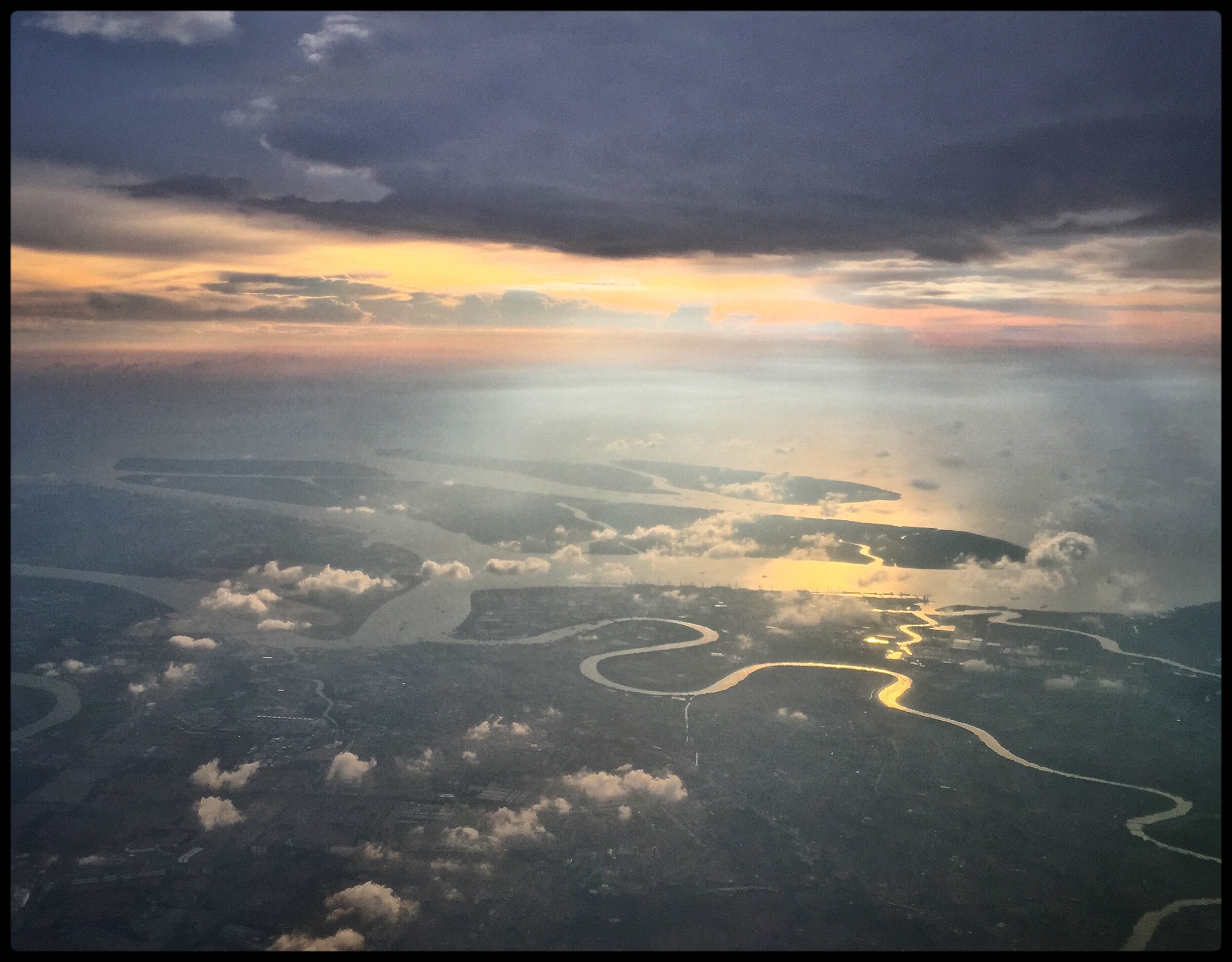

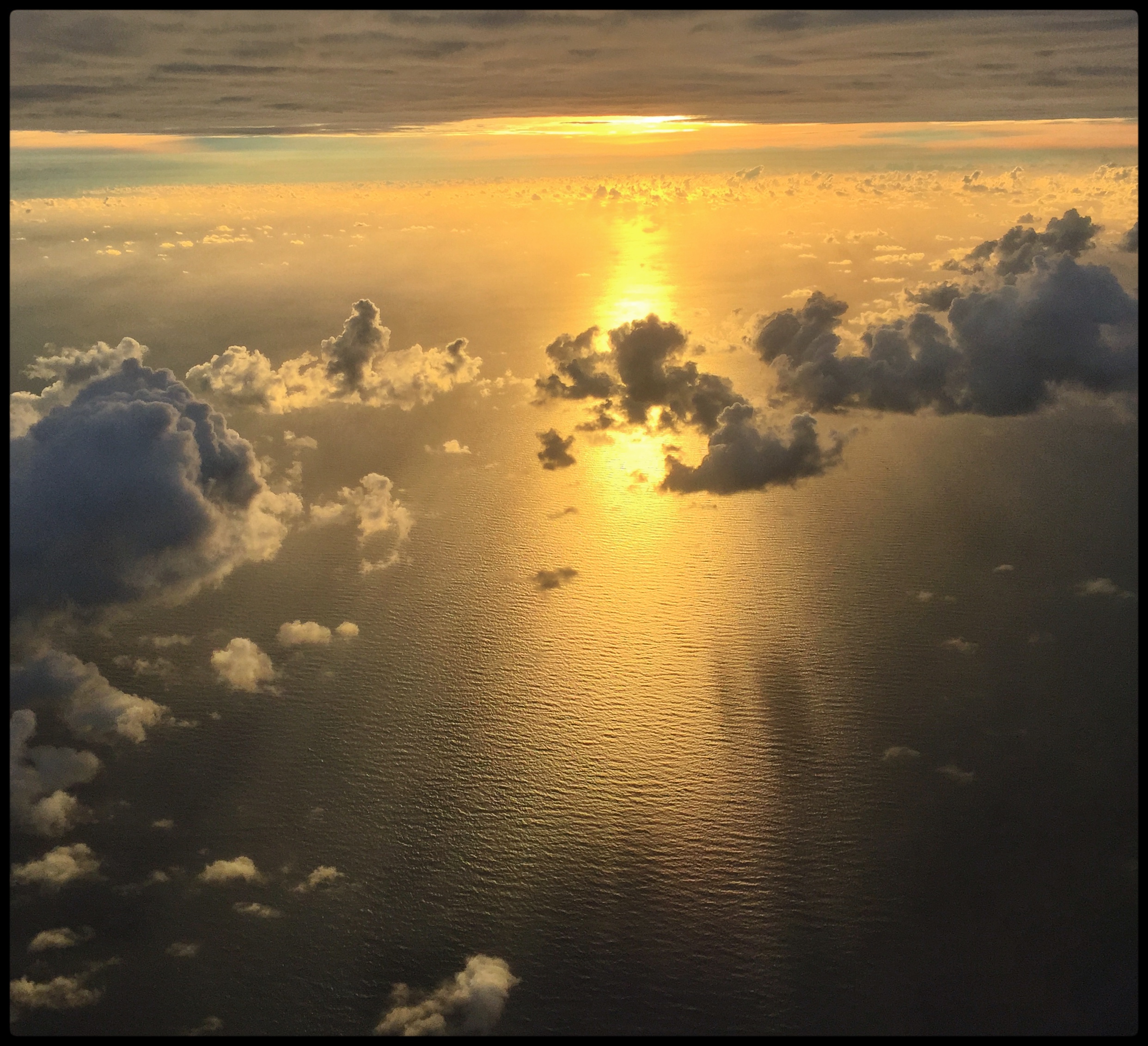
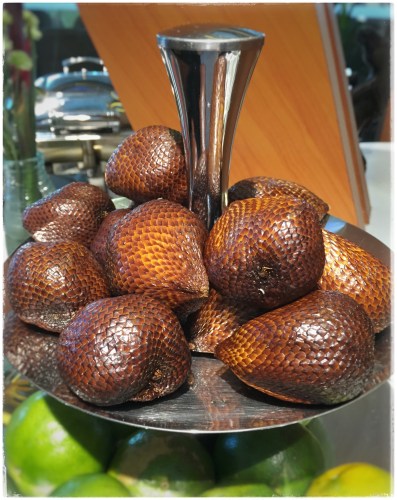 One more snake fruit before I board a plane and fly off this little lovely island. Everybody in this premier lounge is nicely dressed and carrying suitcases – and I came stomping in with a backpack, an old plastic bag, harem pants, and sandals. I have the highest elite tier of my airline alliance but right now I think my appearance here is a good joke.
 6 pm and the sun has disappeared into the jungle. The night cicadas have relieved their afternoon colleagues from the concert shift. While I sit in a luxurious open-air lounge, sipping on my sunset drink, I cannot help but feel something I can only describe as “colonial”. We arrived here from busy Ubud where we stayed at a little homestay B&B, rode around on motorbikes with locals, and ate simple food for about one quarter of the prices here. But “here” is a resort in the cool woods, where 4 bellboys fussed about our arrival and luggage, whisked us onto couches for welcome drinks and registration, and then showed us the way down to the spa – using an elevator in the jungle.
 I cannot help but wonder what the Balinese think of this ridiculous opulence. Indonesia gained its independence from the Netherlands in the 1940s, right after World War II. I understand that here it is difficult for a resident foreigner to own anything; everything has to be held in the name of a Balinese partner. It makes much sense. With the invasion of the Westerners who, like me, fall in love with Bali and want to stay, they would quickly outnumber the Balinese themselves and their capital, in practice reversing the sovereignty of the Balinese and their claim on their island and administration.
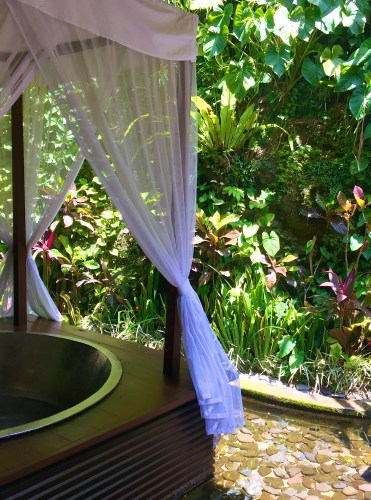 (Maya Ubud resort, Bali, Indonesia; September 2016)
 My yoga friend and I checked in to paradise. She is swimming lazily around in the infinity pool overlooking a river. The cicadas are playing, and the river, too. Swallows hunt for bugs between the trees in the sun. I might give the Balinese Jamu health tonic another chance to become a friend of mine.
 Yesterday night at a Tibetan bowl meditation session we conducted a heart-opening exercise, offering up all the pain and anxiety in us and replacing it with something positive. Letting the first thing that enters be acknowledged. I gathered all the hurt and the memories and the anxiety from every limb and vein and tried to push them out of my body if only for a second. From somewhere deep within me, the word that floated up to fill that vacuum space was “health”. Health of the body and of the mind. If the mind is ill, the body suffers, too. I realized I wanted to become healthy, in every possible way.
 Some time ago my body put a stop to both a beloved hobby as well as an activity my mind was pushing my body to do. I used to run 10-12 km every other day for years, until my knees literally told me to stop running, according to my ayurvedic doctor. I ran them out some time ago and needed surgery in one knee. No running anymore, possibly never.
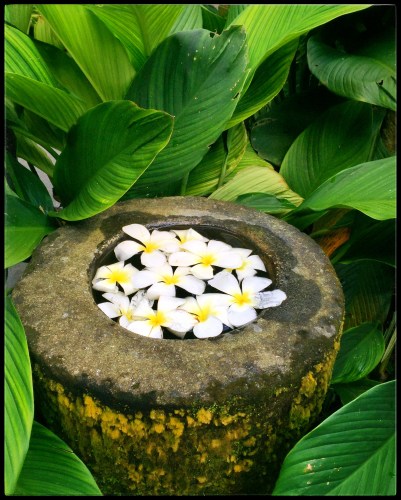 (Maya Ubud resort, Bali, Indonesia; September 2016)
 One hot day we decided enough is enough. Enough heat, enough dust, enough bustle. Two of us hopped into a taxi, and one of us dared a crazy scooter taxi ride out, all the way through the rice paddies and into the jungle. Because (and this is a secret), there is a little patch of heaven hidden in the jungle. Like this:
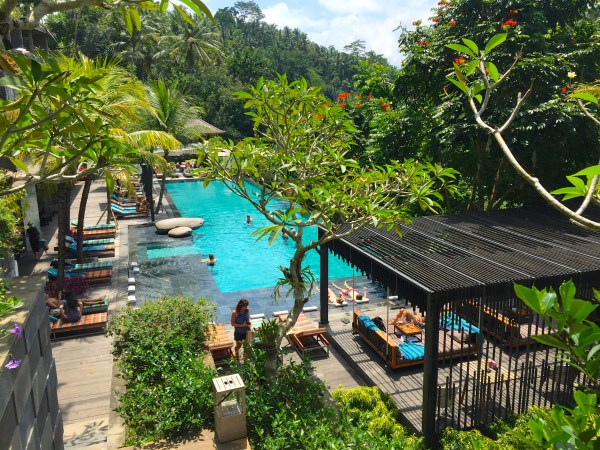 We threw ourselves down into a hanging bed – and to our delight they had sparkling wine on the menu. What a rare treat on Bali! And so were the lovely superfood salads. And so was the stretching and pummeling also called a “Balinese massage”.
  The fish swam in their little pond. We swam in our bigger pond, where the water spilled down over the edge, and the jungle crept close.
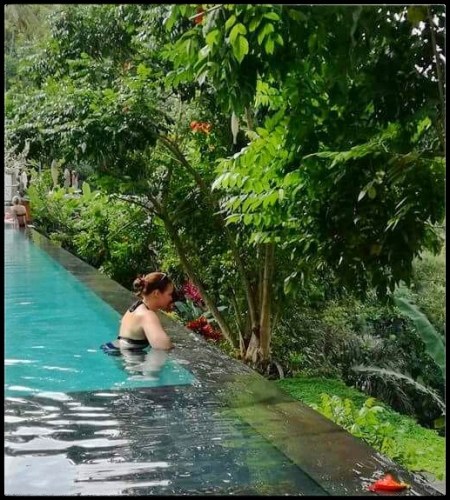 Not until sunset, when the lanterns in the trees were lit, did we get dressed and return to Ubud. And if you cannot muster the strength to leave this patch of heaven (we nearly didn’t), you can dine overlooking the jungle, and check into a room of your own. Yes please. Next time!
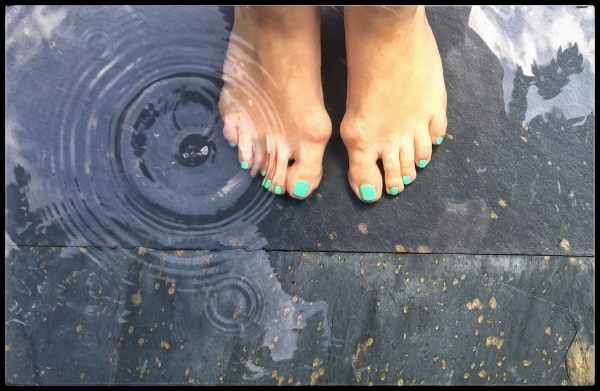 (Junglefish spa, Ubud, Bali, Indonesia; August 2016)
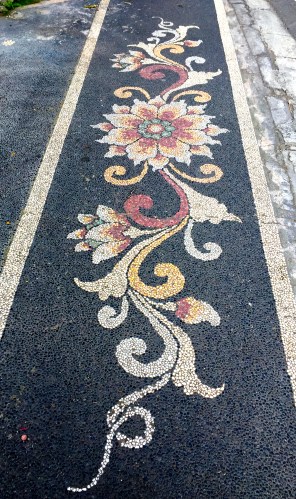 What a marvelous sense for beauty the Balinese have. Everything on Bali is beautiful, right down to the pavements. Why would anybody settle for boring asphalt or concrete, when one can scatter little flowers of beach pebbles here and there, or decorate one’s runway with an intricate flower mosaic pattern? Scandinavian simplicity my a**. I prefer flowers.
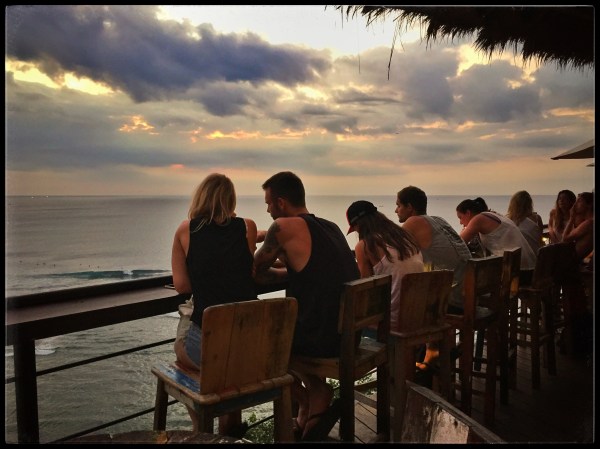 The Uluwatu beach community is built on the side of a rock: stairs crawling up and down, leading into little rural-style warungs serving simple dishes. Uluwatu is still just one inch on the backpacker/local-hangout side, if only for a few years to come.
 No surf today on one of the most legendary surf spots on this planet. When the tradewinds are right, I am told, one can keep on surfing in a seemingly endless, emerald-green pipe. It must be an experience of a lifetime.
 Today, Padang Padang beach was not for surfers but for children. And lazy sunbathers like us, sipping on coconuts and gnawing on freshly grilled corn cobs from the fire.
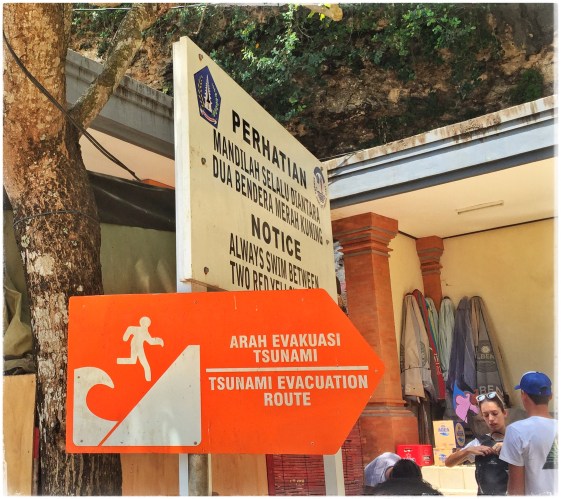 (Padang Padang, Bali, Indonesia; August 2016)
 After bustling Ubud, Uluwatu is silence, sea, and surfers. Hot, winding, dusty roads with bush and dry forest everywhere; a house here, a villa there. The air is steamy from the evaporating surf.
 The Uluwatu temple is one of the most sacred temples on Bali, alongside Pura Tanah Lot, the other temple ravaged by the sea and the wind.
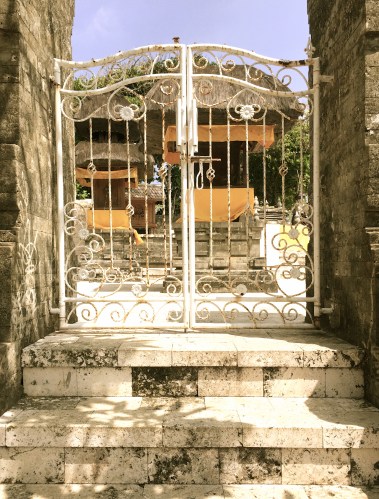 (Uluwatu, Bali, Indonesia; August 2016)
 This blue marble