
 It is a sobering reminder to have the text “DEATH for drug traffickers under Singapore law” written on my visitor pass. How ironic it is, then, that much of Singapore’s past is linked to hard drugs: opium trade between China and the British Empire.
As the British empire is credited as the founders of Singapore, and Britain became an empire to a large extent thanks to the cash flowing in from opium, much of Singapore’s colonial wealth and growth momentum could also be attributed to this highly addictive and devastating drug, flowing out from British India towards China, through Singapore’s harbors.
As I amble through the National Museum of Singapore, none of this is mentioned anywhere. Instead what I see are a few old opium pipes and a reproduction of an old awareness article painting the picture of what happens to a man and his family when he gets hooked on opium (spoiler: in the end he makes his wife work for him so he can buy more opium, and finally he dies leaving his wife without a legal guardian). What is mentioned is that Thomas Stamford Raffles, one of the two credited founders of Singapore, was against gambling and addition, and evicted his British co-founder who was into these decadent activities. The Brits seem to politely be hailed as patrons of Singapore.
The National Museum does have one exhibition that highly contrasts against the politeness of Singaporean culture: one covering the Japanese invasion during 1942-45. It leaves no sense of ambiguity and starkly accuses Japan of ethnocide of any “anti-Japanese” Chinese, as well as an attempt at annihilating local culture. The exhibition explains that the Japanese vision was to wipe out all other languages and to instil a uniform national identity. When children were required to learn and to speak Japanese in school, many parents refused to send their children to school. When the older adult generation was required to learn Japanese for work, they chose to stay at home if they could. Those who spoke the language received incentives and benefits, but the above combined with the degree of difficulty in learning Japanese made the attempt of introducing culture via language a failure.
Three years seems like a short while, but my impression from the exhibition is that it was a difficult and dark time. The proper building of modern Singapore began in the 1950s-60s, with a positive outlook after the people had decided they did not want to be part of Malaysia. Indeed, in the 60s there was an attempt at merging little Singapore with its larger neighbor, but people objected and the merger was short-lived. It must have been a brave decision to try to survive on one’s own, geographically sandwiched between Indonesia and the West, and Malaysia to the North and Northeast. But what must have been a very thought-through economical growth strategy worked, as Singapore is now considered a prime economy in all of Southeast Asia.
Opium trade, why would anyone think of such ancient times anyway?
(Singapore; July 2018)
 Perhaps once this was a busy street, crowded with horse-drawn carriages, pedestrians in fine suits and long dresses, and dogs and children running around? Now it is simply quiet and idyllic, with greens shooting up between the cobblestones that get to rest most of the day.
 Jean Cocteau sure did love the Riviera. His self-portrait is on the Muretto wall by in Alassio, and he self-handedly painted an entire fishers’ chapel interior in Villefranche-sur-Mer.
 (Alassio, Italy; July 2018)
 Dear old wisteria, how old are you? How were you brought to the rooftop of the palazzo Doria Tursi on via Garibaldi? Were you a sight to be seen, covered in periwinkle flowers? Were you the centerpiece of a pre-dinner cocktail gathering? How many kisses stolen and promises of love fervently whispered have you hidden underneath your branches?
 Why are painted renaissance naked newborns always boys? And why do they actually look more like old men than boys? Also, why do the women never look like they are in full possession of their wits? Thoughts as we tour the palazzos of via Garibaldi…
 No, this is not the Versailles. This is not even in France. The Italian aristocrats knew how to build palazzos, too. And in Genoa they built an entire street of palazzos. Imagine it as any other neighborhood: families living next-door to each other – except for instead of a house or an apartment each would have a gilded castle to themselves, complete with rooftop gardens large enough to serve cocktail parties and balls.
  And while we are imagining: what must it have been like to know that any given night there was some dinner or ball attracting dozens of carriages into the tiny street? Oh the hubbub. And oh the shame, if one was not invited.
 (Genoa, Italy; July 2018)
 Once upon a time, a young crown prince went salmon fishing by a whitewater surrounded by scraggly old pines and water-polished rocks. He discovered he could wade between a number of little islets, surrounded by foamy flying currents and leaping salmon. After just a day he and his princess were in love with the rugged place, one that was Nature’s own and nobody else’s.
  Years later, the crown prince returned, now as the Emperor of Russia. He rediscovered his love for the wilderness and said, “let us build a house for us. Let it be a simple, wooden fishing cottage. Let it be a Finnish house on Finnish grand duchy soil, for the Russian emperor to be.”
 And so the house was built as were the wishes of the crown prince. It was simple but of skilled making, and out of the best materials. There was a kitchen – and to the horror of the staff, the Empress Maria Feodorovna cooked in the kitchen with her own bare white hands. There were beds upstairs – but whether anybody slept in them overnight is not known, as the Emperor’s fleet was moored right beyond the last bend of the river, by the coast. The Emperor is rumored to have chopped his own firewood – also quite unheard of. But then again, who would hear or care? Such things are what hideaways are for. Even for the greatest of royalty.
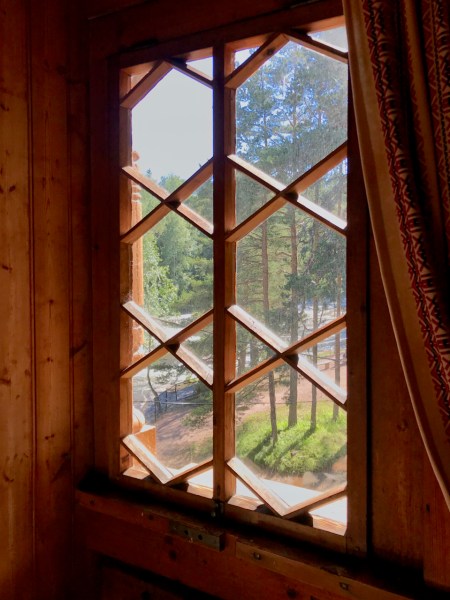 (Langinkoski, Kotka, Finland; June 2018)
 The long, wooden house stood by itself in an overgrown meadow of high grass and flowers, shyly exhibiting brand new walls painted red, sparkling white corner posts, and a sturdy, new roof. Why shyly? Because its exterior was nearly 300 years younger than its timber construction. It is not with complete comfort that one bears new clothes after loving one’s only outfit for centuries.
 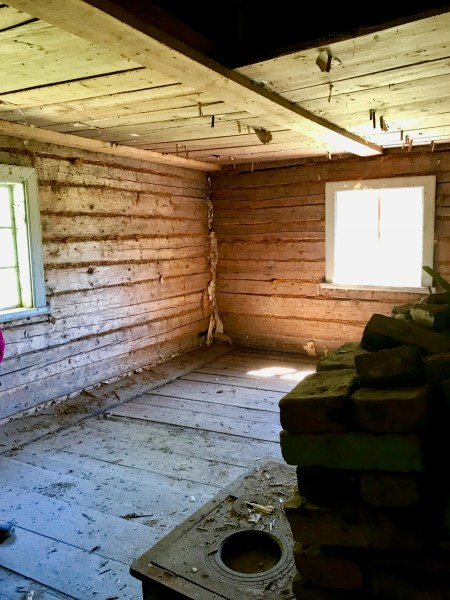 My great-grandfather and great-grand uncle were born in this house. They were not born in this meadow though. Before the house was dressed in new clothes, it was dismantled, every log and plank numbered, carried a few dozen kilometers further, and built up again from scratch. Why? Because someone thought it was a valuable piece of history and should be kept under a watchful eye.
 (Pernaja, Finland; June 2018)
 I never saw the famous World Trade Center Twin Towers, except for in photos. They defined the lower Manhattan skyline – until the day they didn’t. I first visited Ground Zero in 2008. It was one big hole, part concrete and soil and part construction crews. Visitors were lead around on boardwalks and held back by ropes. There were only a few smartphones and certainly no selfies or selfie-sticks. The atmosphere was somber, even if the attack on the twin towers was seven years in the past.
 (9/11 Memorial Plaza, New York City, USA; May 2018)
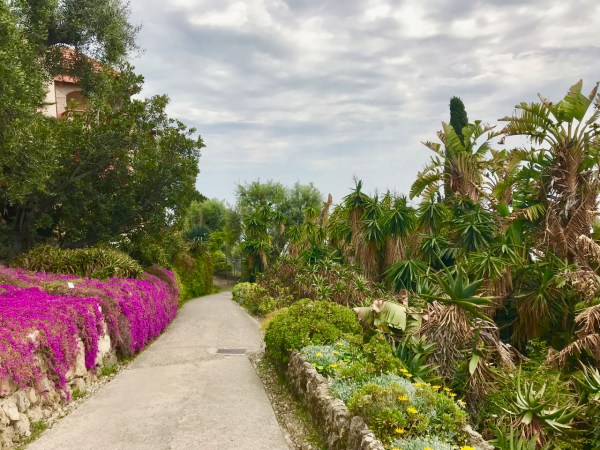 When one is 35 years old and wishes to establish oneself, one can either join the entertaining society or one can entertain oneself by building a fine garden from scratch. In this garden it is not enough for the visitor to love flowers to see them; here one must climb down a height difference of 100 meters to see the end of the garden by the ocean – and another 100 m up again to exit by the gate. When deciding to establish themselves, Sir Thomas Hanbury and his brother Daniel did not choose a garden site with step-free access.
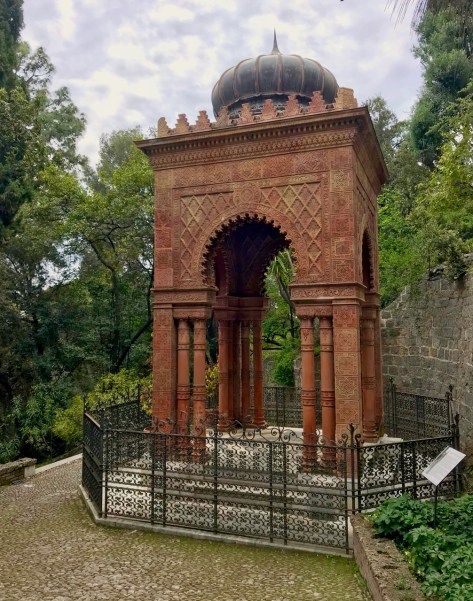 To compensate for the viewer’s labors, in the late 19th century the La Mortola garden was one of the most famous gardens in the world: nearly 6,000 different plants; many exotic and brought home from Asia by Sir Thomas himself.
 (La Mortola, Italy; April 2018)
 This blue marble