
 The Cro-Magnon people of Europe drew mammoths, deer, and moose. The San people of Africa made giraffes, oryxes, and wildebeest. Both depict hunts, hunted animals, and the styles are quite similar. If you look closely you can even see an animal with double sets of legs, like the one at Lascaux which is suspected to be like an animation of a walking animal when properly flashed with light. The Cro-Magnon people drew shamanic apparitions, as did the San people: if you look closely at the Twyfelfontein rock painting site you can find a lion with a deer-like animal in its jaws. The lion has a long, angled tail, with a pawprint at the end. As if from a trance dream.
The rock drawings of Twyfelfontein are similar to the ones in Lascaux. We people share a universal, collective mind, regardless of where in the world we live. Which drawings are older? The San people who drew the Twyfelfontein paintings are said to be the oldest original people of Africa, but these drawings are only about 2,000-6,000 years old; while the paintings in the Lascaux caves have survived 17,000 years. The oldest known rock art, in Indonesia, is dated 40,000 years back in time. On the one hand, the Twyfelfontein art is much younger. On the other hand, the Cro-Magnon people seem to have stopped making rock paintings some 10,000 years ago, while the San people did it until they were banished to the nearly rock-less Kalahari desert when farming became popular after Namibian independence.
Living prehistoric culture is unfortunately very easy to kill.
(Twyfelfontein, Namibia; July 2017)
 Three ladies and a monster Land Cruiser. Four-wheel driven, stick shift, and to be driven on the left side of the road. Requires two people to get it into reverse gear. With two (in principle) pop-up tents on the roof, which in practice require two tall, strong people to pop them up or fold them down – or three ladies climbing all over the car for 15 minutes to do the same job.
 (Namibia; July 2017)
 Last night at Walvis Bay. After one month I still have trouble with how strong the segregation is here. Last Friday we went to a bar and talked to the black bartender we knew. We wanted to go clubbing for once, and thought it was a great idea that he’d come with us to show us the local nightlife hotspots. But most of our team wanted to be within walking distance of the house (on the “white” side of town, mind you), and so the vote fell on another bar in the marina. Our bartender was very sorry but could not join us as he would not have felt welcome in that bar.
 How to have fresh mussels on the beach: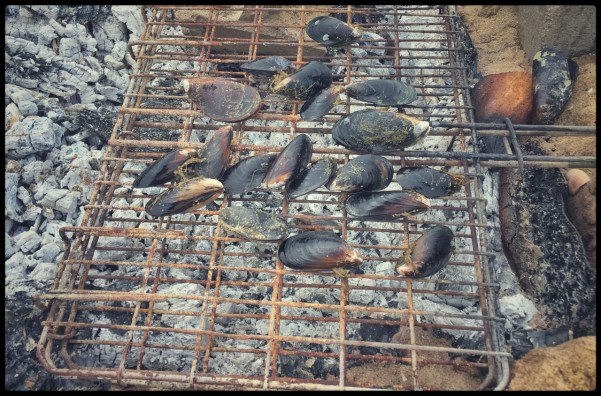
 (Pelican Point, Walvis Bay, Namibia; July 2017)
 For a month we’ve been cruising around and past Pelican Point, viewing the desolate, 10 km long sand bank with its millions of noisy seals from the sea. Today we off-roaded through it, all the way to the seals at the northernmost tip. 2 cars, 12 people, 1 kayak, and lots of food for a beach barbecue.
  We could naturally not do a beach outing without gathering some data, too. The kayak was brought along not just for fun, but also to record Cape fur seal sounds. The seals often move with the dolphins when feeding, and so it is good to understand the noises they make. Two from our team also snuck up on the seal mothers and their pups in the nursery on land, crawling as close as they possibly could, and leaving a SoundTrap behind.
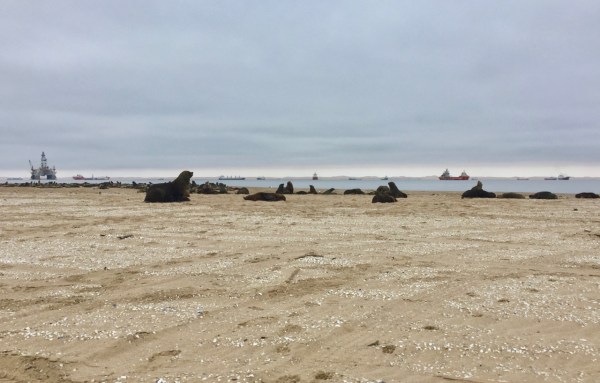 I crawled close to the seals, too, just to watch. On all fours, we three people ultimately got about 10 meters from the “gentlemen’s club” of male seals, lying away from the big group of mothers and pups. The furry, almost shaggy large males sat proudly with their noses in the air, as if they owned the world. And from their point of view, they probably did.
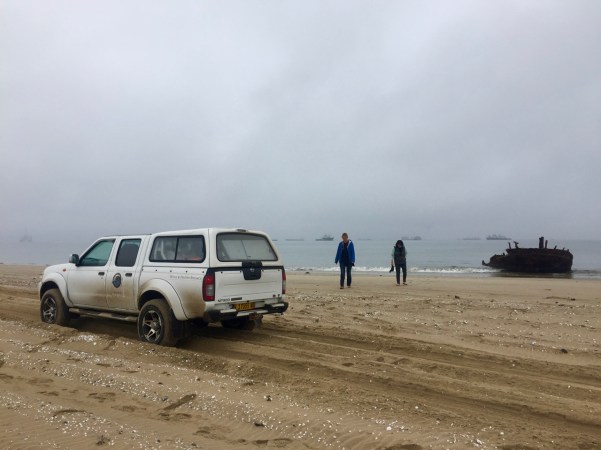 The seals and the jackals inhabit a long, lonely stretch of the world. If the wind picks up, there is no way for the jackals to go except for to trot ten kilometers back towards mainland. Or to burrow themselves down into the 4WD tracks. Because this is Namibia and it is full of desolate places.
 (Pelican Point, Walvis Bay, Namibia; July 2017)
 Dinner time, both for us and for the fish. The lucky wish were hand-fed squid fillets, by scuba divers. Except for the one scuba diver who was mainly filming with his GoPro, never-minding the poor starving fish.
 (Swakopmund, Namibia; July 2017)
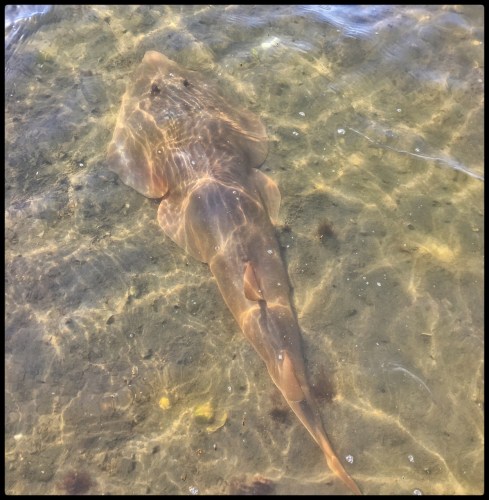 These weird things hang around in the lagoon. Why they are called guitarfish is kind of evident, at least with a little imagination. Although this individual was quite slim.
 The team tried – and missed. A few times. Soon the dolphins removed themselves from an understandably unpleasant situation. It was impossible to work with them anymore, neither by shooting arrows at them nor shooting cameras at them. The team obviously got what they deserved. I heard most of that day was spent playing with the cape fur seals and a GoPro and a SoundTrap, both submerged underwater for the seals to have fun with.
 After a good hour and a half we, too, got the feeling that the dolphins did not want us around anymore. Like an unpopular kid at school, we noticed that they always moved a little distance away from us and resumed their behavior. It was pretty clear we had fallen from their graces, so we paddled home.
 (Walvis Bay, Namibia; July 2017)
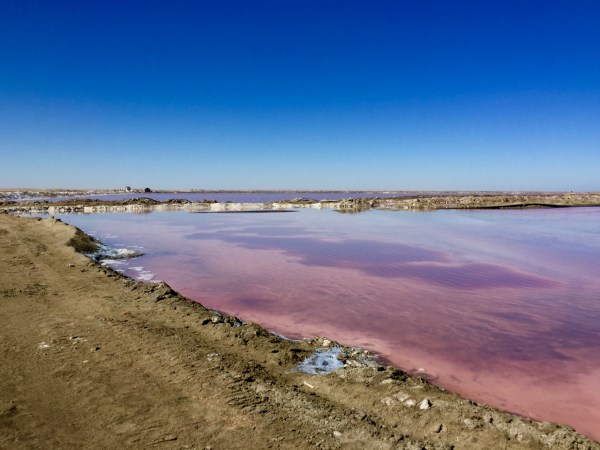 Pink “Himalayan salt” is sometimes Namibian salt, from Walvis Bay. In my understanding this is rock salt, not sea salt, and it is the color of algae (not Himalaya) that gives it a bright pink color. Some of the salt pans were a deep purple.
 2,500 avocets, 1,500 sandpipers, 3,000 flamingos, and several hundred stilts. In just our little section. I did not get the final tally for the entire lagoon and surrounding saltworks. Just take my word for that there were A LOT of birds. And so, why not spend my Saturday off counting birds with a lovely bunch of bird lovers?
 This blue marble