
 And there it was: another of those unbelievably bright, long-lived shooting stars above the desert. The night skies over Namibia are remarkable. During a night drive between Windhoek city and airport one is bound to see at least two shooting stars. It is not because they are more common here, but because there is barely any light pollution, clouds, or humidity in the sky between us and the universe.
The first time in my life I truly saw (and paid attention to) the Milky Way was in a tiny village on the Kenyan coast. It seemed to me as a string of cloud and stars in the sky. But here in Namibia I have seen the Milky way in an entirely new resolution: as swirls of uneven, nebulous patches of light and dark. Here in Namibia it is possible to view other galaxies with the naked eye.
The sky is so densely speckled that I have to get used to the thought that this is what the night sky, anywhere on the planet, REALLY looks like. My perception of a sky full of stars has lacked about half of what my ancestors saw, before the invention of electricity. In fact, if anybody asked me to imagine a night sky, in my mind’s eye it would look completely different than if my ancestors were asked to do the same thing.
It saddens me to think that one needs to go to Africa or the deepest central Asia to see what the sky really looks like. My generation and further, younger generations, will probably not even know what the sky and space beyond really looks like. What was normal to my ancestors will be lost to them. Just like an extinct animal species.
Photo borrowed from Florian Breuer’s blog. Apologies Florian for the steal but there is no way I would have been able to photograph the amazing Namibian night sky with the iPhone I was carrying.
(Namibia; July 2017)
 2,500 avocets, 1,500 sandpipers, 3,000 flamingos, and several hundred stilts. In just our little section. I did not get the final tally for the entire lagoon and surrounding saltworks. Just take my word for that there were A LOT of birds. And so, why not spend my Saturday off counting birds with a lovely bunch of bird lovers?
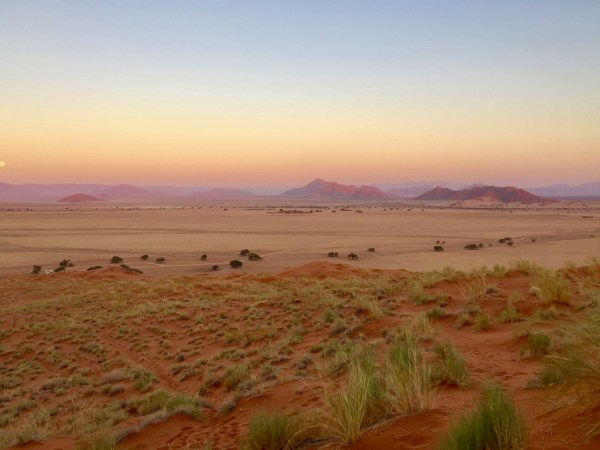 The colors of Sossusvlei and the Sesriem area at dusk and dawn are the colors of every Namibian travel guide. No, the photos of those guide books are not photoshopped: the colors are truly magical. The red and pink hues come from iron content in the sand.
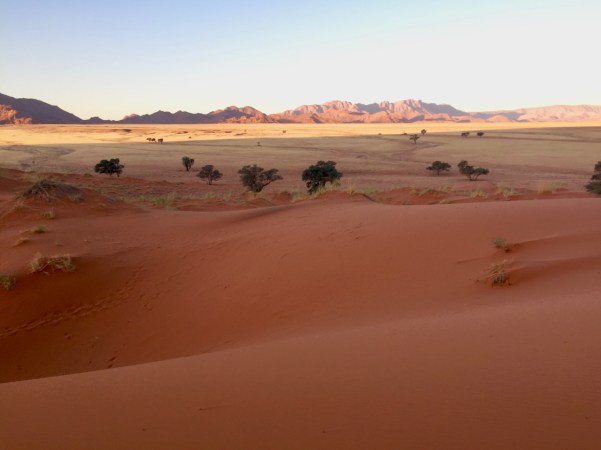 (Namib-Naukluft Park, Namibia; July 2017)
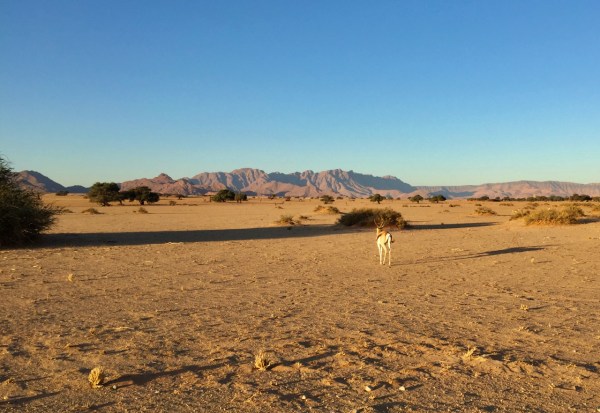 East winds are here again, blowing from the desert for a few days. In Walvis Bay we probably have 27 degrees Celsius on land, and we can feel the hot desert winds out at sea and witness the sand storm behind the dunes. The dunes have obtained a black rind that indicates a shadow: the wind has blown the edge of the dune over toward the sea.
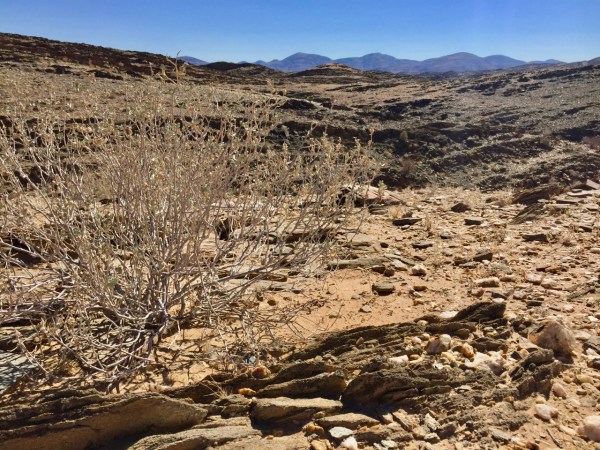 (Namib desert, Namibia; July 2017)
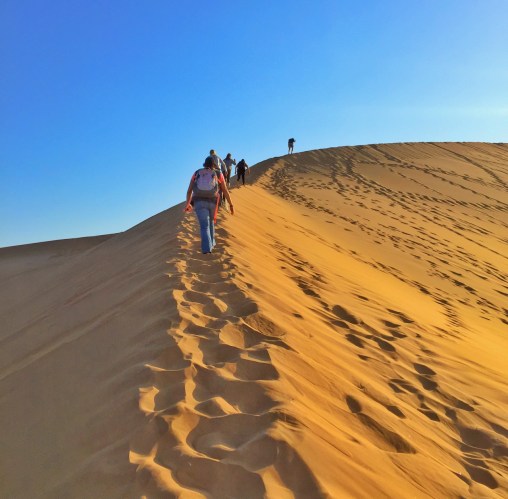 Today I was exposed to so much sand there will be sand in my belongings still one month after returning home. There is a row of dunes between Walvis Bay airport and the town. Dune 7 is the most famous one of them (why?), and does not migrate too much. It is meant to be climbed up and run or boarded down. Dune 7, like any dune, is best ascended barefoot, along the ridge. Descent happens really anywhere one prefers. It is a bizarre sight to see people, young and old, running down a 200 meter tall dune at an angle of 45 degrees without tumbling.
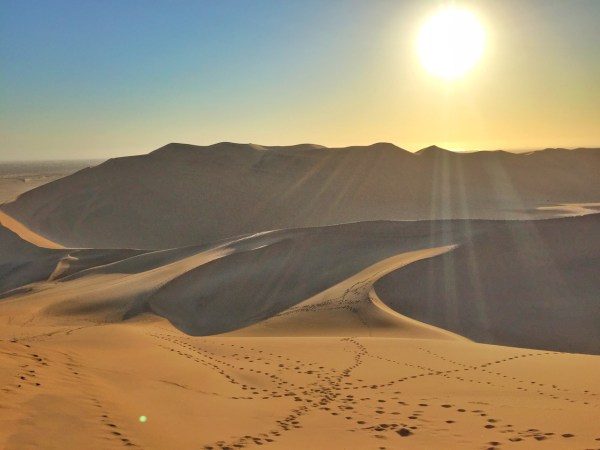 (Dune 7, Walvis Bay, Namibia; July 2017)
 There is an area in the Namib the locals call the Moon Landscape. It really does look like a moon landscape with soft craters and hills made of sand and soft-polished rock. If you scream here, it is highly likely that not a single living thing with ears will hear you.
 Most of Namibia is traditionally uninhabitable, and people have always flocked to the rivers and oases. Because the other choice is a desert with no water bordering on an ocean with too much water, and none of it potable.
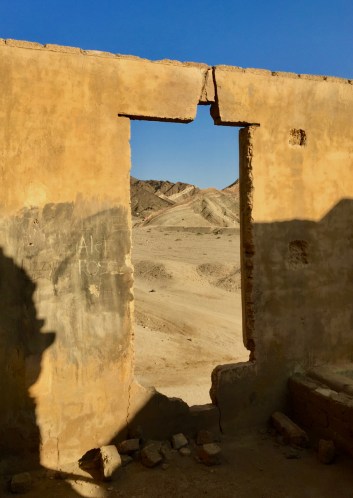 On our day drive we passed three jeeps in a junction in the middle of the wide-open desert. There were three families out on a Saturday drive, drinking beer and driving around the desert. This, and tailgate picnics, seems to be the best Saturday pastime for locals. It is as if the locals do not get enough of the hostile empty hot nothingness but actually embrace it. The human species truly is adaptable.
 (Namib desert, Namibia; July 2017)
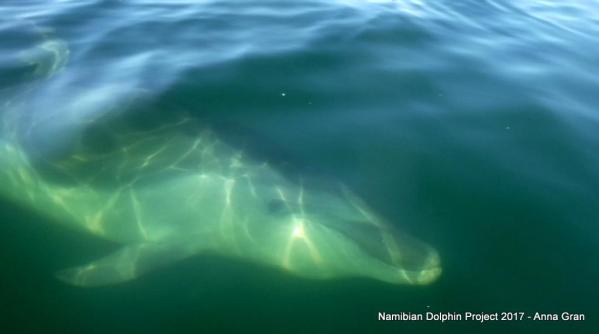
 In Walvis Bay one may not see dolphins for hours, but one is never alone. There is the Namibian Air Force, also known as great white pelicans….
 and cape fur seals, that steal joyrides on boats and ships of any size…
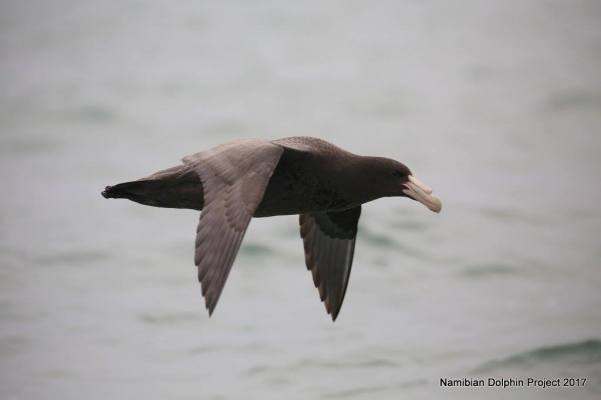 and giant petrels, and penguins. Yes, penguins. A swimming penguin looks like a drowning duck. I have no photos but please take my word for it.
 (Walvis Bay, Namibia; July 2017)
 In places the Benguela current is like a thick soup, with swirls of orange or yellow plankton. There are patches with 5 jellyfish per square meter, just as far down as one can see from the boat. And lots of live jellyfish mean lots of dead, stranded jellyfish. Everywhere. Every day. People slip on them on the boardwalk like on banana peels.
 Back on a boat – and with dolphins. This time with bottlenose and Heaviside’s dolphins, in the cold plankton and jellyfish soup that is the Benguela current. Walvis Bay has a large industrial port, which means dolphins often zigzag between ships and oil platforms. And we, too, alongside of them.
 (Walvis Bay, Namibia; June 2017)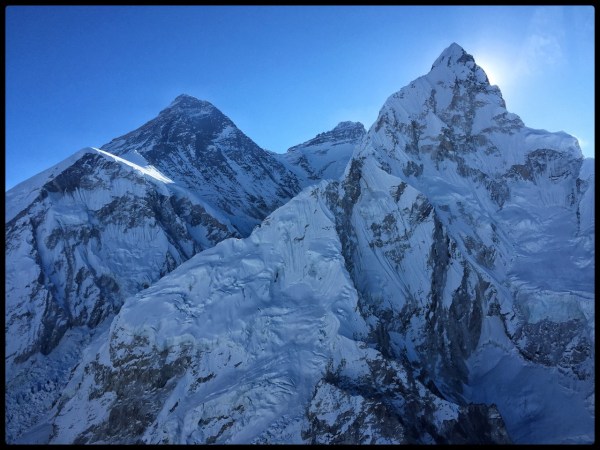
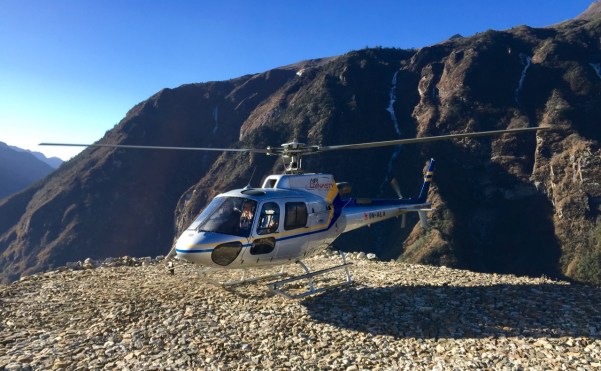 The helicopter was booked to fly all the way to Namche from Lukla, so indeed we did take it out for a spin first. My colleagues were dying to see Everest up close. It may sound lame but this was never on my bucket list. It was possibly the only thing missing from my bucket list. When the chopper landed I was not going to get on it. When it took off I was somehow onboard.
 The moon landscape that makes up the last 4 days of trekking is astonishing. It seems quite dead, but I am convinced it isn’t. This is the top of the world. Life is found in highly unlikely places. And while it is exotic and dangerous to us Europeans, sherpas and yaks consider this their home. Hats off to them (if anybody wears a hat anymore).
 (Namche Bazaar and Mt Everest, Nepal; November 2016)
 This blue marble