
 Lifestyles of thousands of years are quickly forgotten in the turbulence of the past two centuries. In Africa, 200 years is some 8 generations, and thus it was about time that a group of Damara people began to research and recount for their old ways, before all was forgotten. Out of this came the Damara Living Museum: a traditional village made up for tourists, where Damara craft and life is put on display by people enacting their customs for work.
The sun was hot in the desert and everybody wore loincloths. Only a couple of women covered their breasts. Our guide was a young, pregnant woman with full, beautiful pregnancy breasts. She was a gorgeous creature. Men were dangling bones and what looked like donkey or oryx tail hair from their loincloths. Some had leather headwear, to protect from the sun. In summer, the day temperature can climb up to 50 degrees centigrade, thus one may wish to concentrate one’s garments over the head. But the nights are still freezing cold. Fortunately these modern Damara people probably went home to a hut with proper blankets, but how did their ancestors manage all those tens of thousands of years previously? With furs? It is not as if the animals around here are donned with insulating pelts.
We were also taken for a bushwalk to learn about local medicinal plants. Surprisingly many bushes that I recognized actually have known medicinal uses! Even oryx dung was used as a strong potion to stabilize a woman’s menstrual cycle. The ladies explained that it is strong enough to kill an unborn baby. In addition, we were shown how to hunt oryx, and how to trap dassie-rats. Although it was taboo for women to hunt in the Damara culture.
This type of tourism is the best kind: it keeps old traditions alive and feeds local people. It is sad, however, that the only reason the beautiful age-old culture of the Damara exist is for tourists, or in some protected, often distant, areas. “Progress” wipes out so much knowledge, craft, and time-tested ways of life. 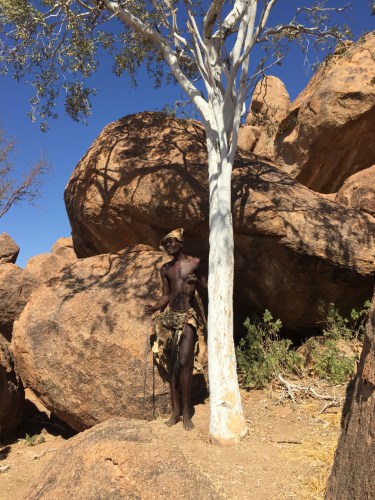 (Twyfelfontein, Namibia; July 2017)
 The Cro-Magnon people of Europe drew mammoths, deer, and moose. The San people of Africa made giraffes, oryxes, and wildebeest. Both depict hunts, hunted animals, and the styles are quite similar. If you look closely you can even see an animal with double sets of legs,
 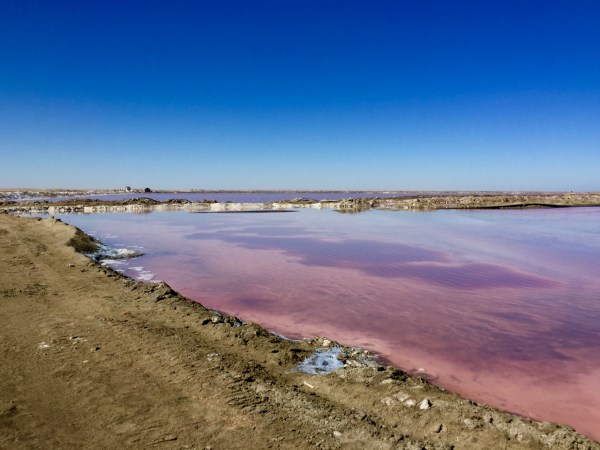 Pink “Himalayan salt” is sometimes Namibian salt, from Walvis Bay. In my understanding this is rock salt, not sea salt, and it is the color of algae (not Himalaya) that gives it a bright pink color. Some of the salt pans were a deep purple.
 Sesriem means “ses riemen” or “six belts” – the number of belts tied together required to reach the water on the bottom of the canyon with a bucket. Very practical. Very survivalist.
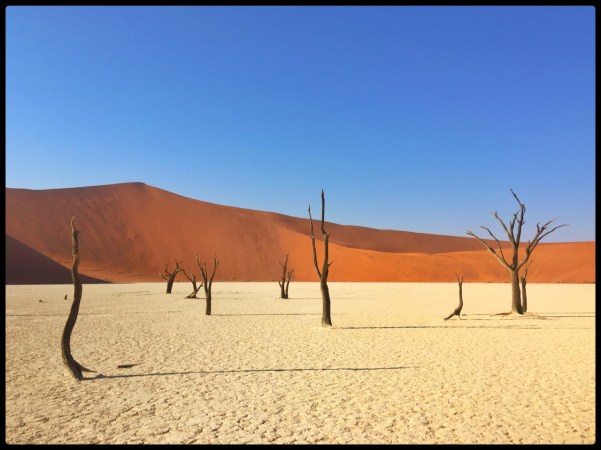 Once upon a time this was an oasis. There was a river flowing through, nourishing these 500-year-old acacia trees. But the river decided to go elsewhere, and the acacia trees could not follow. In the hot, arid desert climate they dried upright, like skeletons from better times.
 The dark scraggly trees against a white lake of salt and the red dunes and blue sky is one of the most photographed landscapes in Namibia. And at 7.30 am it is all mine. I am the only person on the entire salt pan.
 From time to time (not even once a year), the rains come and the dry white pan becomes a flooded lake. When an oryx walks across the mud, its footprints dry up like those of dinosaurs, waiting for the next rains to come.
 (Deadvlei, Namib-Naukluft Park, Namibia; July 2017)
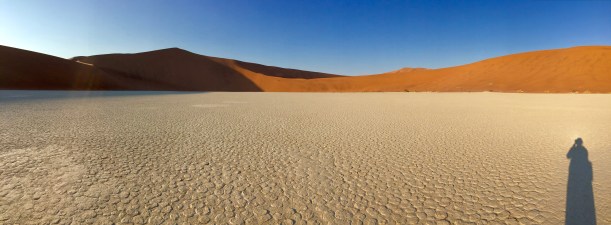 7.30 am on the Deadvlei salt pan. It is as if I am the only person on a foreign planet. A Martian on a red planet of sand, where water once existed but is now long gone. This must be how the space-age people of the 60s imagined walking on Mars to be like. It is quiet. Still. The air is chilly but strangely easy to breathe, even with the dryness. There are no sounds anywhere, except for my team mates and two other crazies trying to ascend the Big Daddy dune, far above.
 Standing in the still desert reminds me of the movie Truman Show, where Jim Carrey plays a man who has a lovely suburban middle class life – until he one day wakes up to realize his world is literally a stage and everything in it is scripted and televized. He begins to seek the boundaries of his physical world and comes to the end of it: at sea, outside of town, he touches the side of the dome which he always thought was the sky and the horizon. The water splashes towards it and all sounds are muffled, as if he were inside a room. Endlessness isn’t endlessness, but finite and staged.
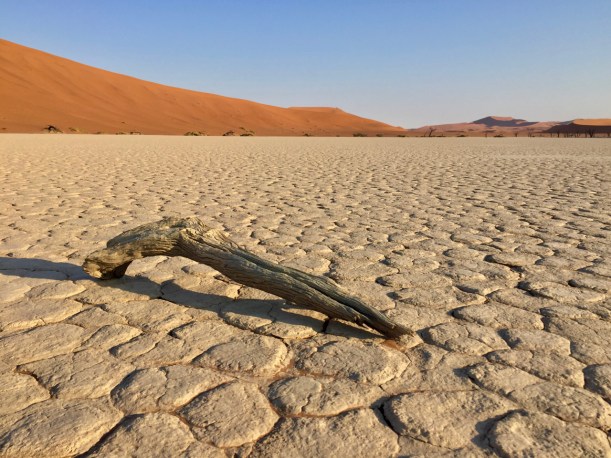 (Deadvlei, Namib-Naukluft Park, Namibia; July 2017)
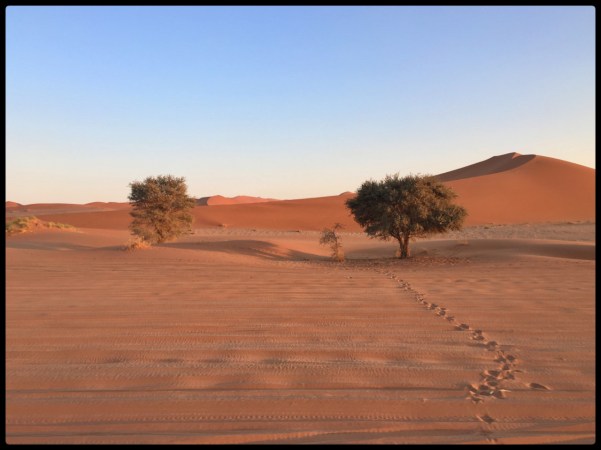 We camped under a full moon at the overflow site, away from tourist buses and noisy families. We lit the braai fire under the tree, under a full moon, with lizards keeping us company. At night as I walked the 200 m stretch from the tent to the bathroom facility, I needed no flashlight because the moon lit up the sand. Somewhere, not far away, I heard the agitated grunt of a grazer, maybe a zebra or an oryx. Either it had a quick disagreement with a herdmate, or it was very quickly killed. Only the moon knew which one was the case. The jackals were howling in the distance. Thank goodness each campsite in Namibia has guards patrolling the area day and night.
 The desert here is one of the oldest in the world. The red sand of Southern Namib comes from the Kalahari desert. When the Sossusvlei area was under the sea the Kalahari sand got washed in and stayed as the sea dried up to the desert it is now. The beaches became dunes. Some of the tallest dunes in the world are in Sossusvlei and the coast around Walvis Bay.
 (Sossusvlei, Namib-Naukluft Park, Namibia; July 2017)
 Being an adult is overrated. Spending time in an amusement park is underrated.
  But we did not touch the crazy colorful candy. Sugar is overrated. I would rather get my kicks in the old, wooden rollercoaster. (and maybe some pink fluffy cotton candy; I confess)
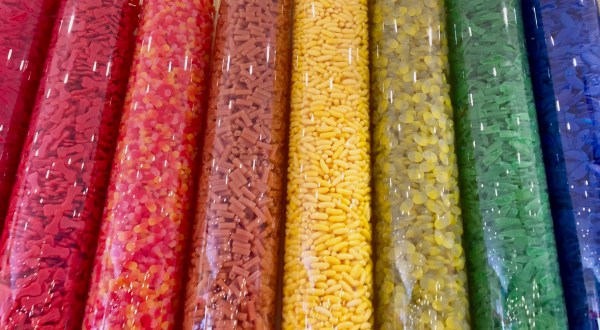 (Linnanmäki, Helsinki, Finland; May 2017)
 At the EU Parliament in Brussels, one can spend an entire morning learning about the twists and turns of the history of the EU. Did you know for example that French war general and president Charles de Gaulle initially vetoed the UK’s entry in the 60’s – twice? And now some say he was right all along…
 (Brussels, Belgium; May 2017)
 Once upon a time the future was all about space, both outside of planet Earth and in the minds of people. It was about scientific progress, with a joyful look at the future of humankind. This time was before anybody spoke of acid rains, holes in the ozone layer, the end of oil, and how tobacco kills.
  Future would be great, and the progress of science was great. It was as if the human mind was too youthful to worry about the heavy responsibility we carry towards our planet and every living thing on it.
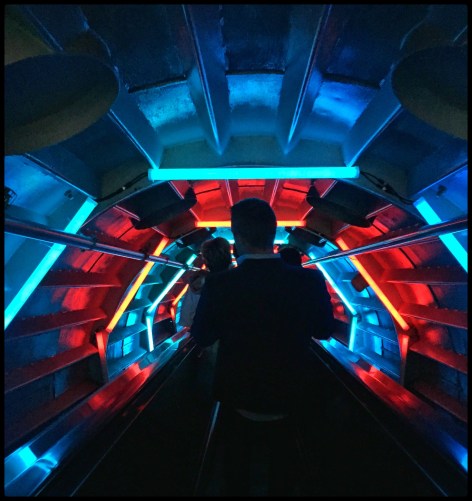 (Brussels, Belgium; May 2017)
 This blue marble