
 European cities may have a few large, designated parks and many small green patches squeezed in later between the houses and streets. In Singapore, urban greeneries and jungles are not inserted here and there after the city is planned and built. Instead, since 1967, they have been consciously included in the plan as the city grew. Surprisingly large areas of green have been retained, such as the Botanic Garden and the Gardens by the Bay. Access is free from dawn until late, in some cases until midnight. My local friend spends most of his weekends in the Botanic Gardens with his wife and baby, discovering new things every time.
Because this is Singapore, “conventional” is not a word used in the urban planning office. The Gardens by the Bay include huge mushroom-like structures of steel towering above the treetops, connected with canopy walkways. There are many theme gardens with colorful sculptures, and two huge, air-conditioned glass domes: the Flower Dome and the Cloud Forest.
The city is littered (or “decorated” if you prefer) with tiny parks, and each park is a carefully constructed piece of art, with surprising sculptures or a decorated walking path. Such attention to detail and imagination only happens when two aspects are met: enough affluence to invest a little extra in every structure being built; and a strategy to consciously incorporate greenness into city planning.
Only this way are there people employed to really rethink the greenness of spaces planned, before they are built.
 (Gardens by the Bay, Singapore; July 2018)
 If it is too hot to enjoy gardens outside, why not build a hollow mountain with a cool cloud forest on the outside, complete with mist, underneath a huge glass dome?
 The Cloud Forest consists of a large, hollow, man-made “rock” planted with flowers, ferns, mosses, and climbers. The entire construction is misted every two hours, and this is the main attraction: visitors time their visit to enjoy the cooling sensation of mist on their skin while strolling the 6 stories of criss-crossing walkways in the skies. Because this is Singapore, one can naturally ride the elevator all the way up.
 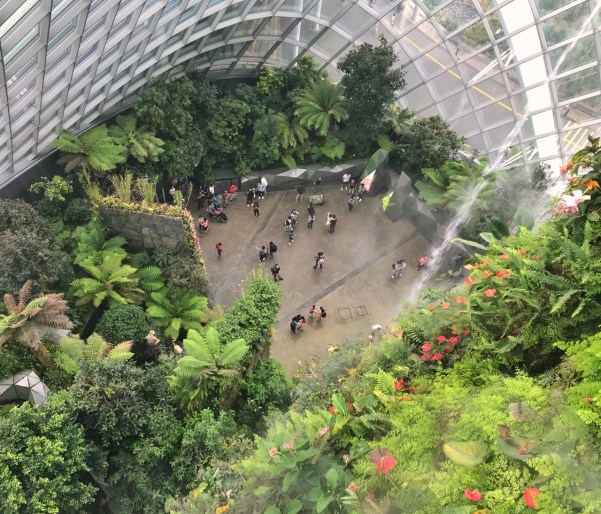 But the best surprise awaits the one who makes it all the way down and still has eyes for more beauty: the waterfall cascades down into a clear pool lined with the most interesting ferns, mosses, epiphytes, and climbers. Oh if only I had a private garden in a cool, shady area – this and a few trees would be the gorgeous landscape. Who cares if there was no sun, as long as there are ferns, mosses, and no mosquitoes?
 (Marina Bay Sands, Singapore; July 2018)
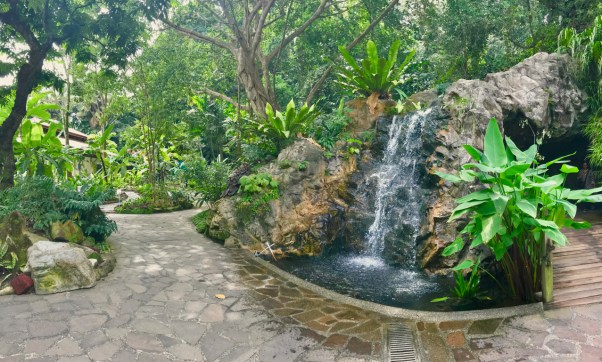
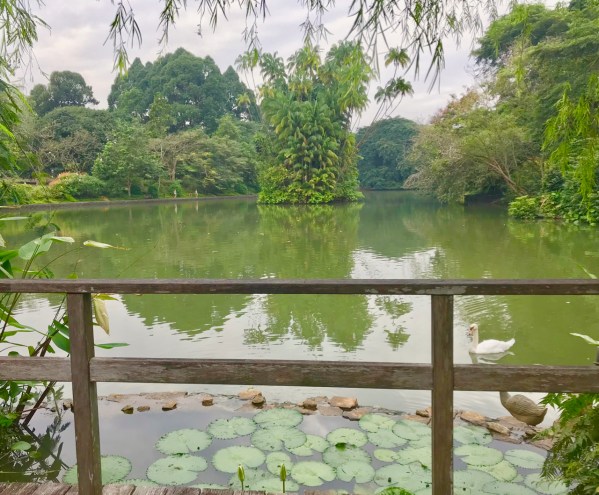
 On a whim I took the metro to the Botanic Gardens. I had no idea it was famous – until I entered and realized it probably must be. I have visited many botanic gardens in my life but nothing comes close to the one here in Singapore. The garden is easily 2-3 kilometes long and 1 kilometer wide. It contains two lakes, several ponds, a rainforest (large enough for a proper stroll!), a palm tree valley, an orchid garden, a symphony orchestra stage in front of a lawn – and approximately 20 themed gardens.
 It strikes me that still 150 years ago we Europeans too knew all about the properties and uses of our plants and trees: which wood is pliable, which is durable like steel, which plants are medicinal, and how to weave bowls and from what. All this knowledge here on the Malaysian peninsula will be lost soon, too, unless it is specifically conserved. Even here in Singapore I would wager to claim it is already lost from the collective mind of commoners and preserved only among few with an interest in herbology and healing.
 (Singapore; July 2018)
 It is a sobering reminder to have the text “DEATH for drug traffickers under Singapore law” written on my visitor pass. How ironic it is, then, that much of Singapore’s past is linked to hard drugs: opium trade between China and the British Empire.
 In the hubbub of Chinatown, stepping into a temple is like stepping sideways out of life.
 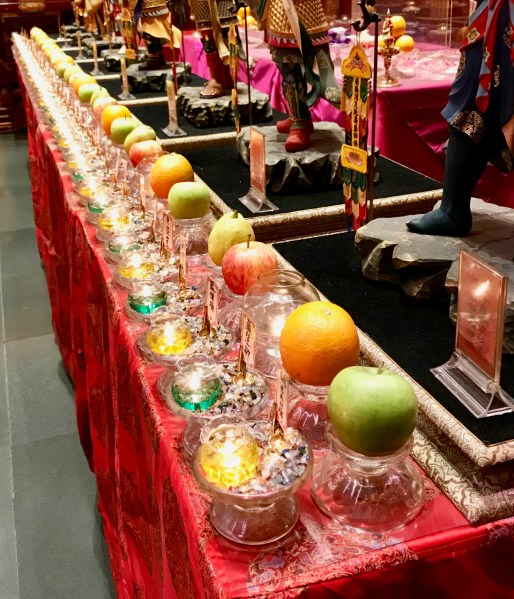 It must be lunch hour here, too, both for gods as well as for scholars: fruits in a row for those on higher planes, and half-empty thermoses left behind by those who needed more tangible nutrition than loving kindness.
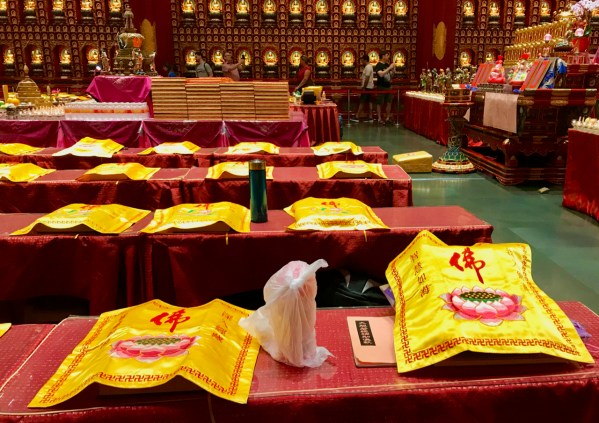 (Singapore; July 2018)
 Deep in what was once called “Little Arabia” and now renamed “Kampong Glam”, sits a lane that once was poor, then totally dead, and now a hipster mecca with artsy boutiques and little independent cafés and bars. The two-storey, colonial style buildings are decorated with street art and at night, music is booming. Here you can grab a cocktail, while a street down into the heart of “Little Arabia” you cannot find any alcohol (or non-halal food) at all.
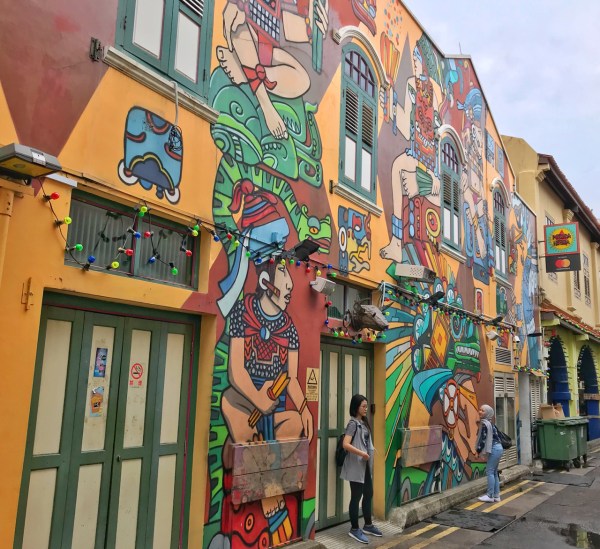 Singapore is ever-evolving, but it is also very orderly and safe. What else could it be if one is fined 300 SGD (170€) for eating a durian fruit at the hotel, 500 SGD (300€) for eating or drinking on the subway, and 2,000 SGD (1,200€) for smoking in the wrong place? Perhaps this is not the most constructive way to encourage good behavior, and it certainly is not the way to function in a positive space, but it works. This, combined with a pleasant and polite demeanor makes the busy society work at least in the superficial view of the visitor.
 But as long as I do not eat durian or smoke, and nobody accuses me of molestation, I should be just fine with a glass of wine here on Haji Lane. And perhaps some Middle Eastern cuisine for dinner, while darkness descends on the golden domes of the Masjid Sultan mosque.
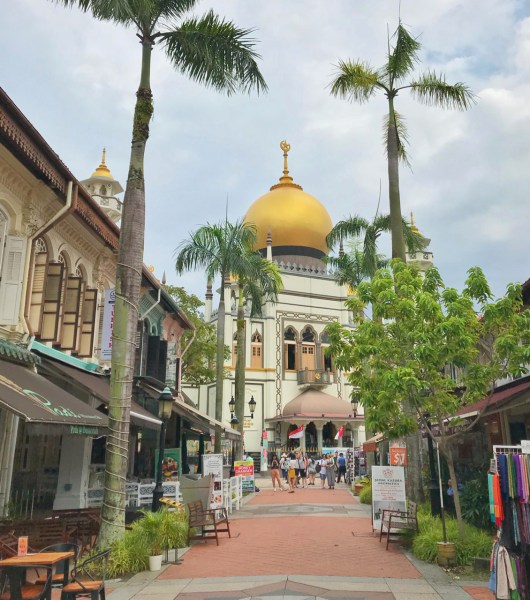 (Singapore; July 2018)
 Hello Singapore! Finally not only a quick greeting after I breeze through Changi airport, but a proper 3-night stay. And where am I staying? Apparently, it’s all about “pods” these days. To the extent that some hostels sell beds covered with a curtain and call it a “pod”. But as I stay in a sleek, large business hotel nearly every week, an actual tiny-living pod seemed like a refreshing experience.
 The views, the seating, the food, the cocktails (!), the service… I am not even sure what should be mentioned and what not. I seldom advertise for places, but Mr Stork has become a favorite in Singapore. As it is on the roof of a skyscraper you need to know where to look.
  And even if you do know where to look, finding your way up is not exactly easy. But if you manage, you may be rewarded with a drink out of an elephant cup (double yay for a paper straw!).
 (Singapore; July 2018)
 Lovely ones, apologies for the radio silence. Wow, nearly three months have gone by: an entire summer. And what a summer. One where it has been an everyday challenge to climb high enough to see the bird’s eye view. Instead I have spent most of the time either buried in the trenches or with my head spinning. It is an act of mindfulness to gently pull on that string that we all have attached on top of our heads. You know the one that, if we just keep pulling, lifts us up higher and higher, so that when we are alongside the clouds we actually see the big picture of our lives.
 This blue marble