
 Spent the morning in Christina Enea park and was quite distracted by four white-clad, surprisingly chubby capoeiristas spinning and tumbling about to drum beats from a boom-box. What’s the deal with wearing white? These well-rounded capoeiristas seemed to represent a local club, with Brazilian flags on their shirts and cameras rolling to capture their dancing battles. The one lady of the trio revealed her convex belly and an awfully bright yellow yoga bra, but who cared? She rocked the outfit, and she could do things while wheeling on her hands and feet that I will probably never master.
  I seemed to sit right under a quince tree, as a lady with a little fat dog busied herself around my bench, picking fruit into a bag. The dog was quite as interested in what was on the ground as her mistress, but not helpful at all in picking quinces.
Gave up on the summit of the park and the capoeiristas’ acrobatics in favor of looking for a toilet. Or “los servicios comunales” as they are often called here. Thanks to a quick Google search pulled up a map of the park and found the toilets, unmarked and well hidden from anyone who necesita el baño. The peacocks I passed on my way look at me with disdain. There is nothing elegant about a tourist desperately in need of a bathroom.
After I successfully completed the comunales project the park was nearly empty. Most families had probably retreated for a late Sunday lunch, and I repaired underneath a tree which at close inspection appeared to be a Californian redwood tree. In Spain. And it certainly was not planted yesterday – or less than a century ago. The whole aim of this trip to Christina Enea park was to create a life plan: what would I like my life to look like 10 years from now? 5 years from now? What needs to be kicked off next year, or this year? I sat underneath the redwood tree and gathered bits and pieces: getting hold of Spanish and then spending the rest of my life trying to decipher French; completing the book manuscripts I have in my head; ensuring my job either includes home office time or a max commute of 20 minutes door-to-door; and ensuring I have enough creativity and headspace in my life. And oh yes, living by the sea. And oh yes, the person I live with wants to move to a landlocked country.
The bits and pieces refused to create order among themselves. Like the insane pioneer claims in a favorite poem by Margaret Atwood, “this is not order but the absence of order. He was wrong, the unanswering forest implied: It was an ordered absence.”
I gave up and went for pintxos and local wine.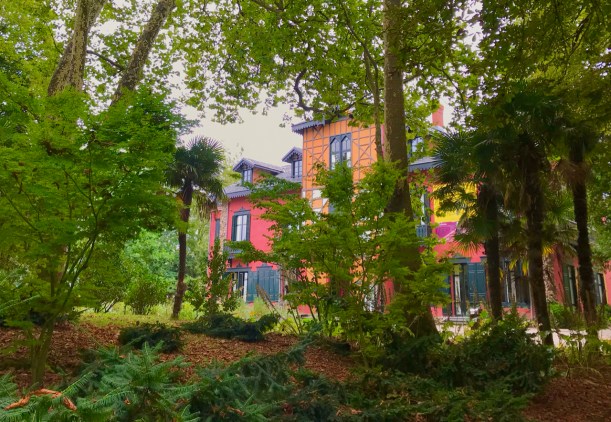 (San Sebastián, Spain; August 2019)
 Sidra, olives, and a setting sun in San Sebastián. There was my Swiss housemate, whom I had found earlier in his room feeling miserable about a broken eardrum which ended his surfing afternoons. There was my classmate who was going to Paraguay for two years. And her mother, who had just arrived and would join school next week. There was an American classmate who had spent a year traveling in Europe, looking for her father’s lost Jewish family. There was a Filipina ex-classmate whose boyfriend was local; and her two Filipina friends. And there was I, listening to my new friends talk and from time to time turning to look at the sun still warming my back.
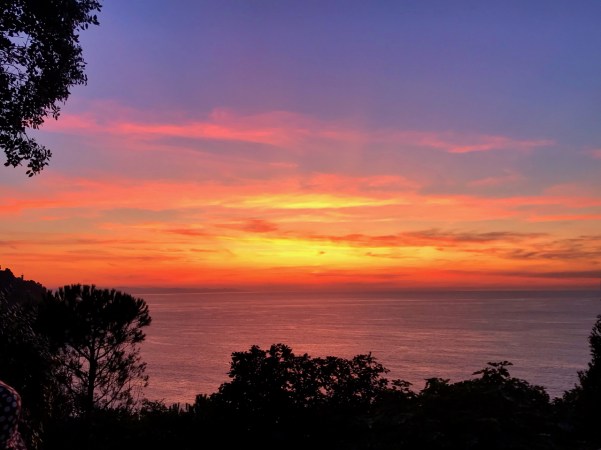 (San Sebastián, Spain; August 2019)
 Yesterday we completed the first week of class. Some students are leaving, and some new ones will arrive. The pace of the lessons may be fast for someone who hears everything for the first time, but for me this is a highly useful repetition of the Rocket Spanish Level 1 content which I completed last winter. Together with the vocabulary cramming I also undertook last winter I am able to stay afloat and relaxedly listening to what is brought to our attention, obtaining a deeper comprehension of the grammar, and picking up 3-6 words every day.
 More pintxos. Of course. This is San Sebastián. I lust for fresh vegetables but all I find is pickled olives, pimientos de padrón, or grilled red peppers on bread (which I do love but in moderation!). At home I steam tenderstem broccoli or flat green beans every day. Word is spreading among my classmates about a restaurant that specializes in fresh vegetarian fare. Sounds like heaven to me right now.

 One sunny afternoon after class I, my classmate, and two lovely Catalan ladies crammed ourselves into a car and headed out to the Flysch UNESCO geopark. Our guide gave us a walking stick each, brought us up a hill with a magnificent view over the coastline, showed us the hiking route across the rocks to a beach we could not quite see, and said “agur”, which is Basque for “adios”. “See you when you get there.” Then he turned on his heels and walked away, back to the car.
 And stunning it was: soft, undulating grassy hills that stopped short as if cut in half, with a rock face plunging straight down into the ocean. Horses with bells and lots of flies, green grass, blue skies, blue ocean water, and white froth. And several pairs of backpacked people walking the Camino, more or less worn out and sunburned.
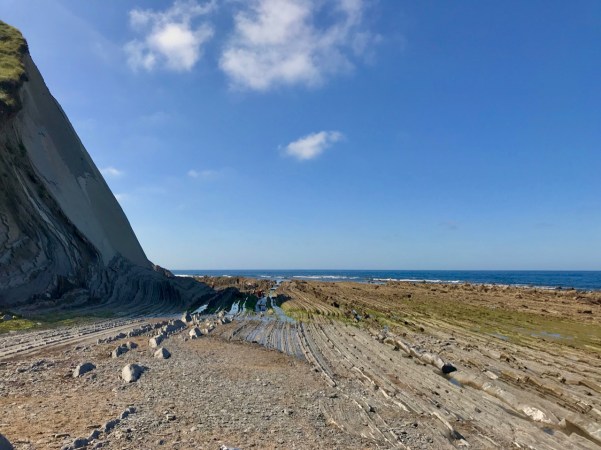 Good shoes were needed, as well as a good head with two functioning ears. Our guide spoke with an Argentinian accent (which I find the most difficult Spanish accent). Somewhere along the tour he must have forgotten that I and my classmate were estudiantes de español, possibly because we nodded our heads too vigorously. And so the guidance of the second half of the tour was lost to us.
 Today was a beach day. I also got sufficiently much sand in my notebook. I found myself needing a new pen and finally located a stationery shop 10 minutes before siesta closure. I then proceeded to spend five of those trying to explain to the shop clerk what a rollerball pen was. “No es una pluma, y no es un stylo o biro. Es un otro lápiz. Más fácil para escribir…” I finally dug out my current pen from my backpack and showed it to her. “Ah!” her face lit up. She did have a Stabilo Worker, although what “rollerball” is in Spanish I still do not know. I missed my heavy, clunky Faber-Castell but as it is too showy outside of the office world I left it at home.
 But first, yoga (early-morning ashtanga Mysore in a quiet, wonderful studio). And then, Spanish class.
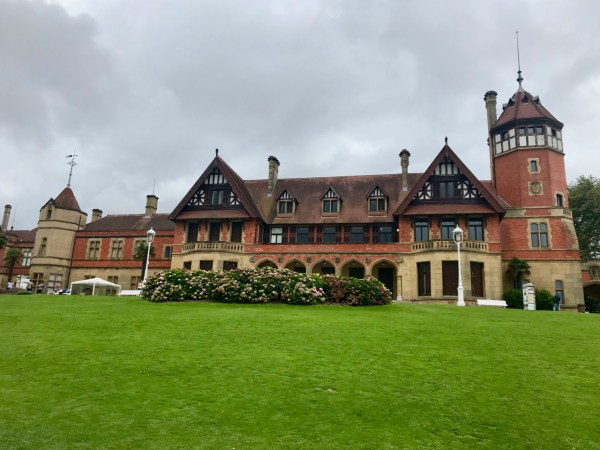 Yesterday I attended the city tour organized by our school, for newcomers. About Spain, in Spanish, of course. I surprised myself by understanding everything – although the guide was a teacher who spoke más despacio.
 (San Sebastián, Spain; August 2019)
 La Semana Grande includes many odd things in its program. Such as a dance and parade of giant Basques. In berets, of course (“baskeri” in Finnish and “Baskermütze” in German).
 (San Sebastián, Spain; August 2019)
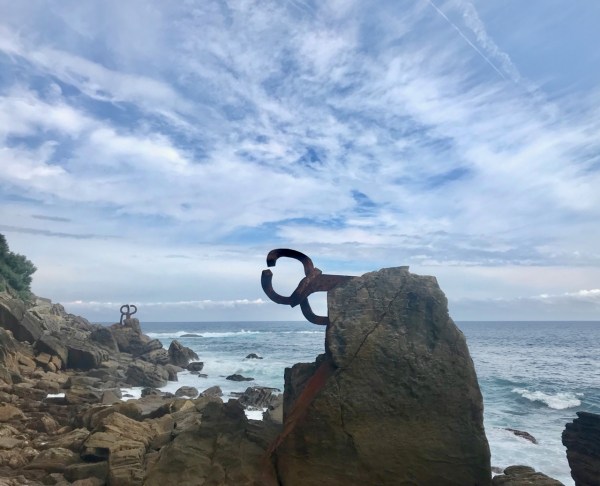 At the end of La Concha beach stands the “iconic symbol of San Sebastián”, according to most travel books and articles. I walked all the way across to have a look, and found myself at odds: two underwhelming, rusty set-ups of curved steel jutted out of two large boulders. Tourists around me took photos – out of duty, or out of true impression? I am not entirely sure what I was missing here: how and why do the locals identify with these? And why are they called El Peine del Viento, or “The Comb of the Wind”?
 This blue marble