
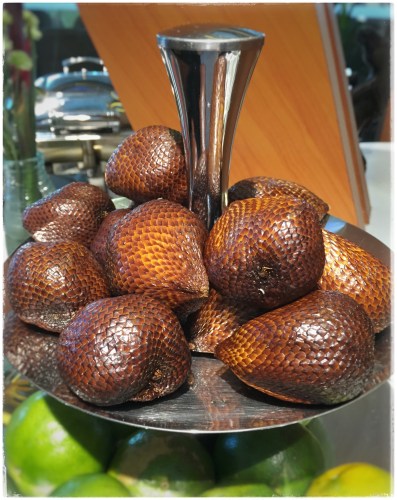
 One more snake fruit before I board a plane and fly off this little lovely island. Everybody in this premier lounge is nicely dressed and carrying suitcases – and I came stomping in with a backpack, an old plastic bag, harem pants, and sandals. I have the highest elite tier of my airline alliance but right now I think my appearance here is a good joke.
Speaking of plastic bags, and all jokes aside: Bali is changing so fast it is almost frightening. New villas pop up everywhere, people become wealthier, and Balinese nature and the ecosystem become poorer. The traffic is unsustainable. In Ubud there is a graffiti work of art on the wall of a house, depicting the elephant god Ganesha with a gas mask.
But fortunately some resorts and restaurants are jumping on the green bandwagon as they have realized that there is money in green thinking. Many people who come to Bali are health- and environmentally conscious. Several cafés now offer to refill water bottles for less than store-bought ones, and plastic shopping bags need to be purchased in the shops.
Plastic… like anywhere else, it is also the greatest nemesis over here. There is not that much of it compared to a Western country, but it is not properly disposed of and thus it is everywhere: by the road, in the rivers, on the beach. And perhaps you know that a plastic bag looks very much like a jellyfish, and great sea turtles eat jellyfish? A plastic bag in the intestines is possibly the most common non-illness related death of sea turtles.
Increasingly, people seem to care, though. Maya Ubud resort offers no plastic water bottles at all. Many resorts and cafés advertise their sustainability programs. It feels as if Bali is on a tipping point. Hopefully the driving force of environmentally conscious tourists is strong enough to mold the future of this island into something that will actually carry it far into the future.
(Denpasar, Bali, Indonesia; September 2016)
 6 pm and the sun has disappeared into the jungle. The night cicadas have relieved their afternoon colleagues from the concert shift. While I sit in a luxurious open-air lounge, sipping on my sunset drink, I cannot help but feel something I can only describe as “colonial”. We arrived here from busy Ubud where we stayed at a little homestay B&B, rode around on motorbikes with locals, and ate simple food for about one quarter of the prices here. But “here” is a resort in the cool woods, where 4 bellboys fussed about our arrival and luggage, whisked us onto couches for welcome drinks and registration, and then showed us the way down to the spa – using an elevator in the jungle.
 I cannot help but wonder what the Balinese think of this ridiculous opulence. Indonesia gained its independence from the Netherlands in the 1940s, right after World War II. I understand that here it is difficult for a resident foreigner to own anything; everything has to be held in the name of a Balinese partner. It makes much sense. With the invasion of the Westerners who, like me, fall in love with Bali and want to stay, they would quickly outnumber the Balinese themselves and their capital, in practice reversing the sovereignty of the Balinese and their claim on their island and administration.
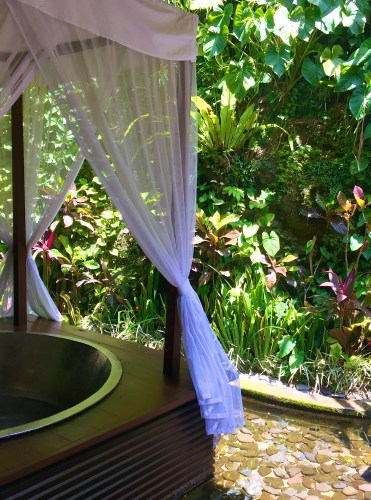 (Maya Ubud resort, Bali, Indonesia; September 2016)
 My yoga friend and I checked in to paradise. She is swimming lazily around in the infinity pool overlooking a river. The cicadas are playing, and the river, too. Swallows hunt for bugs between the trees in the sun. I might give the Balinese Jamu health tonic another chance to become a friend of mine.
 Yesterday night at a Tibetan bowl meditation session we conducted a heart-opening exercise, offering up all the pain and anxiety in us and replacing it with something positive. Letting the first thing that enters be acknowledged. I gathered all the hurt and the memories and the anxiety from every limb and vein and tried to push them out of my body if only for a second. From somewhere deep within me, the word that floated up to fill that vacuum space was “health”. Health of the body and of the mind. If the mind is ill, the body suffers, too. I realized I wanted to become healthy, in every possible way.
 Some time ago my body put a stop to both a beloved hobby as well as an activity my mind was pushing my body to do. I used to run 10-12 km every other day for years, until my knees literally told me to stop running, according to my ayurvedic doctor. I ran them out some time ago and needed surgery in one knee. No running anymore, possibly never.
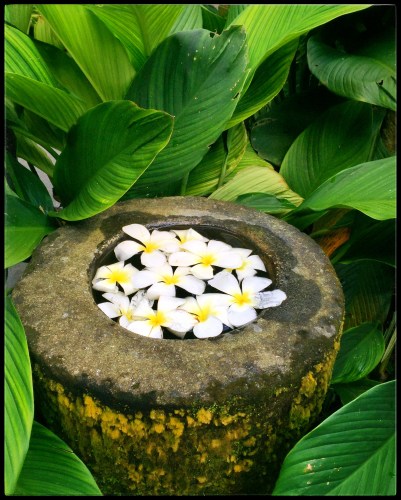 (Maya Ubud resort, Bali, Indonesia; September 2016)
 After bustling Ubud, Uluwatu is silence, sea, and surfers. Hot, winding, dusty roads with bush and dry forest everywhere; a house here, a villa there. The air is steamy from the evaporating surf.
 The Uluwatu temple is one of the most sacred temples on Bali, alongside Pura Tanah Lot, the other temple ravaged by the sea and the wind.
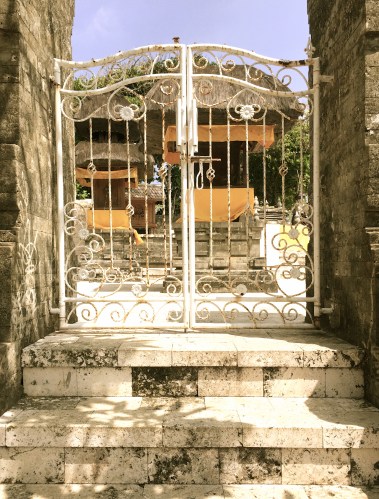 (Uluwatu, Bali, Indonesia; August 2016)
 Lovely ones, please rewind to mid-August with me. We are about 11 kilometers up in the air, flying over Nizhny Novgorod, skirting past thunder clouds scattered on both sides. Thunderbolts light up the dark above Russia. The time is 1.30 am. I am sipping a glass of ice wine and thinking about my flight out to Bali one year ago. I was in a low mood, pondering about pain and loss and the hardships of staying alive.
 So I do as I choose. I do as I please. I have been forced to trade off a huge chunk of my life, which definitely justifies some indulgence. And so I allow myself, without shame, to fly business to Bali to practise yoga, eat delicious raw food, spend time with myself and friends, and to be pampered by a luxurious spa in the jungle. And I will begin with having a Singapore Sling in the Raffles Long Bar with a couple of long-lost friends.

 As I browsed through the stock-full shelves of the Shakespeare and Company book shop, I pondered what it is that makes a city a writers’ and artists’ city. Why is it that in the 1920s Paris was the place to be, and perhaps today one should be in Berlin? Why did so many artists congregate on the French Riviera in the end of the 19th century (was it just the peculiar light?)?
 Google made me none the wiser, except for one important factor: money and cafés. A writer thrives in a location which is esthetically pleasing and has good cafés where one can observe life – but that even a poor creative soul can afford. Places like Brooklyn and San Francisco, and St Germain-des-Pres in Paris, used to be hot hangarounds for creative people – until so many came that the area became “too hipster” (now define it if you please) and the poorest but also coolest full-time aspiring artists had to move out to find yet another inspiring haunt.
 Perhaps it does not matter where one writes, as long as one is surrounded by things that inspire. Or perhaps it does help to be allowed to crash at for example Shakespeare and Company, to punch away on the age-old typewriter in the corner, or to bounce around ideas and angst with fellow aspiring writers in-between shop duty.
 “Before, the city center was marked by the cathedral. Now, down-town is identified as the place where the banks are”, said Geshe Tenzin Wangyal Rinpoche as he sat down, removed his shoes, crossed his legs, and commenced his lecture at a major school of economics in Helsinki. I do not think any leader ever sat on that stage without shoes, cross-legged. Or without a suit.
 Thought of the day: to be happy with what one has means not looking for more. If one is not looking for more, one is not curious about change and new things (unless purely for speculative or rhetorical purposes). Thus, contentment kills curiosity, and without curiosity there cannot be proactive personal growth. Is it, then, an impossible equation to not chase for more (be content), and simultaneously grow as a person?
 This blue marble