
 Imagine an empty stretch of beach. The palm trees curve over the fine pale sand, like in those travel bureau brochures. Turquoise water gently froths the edge of the beach sand. Clouds crawl across the blue sky, rolling as if in slow motion. Not a soul in sight.
This scenery is very rare on Zanzibar. Either you will see a fishing boat, or a colorful flag of a hotel or kitesurfing center. And in 99 cases out of 100 you will see at least a handful people walking on the beach. Zanzibar is like Bali: so beautiful its existence is threatened by tourists loving it to death.
Everything must have been so different here when the traders and Europeans first began to settle: pristine, empty, white beaches and a few fishing boats, some mud brick huts, and reed huts. Local people probably wore very little clothing, and in general received everything they needed from nature. Today, what we tourists call a “beautiful sight” might be a wooden restaurant deck on stilts, stretching over the same beach, white-chalked hotel walls, and Swahili women in colorful long sarongs and headscarves.
While in Nungwi one can look over the water to Tumbatu island, which is part of the Zanzibar island group. Tumbatu is said to have only one road, used for walking or biking. There is no power except for a recent installation of solar panels. My guidebook and online sites say voodoo practice is deeper ingrained Tumbatu than on Zanzibar, as are reservations against visitors. There is said to be no love of (or for) tourists. Very few stay overnight, and most snorkeling guests are visited by a boat from Tumbatu, demanding money for swimming on their shore. At the same time, the people of Tumbatu want very little to do with the tourist business on their soil.
Zanzibar has some 600,000 inhabitants and Pemba island some 400,000. The Tanzanian government’s vision is to reach 500,000 annual visitors to the Zanzibar isles by 2020. Today, with some 350,000 annual visitors, the roads do not seem crowded, but I am certain the locals already feel squeezed, maneuvering their pushbikes, buses, and ox-carts among hotel SUVs and minivans. At the same time, the number of locals seems to be growing, too: there are two universities on Zanzibar and a surprising number of schools. I watched a school end its morning shift in Stone Town, and an incredible number of students tumbled out of the building. I did not try to count. In the afternoon, a second batch of students will enter the school for the afternoon shift, learning exactly the same things as the morning students did.
Zanzibari families are large: a farmer family might easily have 6-8 children, maybe more. With today’s healthcare and education systems, child mortality must be decreasing. In 20-30 years Zanzibar will not be recognizable, thanks to its growing inhabitant and visitor numbers. The rate-limiting factor is employment: people leave the islands if they cannot be employed. But I am convinced that as the population grows and tourism industry expands (most beaches are still far less developed than Nungwi or Paje), there will be more work.
I am glad I came now and not 30 years later. And I am sad if the lushness, the peacefulness, and the feel of paradise will have disappeared by then.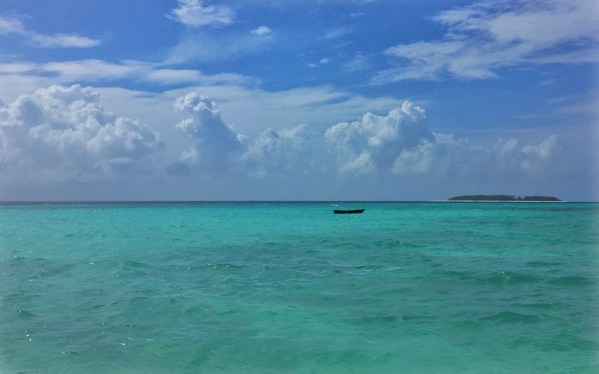 (Paje, Zanzibar, Tanzania; August 2017)
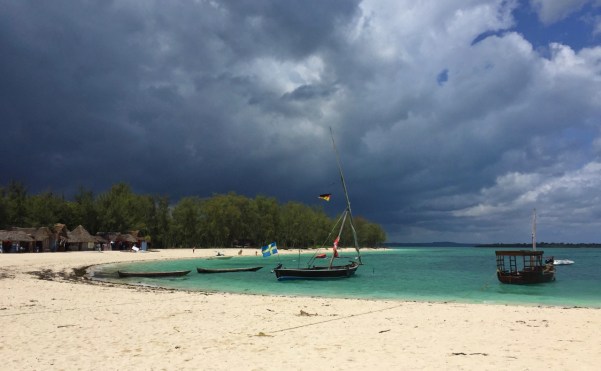 The rains are soon here. It is August and we get a few drops every day, but the clouds look more menacing than what they are. Thank goodness the tiny Swedish (?) boat made it back in time.
 (Paje, Zanzibar, Tanzania; August 2017)
 Back to school. Obtaining the Open Water Diver certificate was a lot of work. Fortunately I had plenty of time here in Paje.
  (Paje, Zanzibar, Tanzania; August 2017)
 The first time I dove I felt a tinge of panic: “what if I would just lose my head right now, remove the regulator, breathe in a gulp of water, and die? It would be so easy to die.” Indeed it would. And I am still trying to get used to the idea of the PADI buddy system: you travel anywhere on the planet, seek out a reputable dive center, get paired up with a stranger you’ve never met in your life and will probably never meet again, and then place your trust in this person; that he or she is going to stick nearby you during the entire dive and is willing to give you his/her alternate regulator should your air supply fail. And that he or she will stick with you and leave the beautiful scenery behind, should you need to return to the surface, far away from the boat.
 (Paje, Zanzibar, Tanzania; August 2017)
 I have a love-hate relationship with diving underwater. On the one hand I love the sea and looking at the underwater world. On the other hand, my ear canals are small and I have problems flying with the smallest symptoms of cold, or freediving deeper than 3 meager meters. But together with an instructor from Buccaneer Diving, a divemaster friend, and a lot of technique rehearsing, in Paje I found a way to equalize my ears. My goodness. I also found a way to work with my sinuses pre-emptively so that my ears would also not crackle and pop the next day after the dive.
 Hello fish, here I come. Even if I now go through the following routine every single minute: equalize by blowing against my nose, get water in mask so I can’t see, stop to clear water from mask by blowing bubbles. Hence, I need to become masterful in buoyancy control and level-diving to minimize pressure changes and the need to equalize. But hello fish, here I come!
 (Paje, Zanzibar, Tanzania; August 2017)
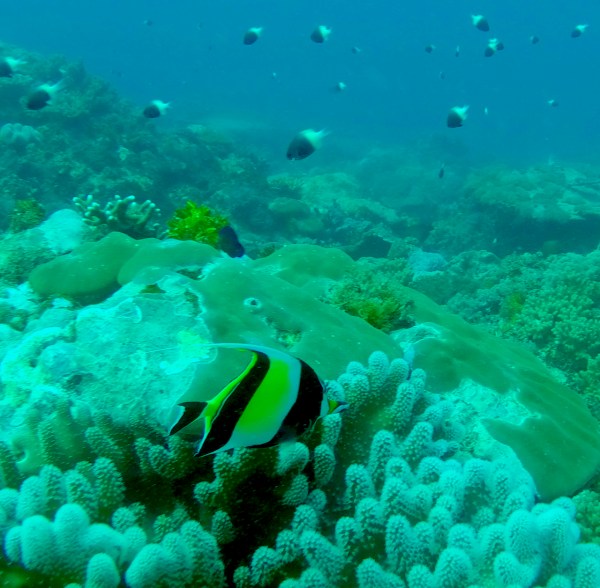
 It turned out that the beach hut in Paje was next door to a 5-star PADI dive center. And on Paje beach, every 200 meters there is either a kitesurfing school or dive center. Not going out and underneath the waves was obviously out of the question. And what an amazing reef, outside of the lagoon.
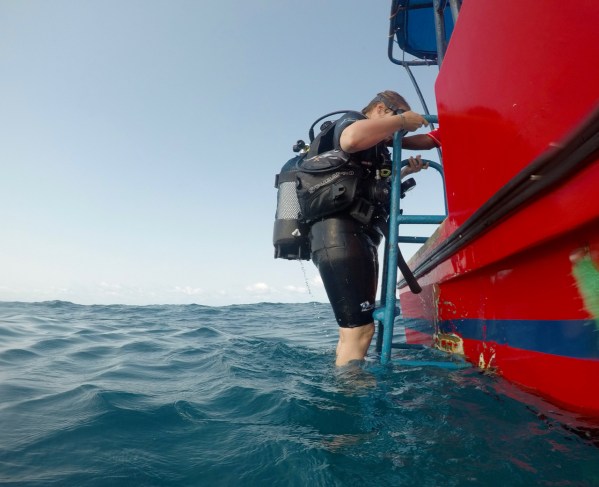
 Paje is a windsurfing hotspot because of the wind, of course. This means that getting into the dive boat (and changing air cylinders) was – well, choppy, to say the least. On some days, positively “swell”.
 (Paje, Zanzibar, Tanzania; August 2017)
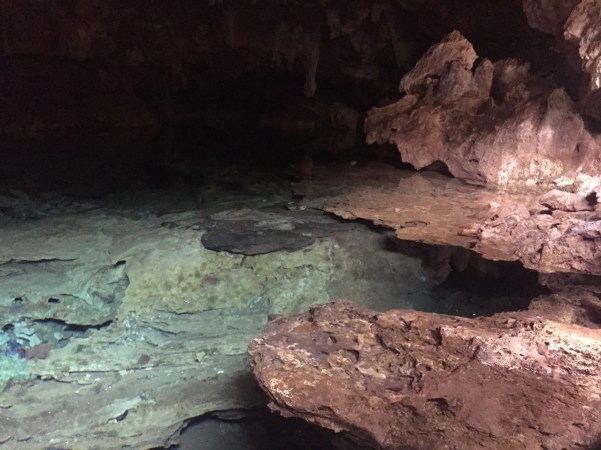 Underneath the surface, Zanzibar is a maze of coral rock caves. We stood on the beach near the Fukuchani ruins and felt the hollow ground shake beneath our feet: the waves crashed into subsurface holes in the coral rock. Oh the joy of baby fish, to play hide-and-seek in such a labyrinth!
 No regrets for a very expensive dinner at the Hilton DoubleTree, so I could use their fast wifi for photo and video transfer. It cost me 79,000 TSH, which is about four times the price of a low-end tourist dinner, and about sixteen times a village dinner. In euros it is only about 30€, though. Cost is more culturally bound in Africa than anywhere else I have been, including Southeast Asia.
 Sunbathers, cows, kids playing soccer, maasai touting safaris, others touting coconuts, and ladies fishing in colorful robes. This is the Africa I know, and expected but never encountered in Namibia. On the flipside, it is an odd shift to go in an instant from well-watered lawns and white-washed houses to bare concrete, trash on the ground, chickens running everywhere, and no imminent beauty in design. The people here live well it seems, but they just do not appreciate the same things we do.
 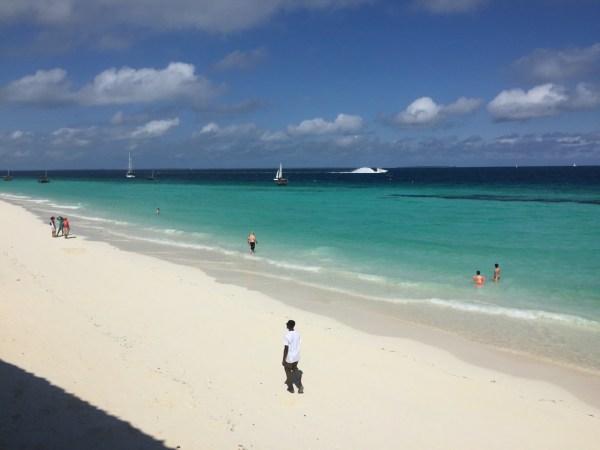 During the day, kids crowd the beach: boys, big and small, play soccer in the sand; while girls, already draped in hijabs, walk on the beach giggling. It seems that the fashion here is very tight jeans or leggings and a looser, flowing top plus a beautifully colored headscarf.
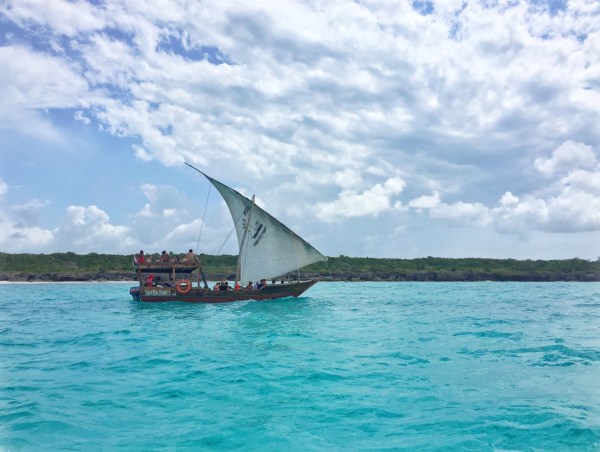 (Nungwi, Zanzibar, Tanzania; August 2017)
 Our boat was freshly made, out of mangowood. The finishing touch was given by a fire just the night before. Burning the surface with a hay fire made it more seaworthy. I was glad it floated.
 Our fisherman guide said he would not normally take his own daughters or wife out in the boat. It is not done. Women are considered to be too weak to manage the seas. He laughed when I said I pretty much grew up spending my summers on boats, home-made rafts, and other floaters. Local women do fish, but from the shore, wading in the water. Honoring the women, a boat may be named by other villagers after a man’s daughter. This boat was only proving to be seaworthy on this very voyage, so it had not yet earned a name.
 (Nungwi, Zanzibar, Tanzania; August 2017)
 This blue marble