
 One night in Salzburg there was a little train that took us aboard and climbed up the hill, all the way to the top. Strong fortress walls welcomed us (or perhaps rather said “keep out, strangers to the city!”). There was a simple Austrian dinner in a simple wooden restaurant with a view. There was a waitress who was happy it was her last shift as she confused the orders and languages needed (her job cannot be easy on her mind).
And there was a magnificent wooden state hall, simple but tastefully decorated (and probably awfully cold in the winter!). With views over the city. And finally, there were violins and a cello; Strauss and Mozart.
As the joyful music drifted out from the open window over the city below, just like it has done for centuries, I thought of the castle lords’ best rewards: after months of chilly days and nights with no heating, after years of worry about defences and politics and threats for the safety of one’s head, disregarding the lice and cockroaches; a couple of soft, warm summer nights with good food and music must be very soothing for the soul. (Salzburg, Austria; July 2019)
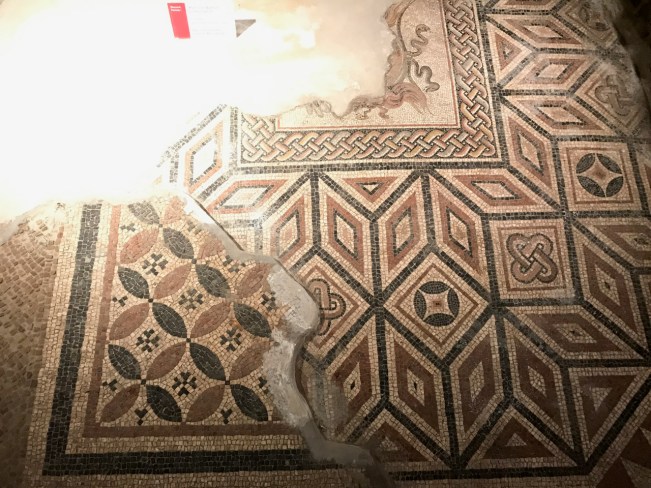 Deep under the cathedral of Salzburg, one lucky team of archeologists discovered old Roman street pavings and house floors. What a thrilling sight it must have been, to slowly brush away dirt and debris from what once was the surface of the city.
 (Salzburg, Austria; July 2019)
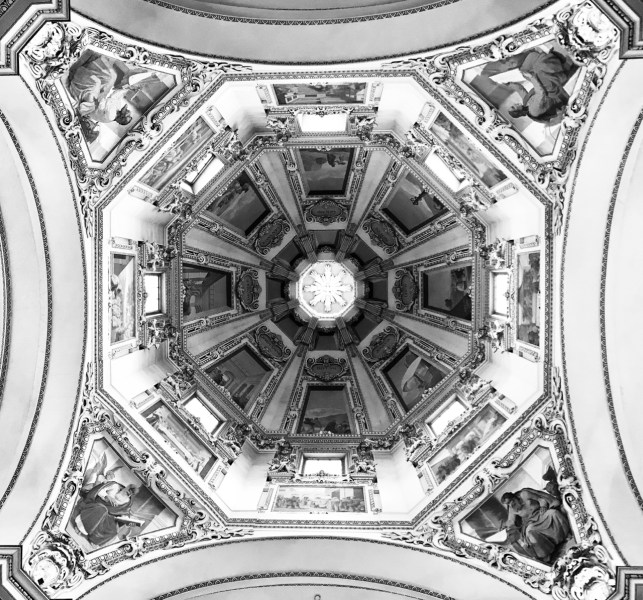 I stepped into another of the magnificent European cathedrals, this time in Salzburg. Just like in so many other places, a church has stood here since the 8th century AD. Since then, the church has been rebuilt two times: once after a fire and once because of other severe damage. This is the story of most magnificent European cathedrals: the church we see today is often not even the church of the medieval townspeople. And even if it is, we would hardly recognize the version that served the townspeople 1000 years ago, with so many alterations and additions.
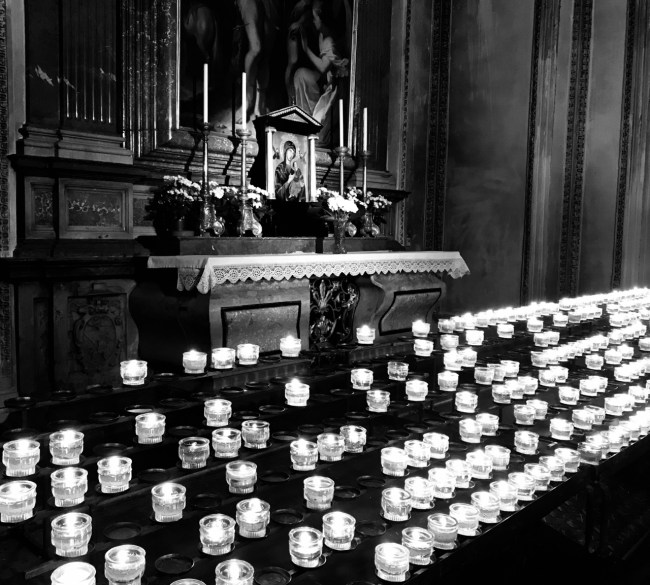
  In the 1960, the lovely people of Salzburg added 5 new bells to the 2 surviving, 17th century bells. One of the bells is named Barbara, which certainly is an odd name for a bell. She joins the other lady bell Maria, along with the gentlemen bells, to form the total set of seven bells. Sometimes bells are needed in the war, you see. Not because of their beautiful form and peal, but because they can be melted to aid the death of people. What a change of profession for a church bell indeed.
  (Salzburg, Austria; July 2019)
 Himbeeren, Blaubeeren, Brombeeren. The best you can get in the summer, if strawberries are not available. Or perhaps, even if they were available.
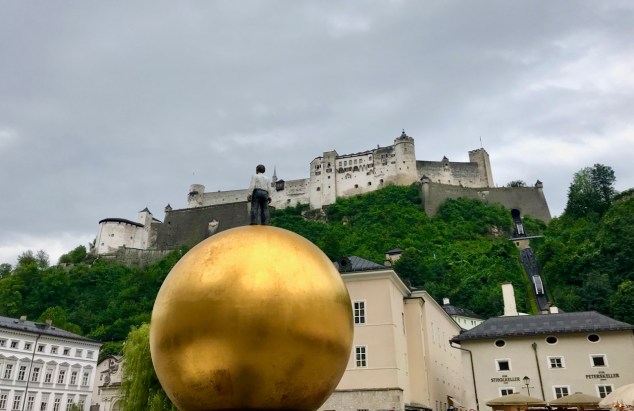
 Today I am in San Sebastián, writing about Salzburg. The photo above is a déjà vu of a scene in San Sebastián old town (mental note: go get a similar shot) but let us focus on Salzburg and its Salzburg Foundation project of designing and erecting new art every year fod a decade. Because it turned out to be funny, you see.
 (Salzburg, Austria; July 2019)
 If one is an archbishop with ailing health, why not just have a palace built next to the center of the city one shepherds? This was how the Schloss Mirabell was born – although the archbishop and his wife would not have recognized their beloved home as little as a hundred years later, when it was rebuilt into its current shape.
 (Salzburg, Austria; July 2019)
 Today I learned that Mozart’s father was a tour manager for his two young child prodigies Wolfgang Amadeus and Nannerl. No school, no normal life, and years of touring around playing concerts in European courts. Wolfgang Amadeus was five years old when they started. I mentioned this to a friend who immediately retorted, “just like Michael Jackson’s father managing the Jackson Five.” Indeed, Mozart’s family was a Jackson Five of the 18th century.
  Perhaps father Leopold was a parent prodigy, too? How else do you have unwavering faith in your four-year-old to even think of teaching him minuets, and the basics of composing sheet music. Surely there must be potential in any child who is able to scrabble a composition down in scrawny hand with ink blobs galore at the age of five, when most children still learn how to write single letters. And surely there were hundreds of hours spent at the piano and with ink quill in hand, as even child prodigies need practice.
 (Salzburg, Austria; July 2019)
 The couch is in pieces, there are nearly no lights indoors, and the Indian home delivery was good. It’s a start.
 Swoosh: across the Alps and into a way-too-fancy airport hotel where I spent a good 6 hours in a meeting. All I truly experienced of Italy was the sveltering heat outside and a plate of penne all’arabbiata.
 Whisked into hot almond milk, curcumin latte is the warmth of the sun in a cup. This one comes with ginger, cinnamon, and black pepper for extra heat. Heat is good, not only in the winter, but also as a digestive for people whose bellies burn with a slow flame, like me.
 This blue marble