
 The owner of this place must have been ambitious. And quirky: she had gazelles, monkeys, and a mongoose in her garden.
She was born into a banker family – and smartly married another banker at the age of 19, not caring her husband was 15 years her senior. Marriages were seldom for love and more for economy, politics, and convenience. When her husband’s business affairs went south she divorced him. They had no children and the rumor goes he not only gave her gray hairs but also a disease that made her barren.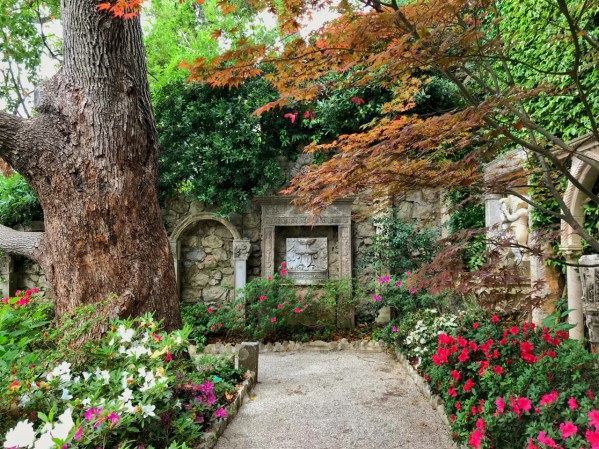 She was no angel either, because just as her husband, she liked gambling, too. Her gambling room in her pink (yes of course, pink) villa is quite something. And if she was not entertaining there, she was being entertained in a casino in Monaco.
Her villa was pink, yes; and she loved to dress in blue it is said. If she had lived today she probably had dressed her pets, too. Perhaps she did. But they certainly all had their own luxurious daybeds from best silk and brocade.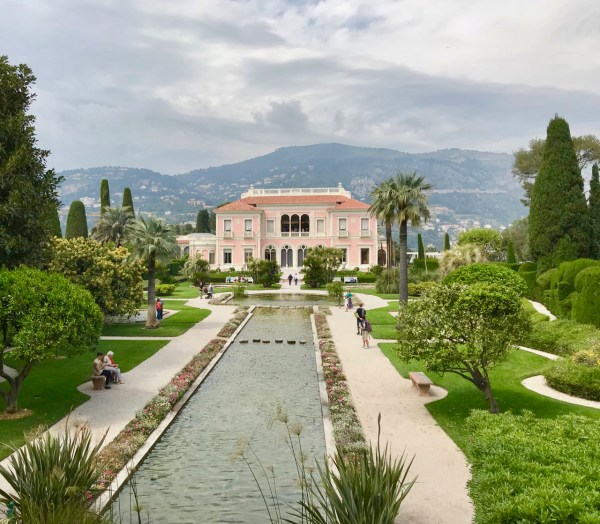 Béatrice Ephrussi de Rotschild lived the most extravagant life a divorced woman in the turn of the 19th century could. She commissioned an incredible villa and garden – not for herself but to see and to be seen. But was she happy? Perhaps she was in some ways. Women in those days found themselves unfit for any mold if they were divorced, unmarried, and wealthy. Perhaps she was shallow and happiest when entertaining. Or perhaps she felt lost in her role and happiest doing all the things she should not: play tennis, ride horseback on a man’s saddle, drive a car, and even fly a plane. Did she find meaning in her life? Perhaps. And at least one cannot blame her for not trying hard enough.
Unfortunately the house took its time to be completed, and the baroness herself was swept away from this life just four years after its completion. But the house is still there, as are the gorgeous gardens. And if you listen really carefully you can hear the jazzy tune from the gramophone and the click-clack of cards and dice from the after-dinner parlor.
 (Cap Ferrat, France; April 2018)
 The laskiaispulla (FIN), or fastlagsbulle (Swedish dialect in FIN), fastelavnsbolle (NO) or semla (SE) is one hell of a calorie bomb: sweetbread carved out to harbor a clump of juicy, bitter-almond tasting marzipan (or raspberry jam for the heretics), with a cloud of whipped cream on top. But what else do you want on a cold February Shrove Tuesday when the body craves for energy?
 Finnish, Estonia, Vepsian, Livonian, Hungarian, Mansi, Sami, Udmurt, Mari, Moksha. How many of these languages have you ever heard of? How about Nenets, Karelian, and Khanty? This is the language tree of the Uralic languages, including Fenno-Ugric languages where Finnish and Estonian belong (the top yellow-and-orange languages in the photo above).
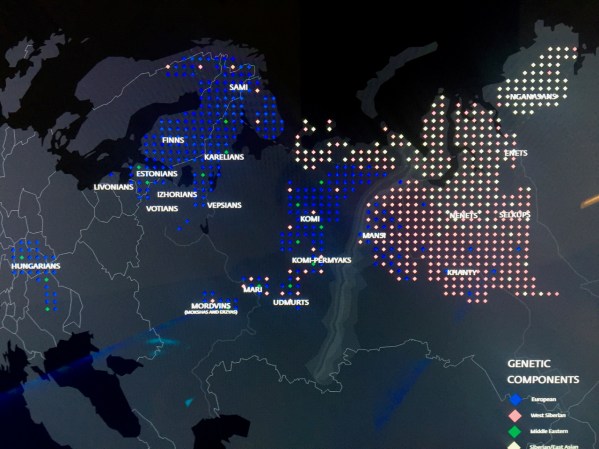 Today this model is challenged. Those who combine ancestry genetics with linguistics say that Finns have a mixed genetic heritage, Finnish came to Finland from Estonia, and as a language it is not really old at all: if you remove all influences of Baltic, Swedish, ancient Germanic, and ancient Russian languages, you are left with just a few words. Surely this is plausible because people adopt each others words when they spend time together.
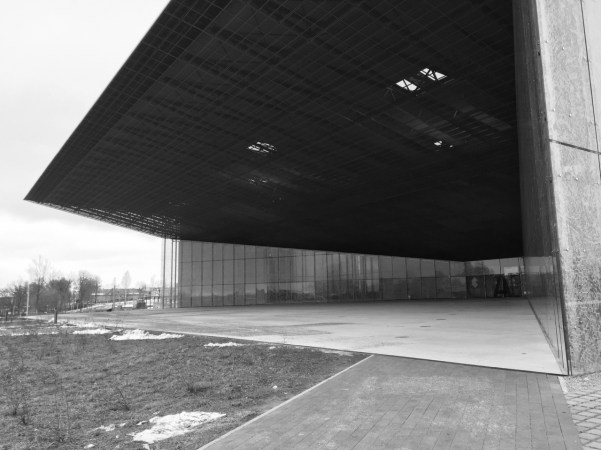 (Eesti Rahva Muuseum, Tartu, Estonia; December 2017)
 There, unassumingly in the park, next to a currently acknowledged house of God stands a much older site of God. A million sacrifice ceremonies have worn out round indentations in the rock, like bowls carrying gifts to the Divine.
 (Tartu, Estonia; December 2017)
 (Tartu, Estonia; December 2017)
 It turns out Estonian student life is not that different from Finnish student life. And probably both cultures have their origin in Sweden. Velvet caps and all. Estonian caps seem to be much more colorful than the Finnish ones. The contemporary Finnish cap is pretty much similar to the one on bottom right, except for that it bears a golden lyre emblem of one’s university.
 Once it was a chapel. Then it was a university library. Now it is the university museum. Tartu used to be one of the grand university towns in Europe. It was founded 400 years ago under the Swedish rule in a country called Livonia. Neither Livonia nor its language Livonian exist anymore. Then it was opened under Russian rule by the Baltic Germans (Yes. There were Germans living in the Baltic countries. European history is confusing). And finally, some 100 years ago, it was again re-opened as an Estonian university. Obviously under Soviet rule for quite a while.
 Look at that: little Finland is all grown up. For countries that happens when you can add three digits to your age. It all started in 1917 when the country tore itself off the flank of Russia and the shadow of Sweden and declared its independence. Borders were drawn and redrawn. To keep its sovereignty during WWII, Finland had to even play a dirty game, letting in the Germans to attack Russia from Finnish soil. As a loser in that game, we paid war reparations for nearly 10 years, delivering hundreds of ships, engines, and ready-to-install houses to Russia. Finland was the only country that managed to pay its WWII war reparation debts.
 Lifestyles of thousands of years are quickly forgotten in the turbulence of the past two centuries. In Africa, 200 years is some 8 generations, and thus it was about time that a group of Damara people began to research and recount for their old ways, before all was forgotten. Out of this came the Damara Living Museum: a traditional village made up for tourists, where Damara craft and life is put on display by people enacting their customs for work.
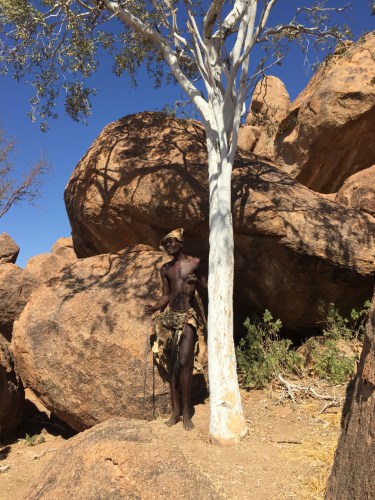 (Twyfelfontein, Namibia; July 2017)
 The Cro-Magnon people of Europe drew mammoths, deer, and moose. The San people of Africa made giraffes, oryxes, and wildebeest. Both depict hunts, hunted animals, and the styles are quite similar. If you look closely you can even see an animal with double sets of legs,
  This blue marble