 Walvis Bay on a Sunday is like an American suburb, except for the desert all around: the streets are empty, with wide avenues and watered lawns, and no white people walking anywhere. The houses are neat, modern, and boxy; and all are fenced off with cameras and security guards. Cars are mostly white (yes, but why?); and new, apparently because everything rusts quickly due to the fog rolling in from the sea.
Everybody seems to go to church here on a Sunday morning. Or to the Farmers’ Market. And with everybody I unfortunately mean the white people, because I simply do not know how the black people live as they live on the other side of town. At the Farmers’ market there were only 3 non-white customers during my visit. Some black families played on the adjacent playground, but did not mix with us at the Farmers’ Market.
A young woman referred to the “whole town” and I had to ask her for clarification if she meant the white community. She nodded – and I could not help but think what kind of tight community she lives in that excludes all the others in town and considers itself an entire town.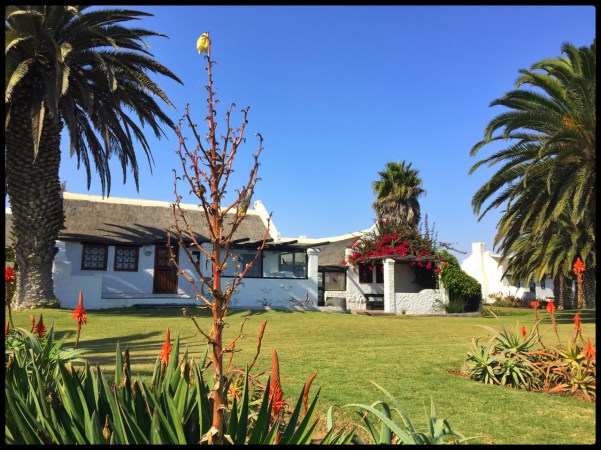 Our house is part of a beautiful, lush compound right by the lagoon. It is locked from the street but open from the lagoon side, via a little picket fence gate. Our house is installed with alarms due to burglars in the past. We are not allowed to bring our laptops into the back yard, lest they be seen and desired. We have been advised to hide our valuables in several places, preferably more creative ones like under the mattress or a pile of clothes in the wardrobe. And we pull the curtains down when we leave.
It is sad that the culture and social climate here have created frustration, anger, and jealousy. It is sad how some here have obtained a sense of being justified in taking something from wealthier people, because they themselves have much less.
Walvis Bay is sweet and sleepy, and very different from my world.
 (Walvis Bay, Namibia; June 2017)

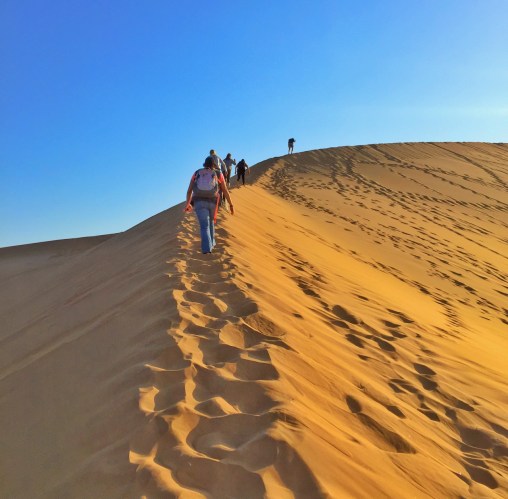 Today I was exposed to so much sand there will be sand in my belongings still one month after returning home. There is a row of dunes between Walvis Bay airport and the town. Dune 7 is the most famous one of them (why?), and does not migrate too much. It is meant to be climbed up and run or boarded down. Dune 7, like any dune, is best ascended barefoot, along the ridge. Descent happens really anywhere one prefers. It is a bizarre sight to see people, young and old, running down a 200 meter tall dune at an angle of 45 degrees without tumbling.
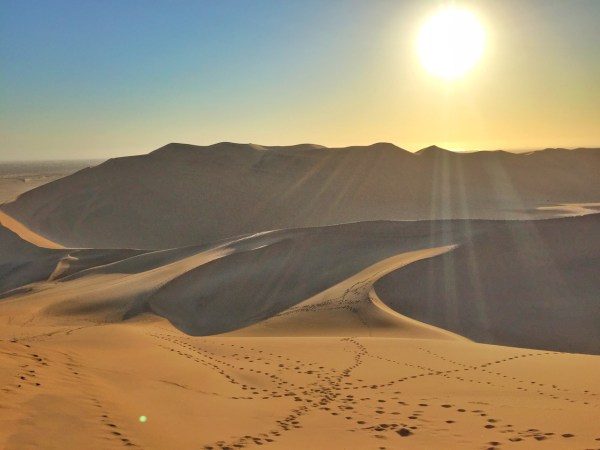 (Dune 7, Walvis Bay, Namibia; July 2017)
 There is an area in the Namib the locals call the Moon Landscape. It really does look like a moon landscape with soft craters and hills made of sand and soft-polished rock. If you scream here, it is highly likely that not a single living thing with ears will hear you.
 Most of Namibia is traditionally uninhabitable, and people have always flocked to the rivers and oases. Because the other choice is a desert with no water bordering on an ocean with too much water, and none of it potable.
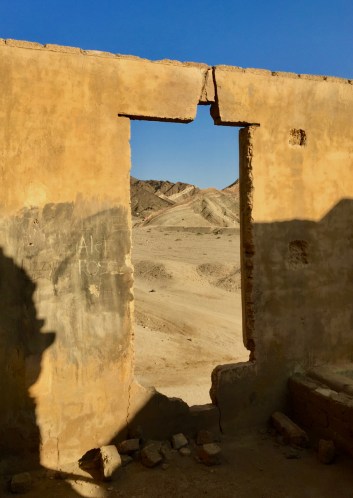 On our day drive we passed three jeeps in a junction in the middle of the wide-open desert. There were three families out on a Saturday drive, drinking beer and driving around the desert. This, and tailgate picnics, seems to be the best Saturday pastime for locals. It is as if the locals do not get enough of the hostile empty hot nothingness but actually embrace it. The human species truly is adaptable.
 (Namib desert, Namibia; July 2017)
 These days there are many drilling efforts around the coast of Namibia, lead by people believing there are great resources of oil to be extracted. Just recently, small amounts of oil were found outside of Walvis Bay. Perhaps in 5 years’ time the entire town and its industrial port will serve an entirely different function.
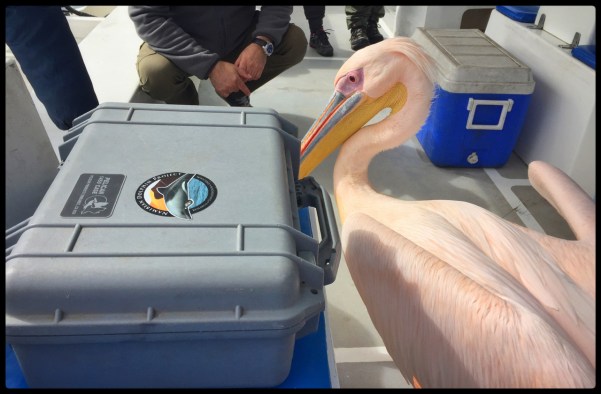 Not even a pelican can break into a Pelican Case. Thank goodness, as the cameras inside are not cheap.
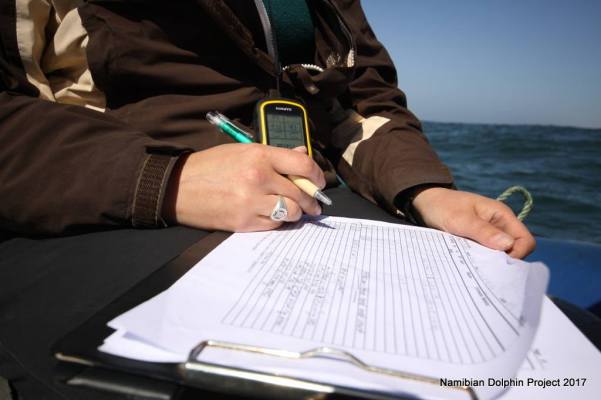 Someone has to be the data monkey, and I never really mind the job. On a rare, sunny day I do not need to wear gloves. Underneath that windbreaker are two (!) fleeces and a merino wool underlayer. Yes, this is Africa, still. And freezing cold, misty, and humid most of the time, due to the Benguela current that pulls up right from Antarctica.
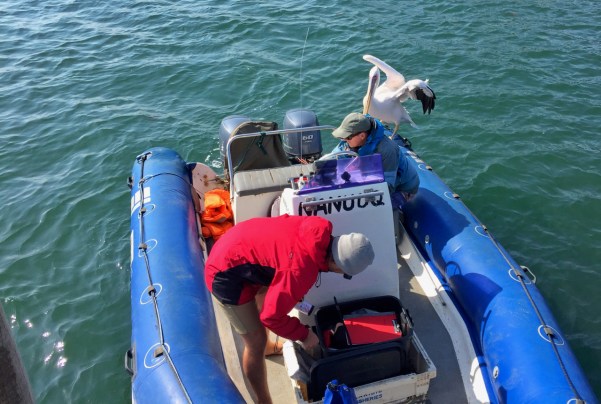 (Walvis Bay, Namibia; July 2017)
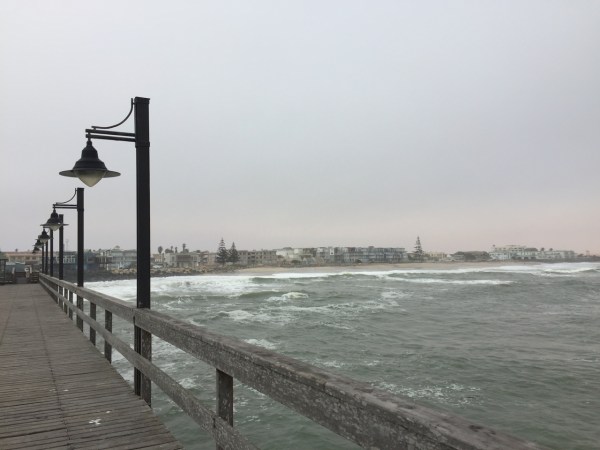 The ocean was raging today in Swakopmund: huge, furious, white-capped surf waves and a deep green undertint.
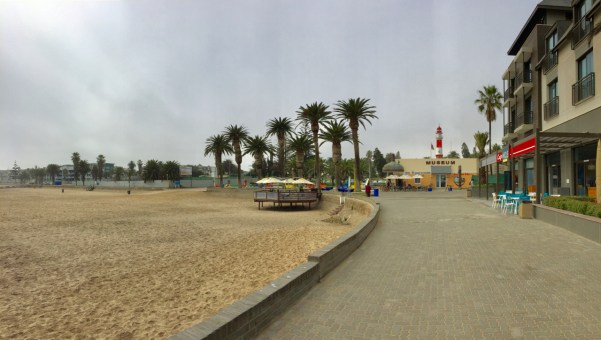 Swakopmund is a cute, little, heavily German-influenced town. It is not cozy and it has the broad, grid-like streets of an American town, but there are a couple of pedestrian shopping streets and a nice waterfront. There is even a German-owned curiosa shop stock-full with memorabilia from the German colonialization time, when Namibia was the “German Southwest Africa”. It would seem that many Germans are interested in the history of their African colony, but I could not help but wonder if it really was such a glorious and justified time as the memorabilia make it sound like?
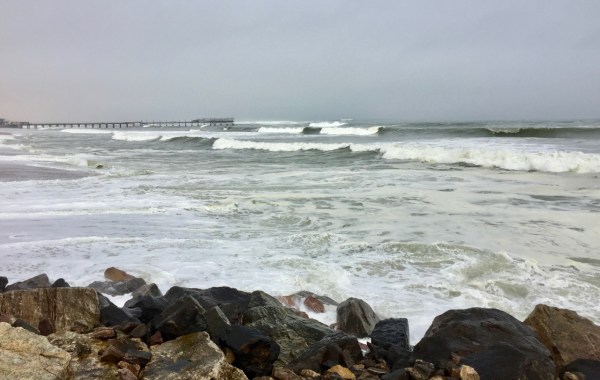 (Swakopmund, Namibia; July 2017)
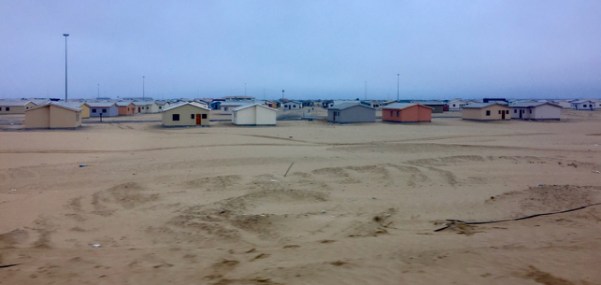 On the way to Swakopmund I finally saw how the black community of Walvis Bay live: in an endless grid of houses and sand roads, on the outskirts of town, practically in the desert. There are no watered lawns, paved roads, and flowerbeds here. Most of the houses are built by the government and given to each family, especially after Namibia became independent in 1990. They seem sturdy and alright; and my perception is that most people in Walvis Bay have work and a decent standard of living.
 In Walvis Bay one may not see dolphins for hours, but one is never alone. There is the Namibian Air Force, also known as great white pelicans….
 and cape fur seals, that steal joyrides on boats and ships of any size…
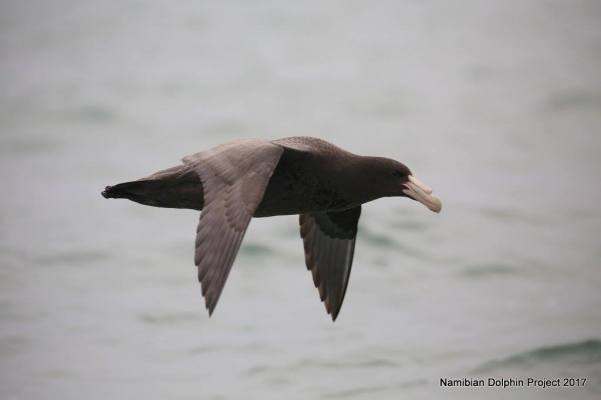 and giant petrels, and penguins. Yes, penguins. A swimming penguin looks like a drowning duck. I have no photos but please take my word for it.
 (Walvis Bay, Namibia; July 2017)
 In places the Benguela current is like a thick soup, with swirls of orange or yellow plankton. There are patches with 5 jellyfish per square meter, just as far down as one can see from the boat. And lots of live jellyfish mean lots of dead, stranded jellyfish. Everywhere. Every day. People slip on them on the boardwalk like on banana peels.
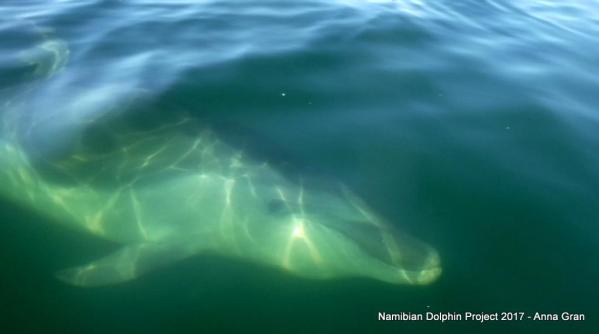
 Back on a boat – and with dolphins. This time with bottlenose and Heaviside’s dolphins, in the cold plankton and jellyfish soup that is the Benguela current. Walvis Bay has a large industrial port, which means dolphins often zigzag between ships and oil platforms. And we, too, alongside of them.
 (Walvis Bay, Namibia; June 2017)
 This blue marble