
 Teeth and bones and fins. That is what piranhas are made of. I once learned it the hard way, trying to fish for a living in the Amazon. They do not make a proper or tasty meal. I tried my best to catch arapaimas and arawanas, but all I got was piranhas. Over and over again, while our base manager miraculously pulled up delicious fish out of the living fish soup that was the Amazon in dry season. Most of the time the piranhas chewed off my bait so I lost the hook and sinker, too. I often wondered whether our base manager was using a spell or a mantra before throwing out his fishing line. Even if we were performing the exact same action I was obviously doing something wrong.
There are impressive piranha teeth – and there are possibly even more impressive sawfish teeth. Why keep your teeth in your mouth when you can grow a jaw outside of your skull and place your teeth around its outer lining? Much easier to stun and cut prey, yes?  (Aquarium of Genoa, Genoa, Italy; July 2018)
 That one free-floating jellyfish reminds me of Richard Bach’s Jonathan Livingston Seagull. The upside-down jellyfish actually considers upside as down, and the ocean floor as home. Just like the “breakfast flock” of the gulls Jonathan once called family, perhaps they are ignorant about what freedom really feels like?
 With its brackish water, its smattering of islands between Finland and Sweden, and limited and slightly altered flora and fauna, the Baltic Sea is an inland sea and far from an ocean. Every seven years a huge saltwater swell pushes up the salinity gradient a notch, and slowly the rivers trickling down into the sea change it back towards sweet.
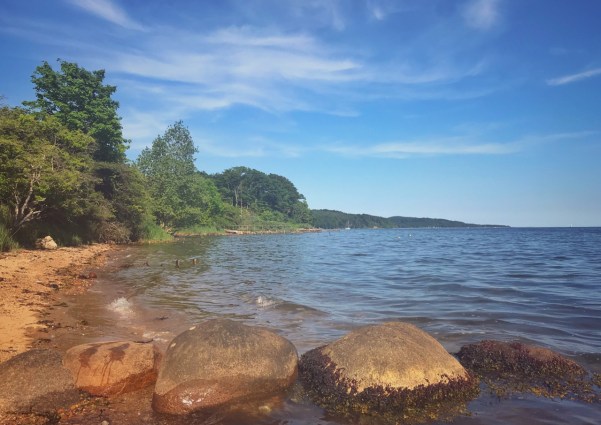 (Denmark, May 2018)
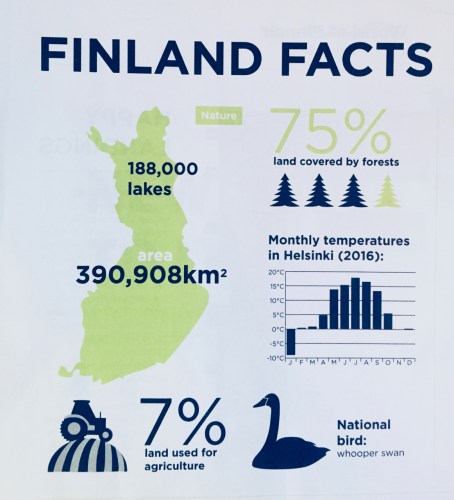 This is Finland – or some of it. We still have 75% of our land covered in forests. Nobody thinks of that as contributing to the “lungs of the planet”. Why is that, by the way?
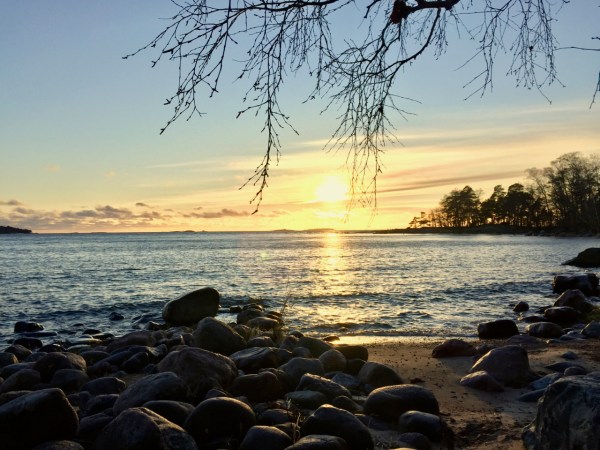 December days are short up in the North. Helsinki, just before 3 pm, as good as it gets before the sun sets.
 I may have studied a little bit of astrophysics and astrobiology, but when it comes to looking up and knowing what I am seeing – well, that is a completely different thing. The constellations I know are the ones I learned when I was a child: the Big Dipper/Ursa Major, Cassiopeia, the Pleiades, and the Polar Star. That is it. Orion? Betelgeuse? Halcyon? The Zodiac? I had no clue. How does the night sky shift (or how does our planet actually move) through the seasons, and how do I orientate to find stars and constellations? No knowledge.
 One sunny day in August I discovered that the little, old observatory was open for sun viewings. The sun is a star, right? Mission accomplished. And I have been able to stare at the sun without being blinded. Seeing its protrusions, its sunspots, all the beauty flaws it tries to hide under its brilliant light. I have seen the true nature of the sun and it is absolutely fascinating.
 (Helsinki, Finland; September 2017)
 Zanzibar and its surrounding islands are also known as the Spice Isles. Curiously, this is a wholly imported conception, as there was no real concentration of spices growing here until the Arabs and the Portuguese came and planted spice and fruit varieties they had encountered on their travels around the world. Everything seems to grow on Zanzibar, and so now the farmers grow peppercorn from India, lemongrass from Southeast Asia, avocado from Peru, cloves from Indonesia, and vanilla from South America. In essence, the ecosystem of Zanzibar changed completely with the settlement of the Portuguese.
  And yes, cloves come from red flowers on a tree and peppercorn grow on a vine. Cardamom comes from overground root-like pods produced after flowering, and pineapple takes 6 months to mature (and one can only harvest one fruit per plant per year). All of these, as well as cinnamon, turmeric, and other spices are now an integral part of the Swahili diet and kitchen. I would love to know what food tasted like before the Portuguese came.
 (Zanzibar, Tanzania; August 2017)
 At the tip of Nungwi village, by the lighthouse, there is a turtle sanctuary. And for nearly a week they offered sanctuary to me, too, in one of their vacant guest rooms.
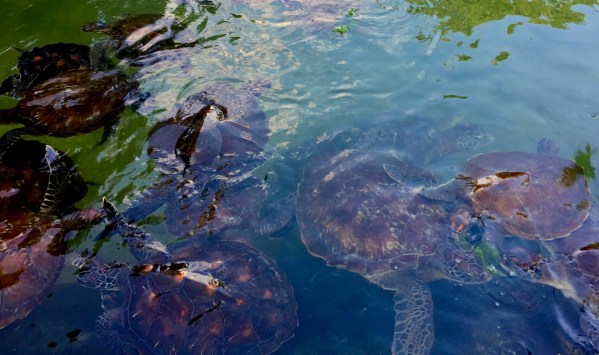 (Nungwi, Zanzibar, Tanzania; August 2017)
 This blue marble