
 With its brackish water, its smattering of islands between Finland and Sweden, and limited and slightly altered flora and fauna, the Baltic Sea is an inland sea and far from an ocean. Every seven years a huge saltwater swell pushes up the salinity gradient a notch, and slowly the rivers trickling down into the sea change it back towards sweet.
The animals and plants living in the Baltic Sea are the sturdiest, most adaptable ones that don’t mind the in-between conditions. Sweetwater perch and pike thrive in the sea. Seagulls and large cormorants don’t mind the smaller fish to eat. The herring has become a bonsai variant, called Baltic herring in English and something entirely different from herring in Swedish and Finnish.
Denmark is the gate to the Baltic Sea and its two coasts look like two separate worlds: its West coast (above) looks like any ocean shore, while its East coast (below) looks like a lake, which is what the Baltic Sea coast mostly resembles.
How convenient: if you live in Demark just pick your kind of seascape. 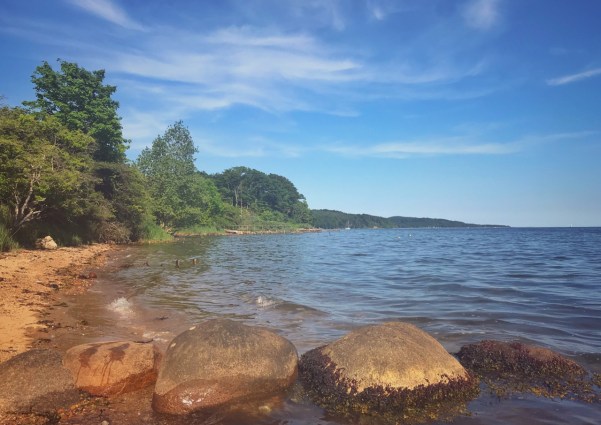 (Denmark, May 2018)

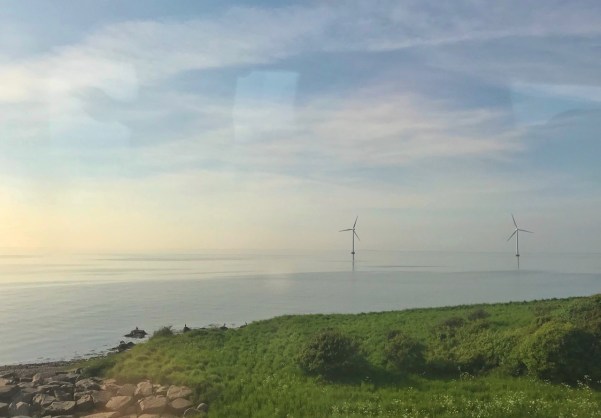 Steaming across the Great Belt Bridge, I cannot help but think of how progressive and practical the Danes must be. And that they love bridges. There is the Øresund bridge (the one featured in the TV show; nearly 8 km long), the two Great Belt Bridges (each nearly 7 km long), the Storstrøm Bridge (over 3 km long), and 7 other bridges each spanning more than one kilometer in length.
 This is what happens when you buy a couple of yellow primroses for your garden and leave them to flourish over 20 years, remembering each year not to mow the lawn until their bloom is over. Among the primroses are white wood anemones, blue scillas, and the offspring of a few purple corydalis that I planted as a kid. I found them in the local woodland and knew they were endangered – but I wanted them anyway. Well guess what, they are far from endangered in the garden of my parents.
 The
The 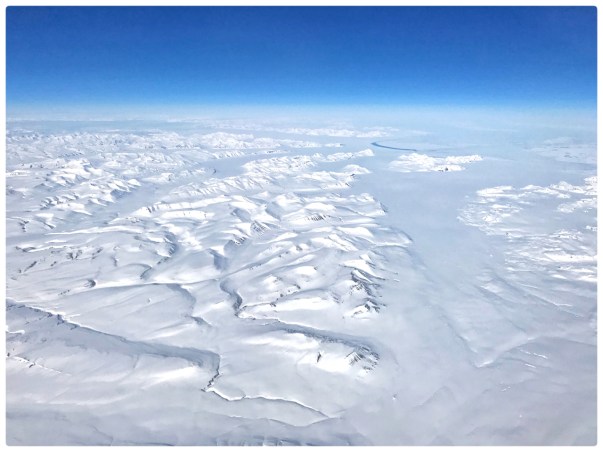 Most likely this scenario will not happen. But who knows if Florida or Singapore will still survive further than a couple of generations? And we humans and our cities is just one single species. The polar bears, the seals, the walruses, and the narwhals are the most obvious species in trouble. But because the ecosystem is a system, who knows what will happen if the currents change and the lowest levels of the food chain (think krill, plankton) disappear, too? No food for small fish means no food for big fish means no food for anything that lives on fish. And no krill for the whales, either.
 (Above Greenland; May 2018)
 My favorite crib in Stockholm is Stallmästaregården, an old gasthaus with creaky old wooden floors, the feeling of staying at someone’s private mansion (not a hotel), and the loveliest staff there ever was. I used to stay here every week, and returning after a year felt like taking a warm bath (the food in the excellent -reviewed restaurant helps, too).
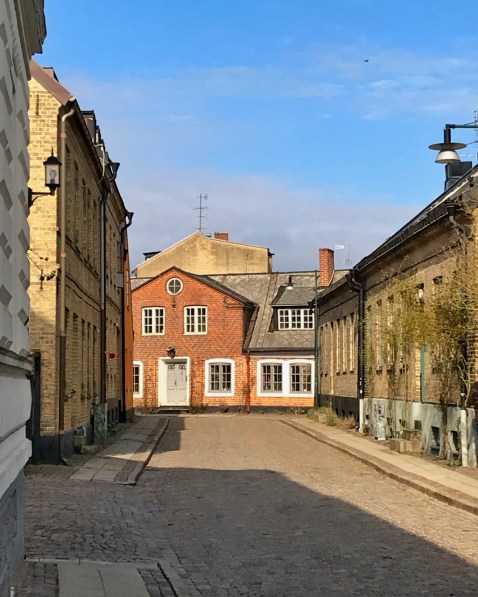 Lund, one of those lovely university towns that faintly smell of cow barn in the morning.
 In my mind, daffodils are flowers of old houses inhabited by sweet old ladies. In Finland they are mostly bright yellow wild daffodils. But oh, those special moments, when walking past a garden I would spot the smaller, white poet’s daffodil, with a little red crown. I could look at the intricate and symmetric architecture of a poet’s daffodil for a very long time.
 Good morning, Stockholm. New view of the city today: above Karolinska Institutet’s old brick university campus buildings, and the brand-spanking new, eponymous, monster hospital.
 In mid-March it was barely above freezing, but the sun was shining and the local bistro had put out deck chairs, hoping somebody would be brave enough. I was. Naturally, hot chocolate with a shot of mint liquor and a cloud of whipped cream helped me stay warm.
 This blue marble