Corona walks, alone or with friends, have become a favorite pastime of mine. This crisp September Saturday I strolled Østre Anlæg and Kastellet, my two favorite central Copenhagen parks, for 4 hours with a friend. We talked about living a creative life, hormonal hair loss and what ovulating feels like, how women’s proper dress is and is not described in the Quran (veils are not mentioned, by the way), and where to get good ice cream. Sometimes I want to run a mile when such topics are being brought forward, but today they felt necessary. Especially the ice cream.
Looks busy as usual, right? The truth is, when I flew back to Denmark in late August these two aircrafts were the only ones I could see across the entire terminal and runways. But the Finnair lounge was open, in contrast to my last visit in late July. Progress? Perhaps – or just a little bubble of normalcy before the next wave of coronavirus.
I was scheduled to be in Finland this weekend, mid-September. The incidence count in Denmark is three times higher than the limit for freely entering Finland. While I can always return home with a Finnish passport, I would need to self-quarantine, or take the chance that I bring illness to my parents’ small current home town, still nearly free of the virus. So I have postponed my flight until mid-December.
One last flight home for a weekend, before border control restrictions and quarantine were imposed once again. Here’s to hoping I can go back at least once before christmas.
Lovely ones, I survived my first week at the new job! What a major adjustment to have to go to the office at least 4 days a week, for the first time in nearly 10 years.
And what better way to treat oneself than to have brunch in the old town of Copenhagen with a friend who came all the way from Sweden to see me.
Biking to the office every day, and having brunch in Copenhagen on a Saturday: ten years ago when I was married in Finland and had just left my science career, I would never had imagined this to be a normal week in my life at the age of forty. But I guess “unpredictable” is also the very definition of life.
If the inhabitants of Lapinlahti mental hospital would have been well, I had envied them for their backyard views. Sitting there by my own free will, sipping my café-bought kombucha, I hope it gave them at least a tiny millimeter of peace and hope every day.
The Emperor of Russia gave an order to build an asylum for those needing psychiatric care, and Lapinlahti opened its doors in 1841, among the first mental hospitals in Europe. Until 2008 it has housed patients, and so so many individual destinies, hopes, fears, illusions, and disillusions.
The house is nestled in the nook of a shallow bay, surrounded landside by lush green parkland. Such a lovely place to find oneself when one is lost. Unfortunately it is never quite that simple.
Over here there really isn’t much coronavirus… the cases can still be counted on two hands. And yet we are only an hour’s drive away from Helsinki. Naturally, if I would bring coronavirus with me from Denmark the entire town would know about it within a week.
Five weeks in this beautiful green bubble have gone by fast. Wish I could stay longer. Waking up to cranes in the wheat fields and crows in the spruce trees corrects my priorities every morning.
Sturgeons are weird creatures. These girls are the ones who make caviar – and to whom it really belongs.
Sturgeons used to be everywhere: from the English channel to the Mediterranean, and from the Black Sea all the way throughout Siberia. Unfortunately, because catching one provides food to many, they have been fished to near-extinction.
The species of sturgeon that once swam in the Baltic Sea disappeared some 100 years ago. These days the only sturgeons out there are the Russian species which are from time to time farmed and let out into the waterways – and I have not heard of anyone catching one in a net, ever.
Curiously, these scary-looking fish lack teeth (except for the beluga sturgeon and another near-related species), and they do not use their eyes when they look for food or eat. Instead they have a good sense of smell, extended to a lot of chemical cues, and they sense weak electric signals from other living things nearby.
The Maretarium in Kotka specializes in fish found in Finnish waters – thus a lot of trout, perch, a few funny-looking pikes, and a bunch of funky eels. Even in cold Finland, where waters freeze over in the winter, there is so much going on underneath the bellies of bathing-suited summer lovers just skimming the surface of the water.
In Finland, park visitors are always welcome to walk on the grass, unless specifically told not to. Of course: the grass is there to feel nice and cool against one’s feet, soft to sit down on, and a cloud of green summer to lie in.
How different it was, then, to move to Cambridge ten years ago and to learn all the rules about walking on the grass. Generally, only fellows, professors, and higher were allowed to walk on the grass in Cambridge colleges. And gardeners, of course. Except for in Newnham, a college built as a beautiful but carefully guarded enclosed space for the girls coming to Cambridge to study. Because they were not allowed out without chaperoning, the college gardens were built for enjoyment – and grass was welcomed to be walked on.
At the Anjala manor in southeastern Finland, they must have seen many timid tourists who needed encouragement: Please, do walk on the grass!
Pyhtää used to be at the border between Sweden and Russia in the 18th century. It is odd to think how far into modern Finland the border stretched: by car the journey to the current border crossing is 80 kilometers.
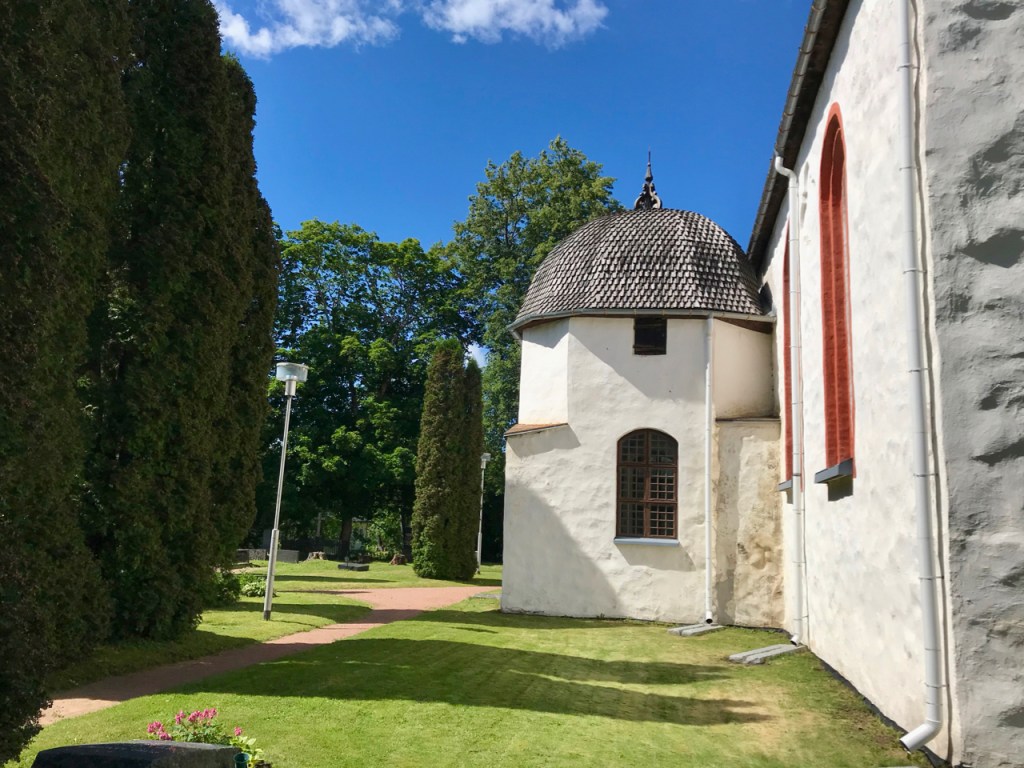
The church of Saint Henry was built around 1460, when Finland was part of Sweden. Elsewhere, this was the time of the War of the Roses, Aztecs, Renaissance, the “discovery” of America, and the Spanish inquisition. I doubt many here in Finland cared, though – the life here has always been relatively down-to-earth and simple. But this one masterpiece got built and it still stands today – very beautifully so.
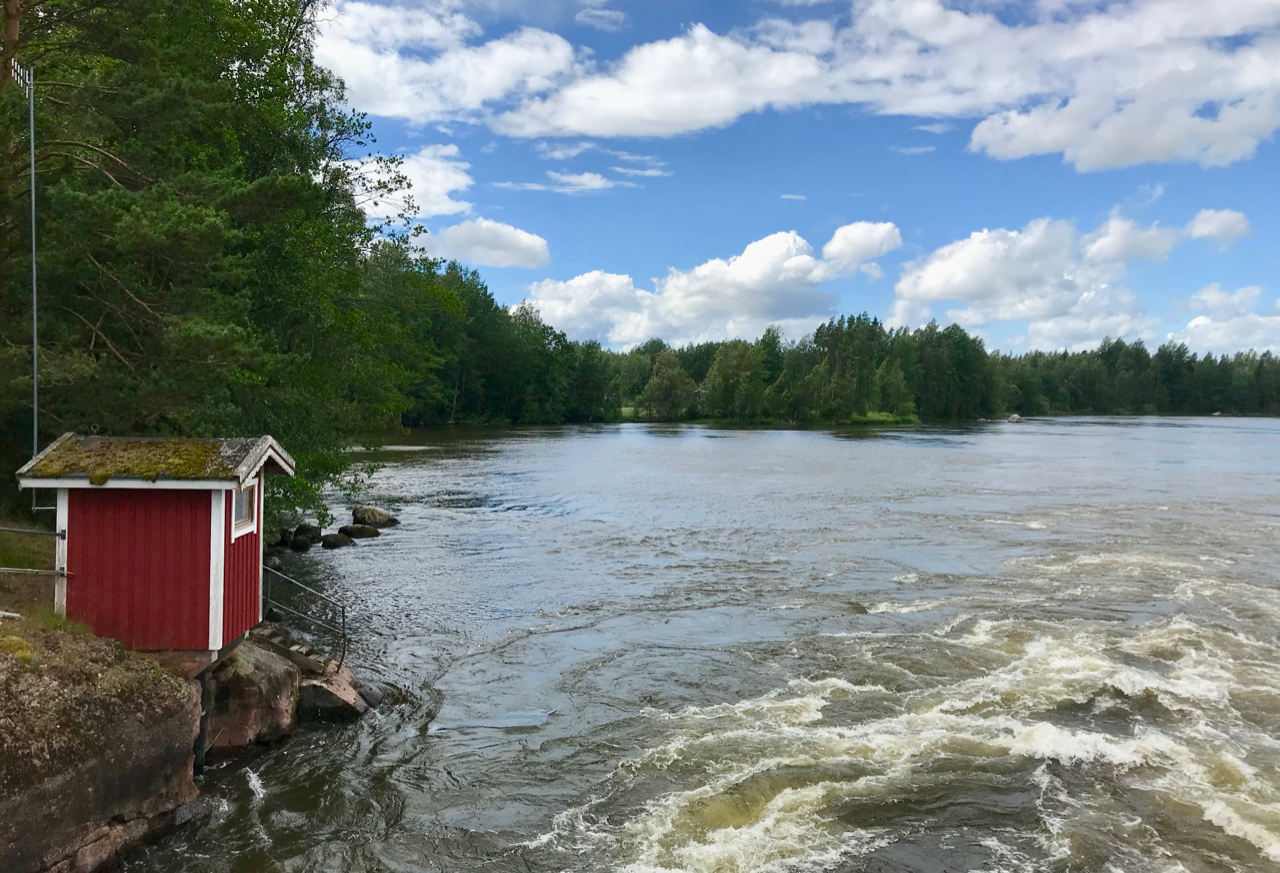
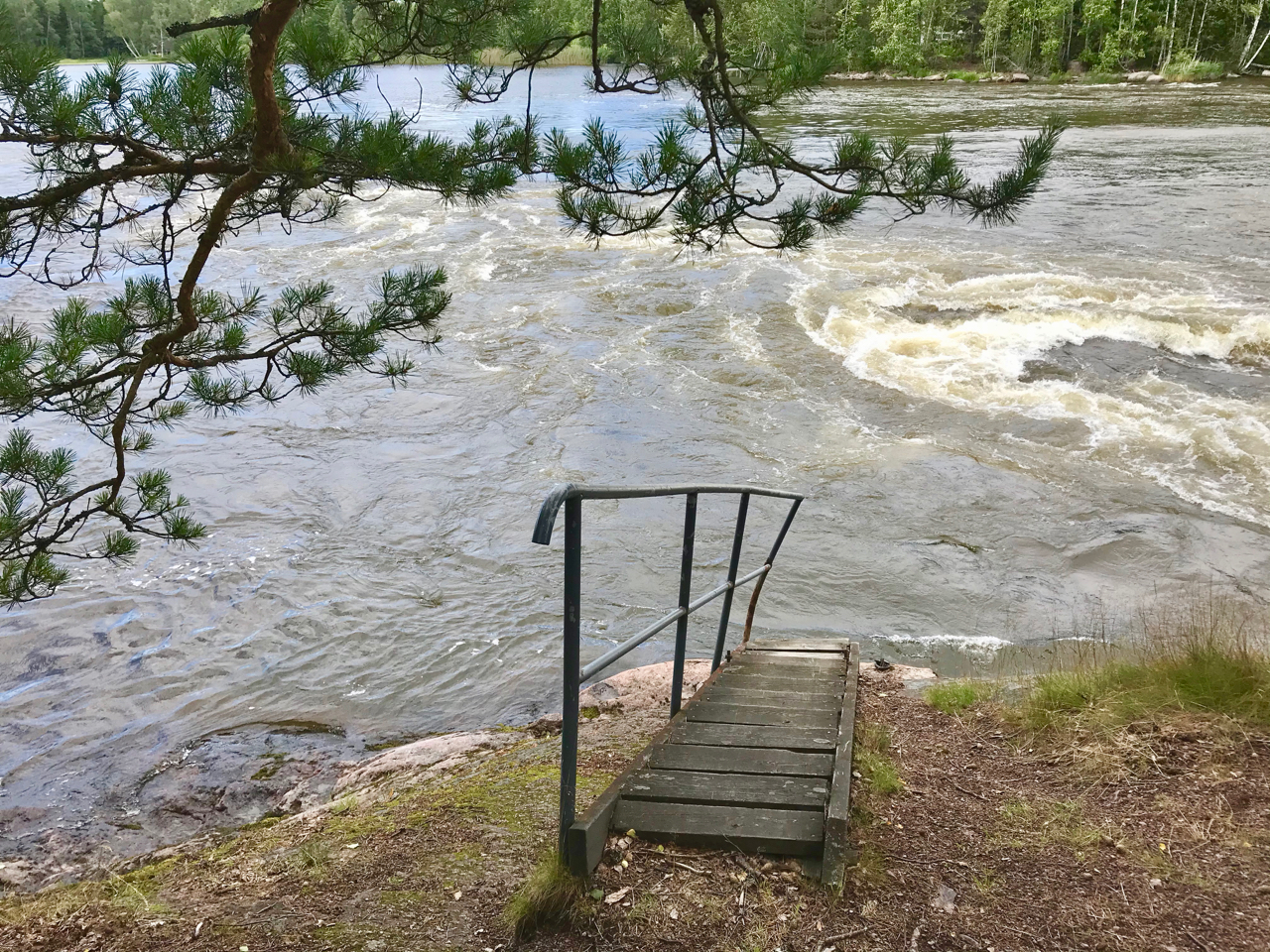
Kymi river is one of the big ones in Finland – although naturally for one used to the Danube or the Amazon it is a tiny stream. But the beauty of Kymi lies in its many rapids and whitewaters, perfect for fly fishing salmon and trout. And simply purifying one’s mind in the white noise of the water.
Ahvionkoski
This coronavirus summer, my father lead a family expedition to discover the various rapids of Kymi river. Every now and then we would get in the car and spend half a day driving around. How he knew how to find the various gravely forest roads leading down to obscure fishing spots along the many arms of Kymi river, I do not not know. Either he has photographic memory after studying Google Maps, or a very good memory from his youth adventures.
I forget which one this was… we stopped on a small bridge.
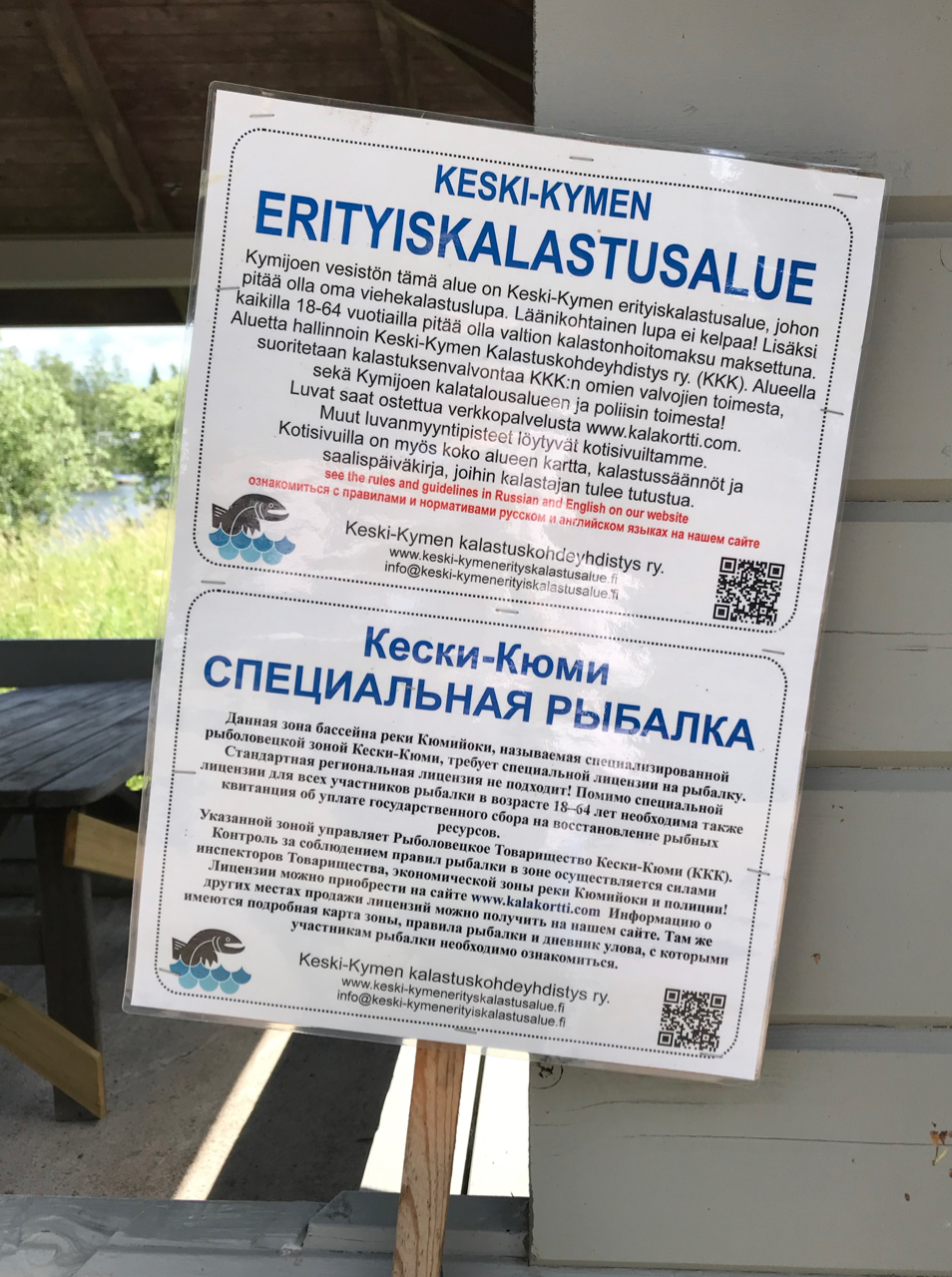
I tried to recall all the names of the rapids, but I realized we had been to many of which I have no photos, and others of which I have too many photos. But they all have one thing in common: the fishing rules are signposted in Finnish and Russian (and, surprisingly, not in Swedish, the other national language) – signaling that the border is nearby.
Hirvikoski
Many of the rapids are harnessed for hydropower use, and most do as far as I know not have fish ladders for salmon and trout to migrate upstream. On the one hand it makes me sad that the beauty is lost, but on the other hand I am grateful they are not dammed, and that fossil fuel is reduced at least a little bit thanks to the hydropower plants.

 Corona walks, alone or with friends, have become a favorite pastime of mine. This crisp September Saturday I strolled Østre Anlæg and Kastellet, my two favorite central Copenhagen parks, for 4 hours with a friend. We talked about living a creative life, hormonal hair loss and what ovulating feels like, how women’s proper dress is and is not described in the Quran (veils are not mentioned, by the way), and where to get good ice cream. Sometimes I want to run a mile when such topics are being brought forward, but today they felt necessary. Especially the ice cream.




 This blue marble