
 Opera houses and theaters were like bars and nightclubs today: places to see and be seen. And because cities were much smaller still in the 19th century, and the ruling class even smaller still, everybody did know everybody. Thus, going to the opera was like going to one grand party where you know all guests.
And what better than to go to a party held in a house decorated in splendid gold, mirrors, and red carpets? So thought the Emperor of Austria-Hungary as well, and commissioned the work of a new opera house in Vienna. 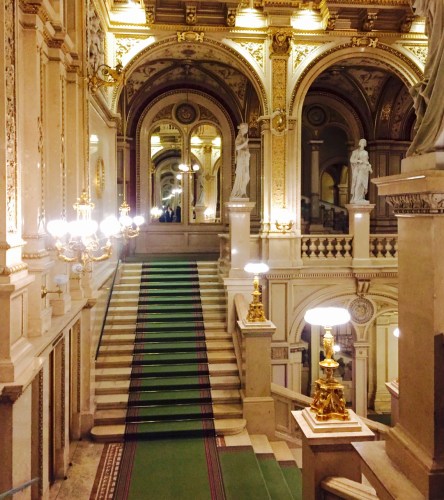 When the glorious building was finished, the architect and interior designer proudly showed it to the court. But their hearts were broken: the emperor thought it rather simple. He proclaimed it resembled a train station. The interior designer committed suicide before the opening night, and the architect died of a stroke not long after.
Life sucks sometimes. But the opera house is still standing. And, viewed through today’s minimalistic eyes that usually encounter bare surfaces, it is quite an extravaganza. Everything is relative.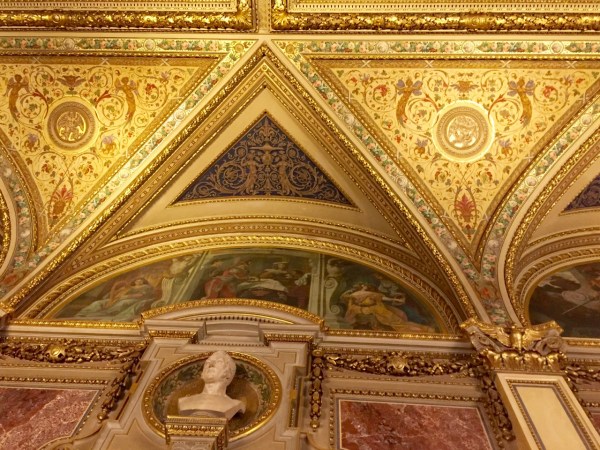 (Vienna, Austria; February 2017)
 On Donauinsel you can run a marathon by just running around the island. The thing is, though, it is only about 100 meters wide so you will be running back and forth on the same route.
 And at each top (or so I am told), you must dodge stark naked people bathing, biking, and skating.
 (Donauinsel, Vienna, Austria; February 2017)
 Who cares that Vienna was twice sieged by the Ottoman Turks, had its shares of plagues and epidemics, and was taken by Napoleon twice. What is remembered of Vienna today is the art, the Habsburg dynasty, the horses, the cakes, the waltzes; and the good, slightly decadent, living. And of course the music: Haydn, Schubert, Strauss, Mozart, and the rest.
 (Vienna, Austria; February 2017)
 Why is it that perfect control over animals is viewed as a beautiful thing in our human culture? Why is it that a perfectly behaving horse or dog is seen as a perfect companion; whereas a cat that levels with a person and establishes a deep friendship, where it still usually does as it pleases, is seen as uncomfortable or even unappreciated? The Spanish Riding School claims to only enhance the natural behavior of the Lipizzaner horses, but why must they be perfectly controlled by straight-backed men (and a few women) for us to love them? As I sat watching the Morgenarbeid (Morning Work) of the horses in the Spanish Riding School, I could not help but think of the incessant need for dominion over animals and anything else that is one of the deepest drives of us humans.
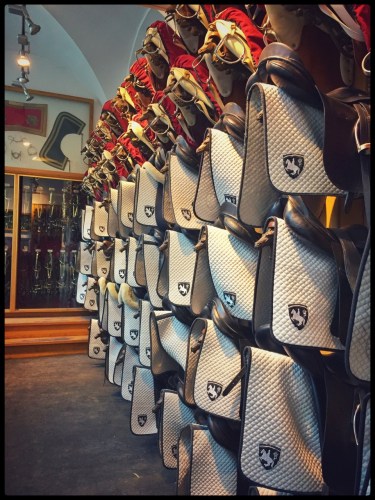 During the centuries, the horses have been involved in much human power play. Lipizzaner horses in the Spanish riding school in Vienna have an Italian name originating from a breeding place in Slovenia. European history in a nutshell. They were specially rescued during the World Wars and have been close to the hearts of the Austro-Hungarian emperors. Today they are close to the hearts of so many little girls and boys worldwide.
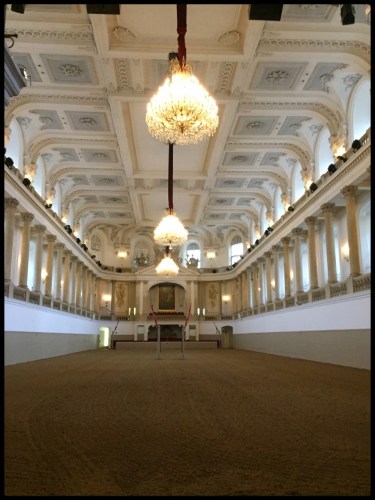 (Vienna, Austria; February 2017)
 Is it 4 shelves of closed books, spines turned inward? Is it a bunker, doors forever closed? Is it a chamber with something precious inside? Who knows. But people did have opinions when the holocaust memorial on the Judenplatz was revealed in 2000. Even some Jewish people thought it spoiled the beautiful little square.
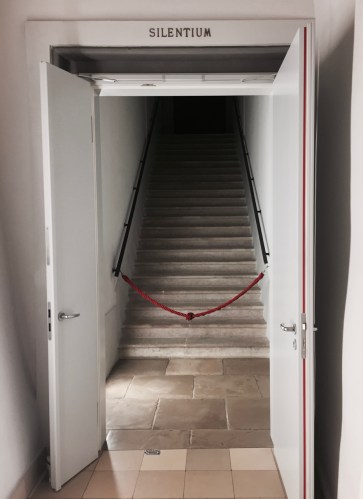 Silentium. Silence. For the sake of the bones of 145 Austrian emperors, empresses, church leaders, and other rather important people.
  Their earthly remains are encapsulated in copper and bronze tombs that are (mostly) elaborate. Some the size of a one-room apartment, decorated like a wedding cake on the outside. But for some very macabre reason, the hearts and intestines are missing from most of the persons. Because, natürlich, hearts and intestines were buried separately, in quite another crypt. All of this is very Egyptian, somehow.
 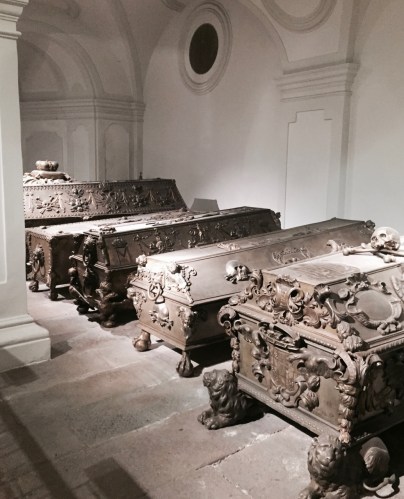 The Capucin crypt contains rows and rows of sleeping Habsburg emperors and empresses. Even Maximilian the Emperor of Mexico (yes, really, for a brief moment). But the two last emperors are missing. Franz Ferdinand, whose assassination snowballed into WWI, is buried elsewhere in Austria. His son Charles, the last proper emperor of Austria, is buried in Italy.
 (Capucin Crypt, Vienna, Austria; February 2017)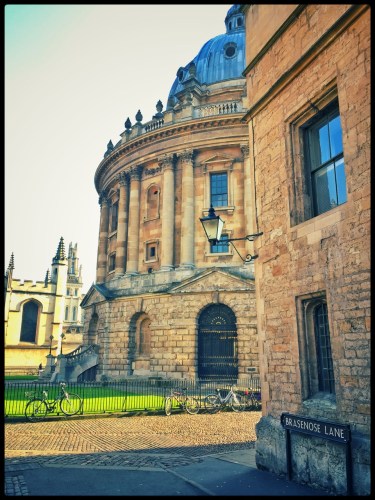
 But during that week there was no time to dream and remember. There were studies, 8 hours a day, with smart people from all around the world. There were too many age-old pubs. There was afternoon tea with champagne. There were colleges to discover.
 And there was even a futile attempt at fencing. Apparently, women wear a madonna bustier – hence the busty look. Another mystery solved. It also turns out well-mannered fencing men have serious trouble fighting a woman – not because of chivalry but because they must shamelessly attack the bustier.
 (Oxford, United Kingdom; January 2017)
 The Aztecs would turn over in their graves if they knew that their precious, spiced, bitter, sacred “Drink of Gods” is today mixed with sugar, milk, and vanilla; and sold in any grocery store and gas station.
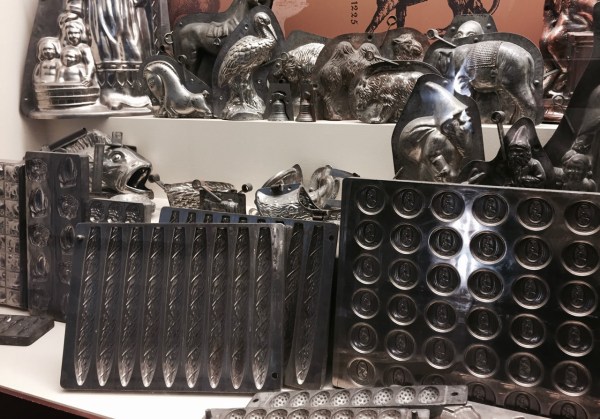 As I looked at various ancient tools for cleaning, fermenting, and preparing cocoa pods and beans, I could not help but wonder how the aztecs first got to performing the laborious process of picking, cleaning, fermenting two times, drying, and roasting the cocoa beans? Why did they not just satisfy themselves with the sweet pulp of the pod, spitting out the beans? Or perhaps somebody spit out the beans and left them to ferment and then dry and then his or her children ate them by mistake and found them delicious? Or perhaps their god appeared to a priest in a dream and told him how to make cacahuatl?
 And who first spilled sugar and milk into a drink that was served prepared in water; hot, spicy, and bitter? How did the drink of warriors, priests, and men requiring strength become the consoler of lonely women sitting by their televisions?
 (Bruges, Belgium; December 2016)
 Turns out Manneken Pis has a wardrobe, and a sister. Jeanneke Pis, with her yogic flexibility, looks like she is pleasantly meditating on the way of the world. You can find her peeing away in the end of a little dead-end street, just off the Grand Place.
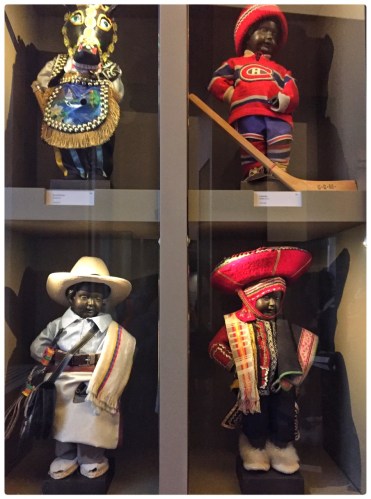 (Brussels, Belgium; December 2016)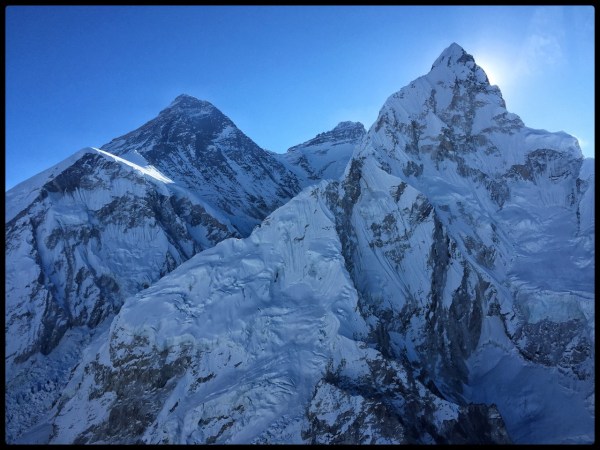
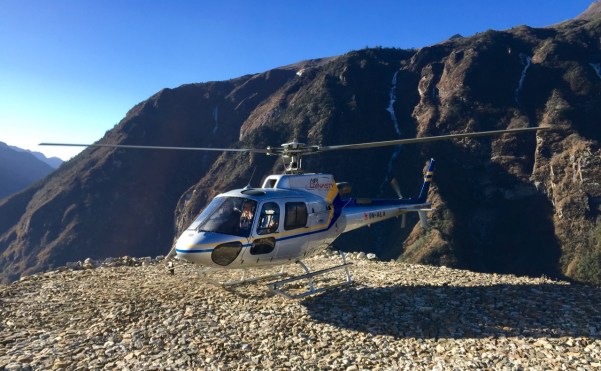 The helicopter was booked to fly all the way to Namche from Lukla, so indeed we did take it out for a spin first. My colleagues were dying to see Everest up close. It may sound lame but this was never on my bucket list. It was possibly the only thing missing from my bucket list. When the chopper landed I was not going to get on it. When it took off I was somehow onboard.
 The moon landscape that makes up the last 4 days of trekking is astonishing. It seems quite dead, but I am convinced it isn’t. This is the top of the world. Life is found in highly unlikely places. And while it is exotic and dangerous to us Europeans, sherpas and yaks consider this their home. Hats off to them (if anybody wears a hat anymore).
 (Namche Bazaar and Mt Everest, Nepal; November 2016)
 This blue marble