
 Winter detoxes and spring cleanses never seem to go out of mode. To be honest, as a scientist I do not believe in quick “detoxing” (I also do not believe one can “wring toxins out of the liver” while squeezing into certain yoga poses). But I do believe in resetting metabolism: resetting energy intake and resetting cravings for salt, sugar, fat, pickles, candy – you name your own craving.
And so, nearly my entire adult life I have taken a timeout of one to three weeks, early on in the year, and focused on clean, healthy, often light food. I have tried a version of the “heart surgery diet” or the “cabbage soup diet” – mainly for excess fluid loss and carb reset, not weight loss. I have also tried three or four different Goop detoxes and found them insanely expensive, adventurous, and delicious.
The past few years I have used a version of an ayurvedic kitchari detox. My ayurvedic dosha is pitta – except for that some of it, and especially my digestive system, is kapha. The combination of mung bean dhal, lots of spices, pickled ginger, and a little rice just works. Especially if you have a slow metabolism or kapha imbalance, or just feel tired during the winter time you might want to give this a go.
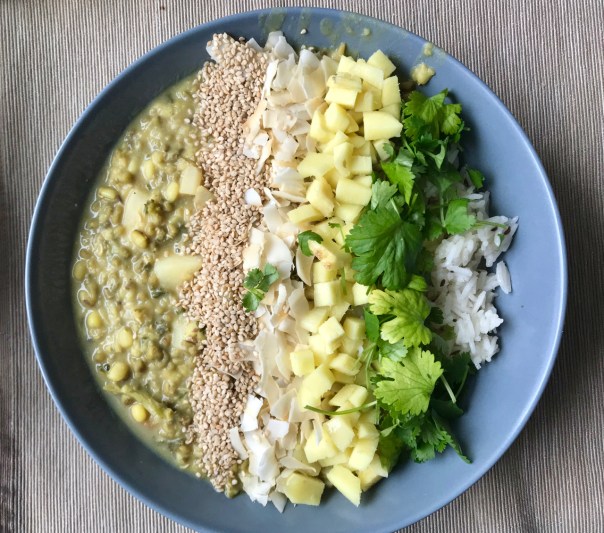
The catch with this winter reset, first published on Oh Holy Basil, is that you really must like this dish because it is all you eat. Every day. The recommendation is a three-day diet but I throw in a light almond milk based smoothie every morning and combine that with the kitchari for seven days. Why on earth?? Because it gives my stomach a well-deserved rest. No surprises. No difficult-to-digest raw vegetables, bloating short carbs and sugars, and no chemical additives or caffeine or alcohol. Just highly nutritious, easy-to-digest, clean foods. Every day. And this dish is delicious, especially with the condiments of pickled ginger, shredded coconut, sesame seeds, and fresh cilantro.
My week-long simple reset is as follows:
Morning: Half a lemon squeezed into a glass of warm water, with a dash of cayenne pepper stirred through (to wake up my kapha belly). Followed by a 4 dl smoothie blended from a banana, almond milk, super green powder (think spirulina, wheat shoots, nettle), and maca powder.
Lunch and dinner: Kitchari with rice and condiments, as much as you feel like having. Have some more in-between meals if you feel hungry. If you go for an entire week, make sure you go plenty on the ghee or coconut oil, and cook the mung beans well. I prefer to sprout them for up to 36 hours in a bowl of water in room-temperature prior to cooking, to aid my digestion. I also add up to twice as much spices than in the recipe below (and go even heavier on the turmeric).
To drink: No alcohol, of course. No caffeine also means no black or green tea. Only that glass of fresh lemon water in the morning, followed by herbal teas and water. There are lots of gently and tastily spiced herbal teas out there. Not sure how much good they actually do, but for example the Pukka brand is good for exploration during a reset.
This is not a diet to lose weight; it is a diet for feeling good. You might end up losing some fluid and weight if you go for an entire week. If you do not feel your stomach, even after a heavy meal, this diet is probably working for you. You also do not need expensive adaptogens and Moon Dust (google it if you don’t know what it is) but I like to throw in the things I normally take: holy basil, maca, ashwagandha if I am under pressure at work, and vitamin D + calcium as well as vitamin B12 (as I am vegetarian).
An actual reset is also about resetting one’s mind. Try yoga, meditation, or just sitting in stillness, listening to sounds around you and to your own body. Read, go for walks in Nature, or take a bath. Try to spend less time consuming anything in your life that is not either bringing you a sense of calm or a sense of self-improvement (and that includes dramatic tabloid news, Facebook, and cat videos on Youtube).
The recipe for the actual dish follows below, with a grateful nod to Dillon at Oh Holy Basil. If you have tried this, or another “detox” / cleanse / reset you absolutely recommend, please drop me a line as I do like to experiment and improve.
INGREDIENTS
- 1 cup yellow split mung beans (not the whole green ones she says, but I’ve never found yellow ones anywhere), washed and soaked at least 6 hours, preferably overnight, see note
- 2 tablespoons ghee or coconut oil
- ½ teaspoon mustard seed
- ½ teaspoon cumin seed
- 5 cardamom pods
- 1 cinnamon stick
- ½ teaspoon turmeric
- pinch asafetida, if available, otherwise omit it
- 6 cups water
- salt to taste
- 2-3 cups turnips, sunchokes or other mild root vegetables, thinly sliced into half moons
- ½ bunch of kale or the reserved turnip greens from the turnips, sliced very thin
- 1 lime, juiced
- 1 cup basmati rice, preferably soaked for one hour, otherwise rinsed
- 1 tablespoon ghee or coconut oil
- 1 teaspoon cumin seeds
- 4 cardamom pods
- ¼ teaspoon salt
- 2 cups boiling water
- cilantro leaves
- lime
- shredded coconut
- sesame seeds
- melted ghee
- ginger tonic, recipe follows
INSTRUCTIONS
- Drain and rinse the mung beans in a fine mesh sieve and leave them to drain of their excess water.
- In a medium pot, heat the ghee or coconut oil, cumin seeds, mustard seeds, cardamom pods and cinnamon stick over medium heat until the mustard seeds begin to pop. Immediately add the turmeric, asafetida and mung beans and cook, stirring frequently for about a minute. Add the water and bring to a boil. Reduce to a simmer, partially covered and cook for about 45 minutes or until the mung beans have broken down, loosing their district form. Add the root vegetables and salt and cook for 15-20 minutes more, until they are quite soft. Add the greens and cook about five minutes more. Turn off the heat and add the lime juice. While the dal is cooking, make the rice.
- Drain the rice in a fine mesh strainer and rinse a couple of times.
- Heat the ghee or coconut oil, cumin seeds and cardamom pods over medium heat and cook for about 30 seconds. Add the rice and cook, stirring frequently for a minute or two more, until the rice is well toasted but not yet browning. Add the boiling water and boil the rice, uncovered for five minutes. Reduce heat, cover and let simmer until all of the water is absorbed, about 10 minutes.
- To serve put some rice into a bowl and ladle the dal over top of it. Garnish with cilantro, a hearty squeeze of lime juice, the coconut, sesame seeds and melted ghee, if using. Top with a couple of teaspoons of the ginger tonic.
NOTES
GINGER TONIC
- a large piece of fresh ginger, peeled and cut into tiny cubes
- lime juice
- sea salt
INSTRUCTIONS
- Place the ginger in a small bowl and coat with a liberal squeeze of lime juice. Sprinkle with a good pinch of salt and set aside to let marinate for at least 20 minutes.
- Cover and store in the refrigerator.
(Brande, Denmark; February 2019)
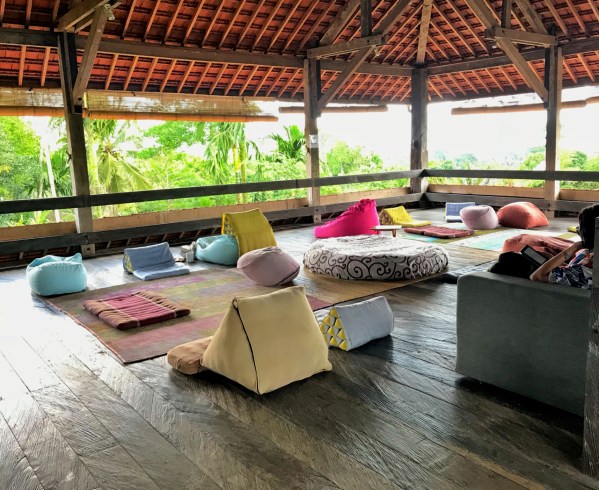 Silence comes so easily. There is no need to read while eating. Everybody seems to prefer looking out into the jungle. I am lounging on the airy top floor of the main lodge, on a beanbag on the floor. There are couches and cushions and more beanbags, and an entire library of books to read. A handful of guests are digesting their dinner with me. Nobody makes a sound, except for the tokee that just woke up in the ceiling, and the rooster that seems to prefer sunset over sunrise in announcing his presence to the world. The first frogs just started their concert.
 (Near Batu Karu, Bali, Indonesia; August 2018)
 Last night there was a New Moon ceremony: agnihotra. The entire silent retreat sat in a large circle around a ceremonial fire, thirty faces lit up by the warm glow of the flames. We chanted a verse of giving things up to the fire. Over and over again for probably an entire hour. I lost track of time as I stared into the bowl of flicking flames.
 (Near Batu Karu, Bali, Indonesia; August 2018)
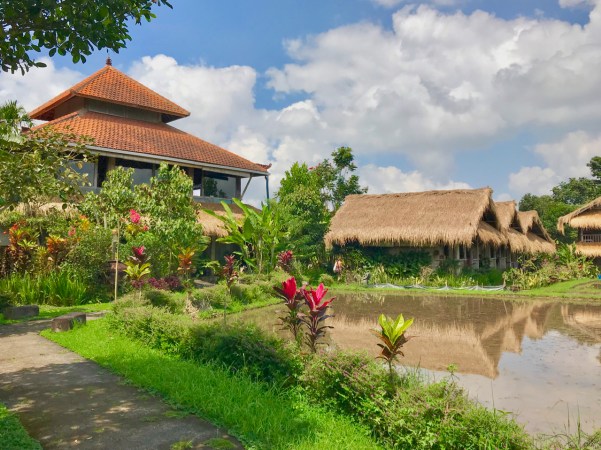 The jungle is loud still at 5.30 am when the gong wakes me up for morning meditation. At 6 am the light changes to an otherworldly, soft purple and the animals of night leave their shift, one by one: an owl quietens, followed by the other night birds, and finally the cicadas. Just the next moment, a day bird picks up where its nocturnal colleagues left off: one loud, confident whistle, without a moment’s doubt that the sun will soon rise. The bird’s rival (or friend?) answers. And the day begins.
 (Near Batu Karu, Bali, Indonesia; August 2018)
 While the earthquake has thrown my Bali holiday upside down, I have also worked on standing upside down. Even after 4 years of practice, falling backwards from a headstand is a real fear. My headstand requires the vicinity of a wall or an instructor. I rarely need them, but sometimes I do.
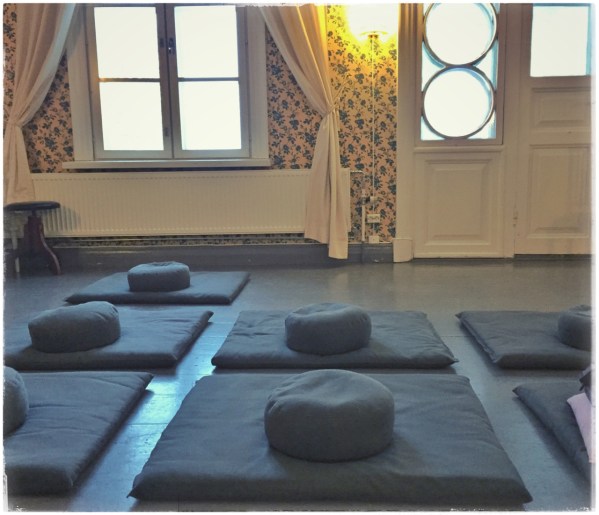 For just one day I checked out of my own life. I reconnected with the person living that life instead. Under the skin of the person who travels 2-3 days a week for work, and consciously has to carve out time for life beyond a job she loves, are ants running around. The trick is, one only discovers them when one stops for a moment.
 Sitting in the shade of coral rocks on the beach. A crab is cleaning out its dwelling in the sand, after the receding tide swept its front door shut. My dwelling is a simple bungalow with wood worms eating out my bed from the inside. Nature is (still) everywhere on Zanzibar.
 Somehow this holiday also became a holiday from ashtanga Mysore practice. I am exploring new things in yoga after a challenging experience last year on Bali that subconsciously dragged down my willingness to adhere to the practice. I confess I have practised very little since then. And before this week, I have only two (very unpleasant) lead vinyasa flow experiences under my belt. Performed in a gym with instructors who lead us like we’d be doing aerobics. But now I am signed up for a week’s vinyasa flow, once in the mornings and once in the evenings.
 Switching gears: from diving to yoga and one last week back in Nungwi. For this very week I have hauled my yoga mat around Africa for nearly two months. I could (and should!) have practised during those months, but either the room was too small or the schedule was too packed or the company was too good, or [insert other well-curated excuses here].
 (Nungwi, Zanzibar, Tanzania; August 2017)
 This blue marble