 Winter detoxes and spring cleanses never seem to go out of mode. To be honest, as a scientist I do not believe in quick “detoxing” (I also do not believe one can “wring toxins out of the liver” while squeezing into certain yoga poses). But I do believe in resetting metabolism: resetting energy intake and resetting cravings for salt, sugar, fat, pickles, candy – you name your own craving.
And so, nearly my entire adult life I have taken a timeout of one to three weeks, early on in the year, and focused on clean, healthy, often light food. I have tried a version of the “heart surgery diet” or the “cabbage soup diet” – mainly for excess fluid loss and carb reset, not weight loss. I have also tried three or four different Goop detoxes and found them insanely expensive, adventurous, and delicious.
The past few years I have used a version of an ayurvedic kitchari detox. My ayurvedic dosha is pitta – except for that some of it, and especially my digestive system, is kapha. The combination of mung bean dhal, lots of spices, pickled ginger, and a little rice just works. Especially if you have a slow metabolism or kapha imbalance, or just feel tired during the winter time you might want to give this a go.
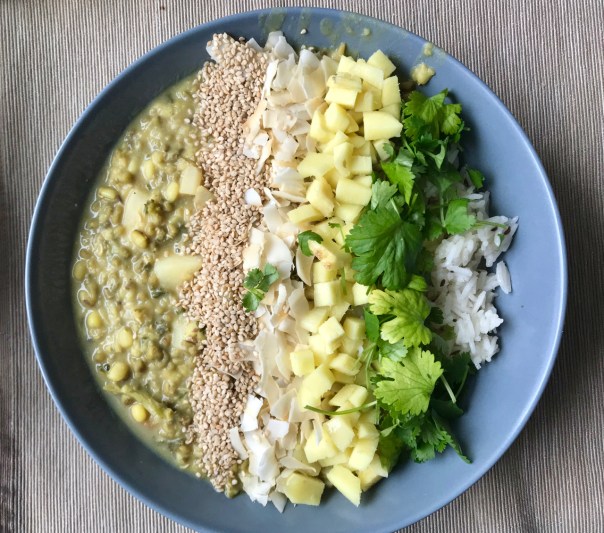
The catch with this winter reset, first published on Oh Holy Basil, is that you really must like this dish because it is all you eat. Every day. The recommendation is a three-day diet but I throw in a light almond milk based smoothie every morning and combine that with the kitchari for seven days. Why on earth?? Because it gives my stomach a well-deserved rest. No surprises. No difficult-to-digest raw vegetables, bloating short carbs and sugars, and no chemical additives or caffeine or alcohol. Just highly nutritious, easy-to-digest, clean foods. Every day. And this dish is delicious, especially with the condiments of pickled ginger, shredded coconut, sesame seeds, and fresh cilantro.
My week-long simple reset is as follows:
Morning: Half a lemon squeezed into a glass of warm water, with a dash of cayenne pepper stirred through (to wake up my kapha belly). Followed by a 4 dl smoothie blended from a banana, almond milk, super green powder (think spirulina, wheat shoots, nettle), and maca powder.
Lunch and dinner: Kitchari with rice and condiments, as much as you feel like having. Have some more in-between meals if you feel hungry. If you go for an entire week, make sure you go plenty on the ghee or coconut oil, and cook the mung beans well. I prefer to sprout them for up to 36 hours in a bowl of water in room-temperature prior to cooking, to aid my digestion. I also add up to twice as much spices than in the recipe below (and go even heavier on the turmeric).
To drink: No alcohol, of course. No caffeine also means no black or green tea. Only that glass of fresh lemon water in the morning, followed by herbal teas and water. There are lots of gently and tastily spiced herbal teas out there. Not sure how much good they actually do, but for example the Pukka brand is good for exploration during a reset.
This is not a diet to lose weight; it is a diet for feeling good. You might end up losing some fluid and weight if you go for an entire week. If you do not feel your stomach, even after a heavy meal, this diet is probably working for you. You also do not need expensive adaptogens and Moon Dust (google it if you don’t know what it is) but I like to throw in the things I normally take: holy basil, maca, ashwagandha if I am under pressure at work, and vitamin D + calcium as well as vitamin B12 (as I am vegetarian).
An actual reset is also about resetting one’s mind. Try yoga, meditation, or just sitting in stillness, listening to sounds around you and to your own body. Read, go for walks in Nature, or take a bath. Try to spend less time consuming anything in your life that is not either bringing you a sense of calm or a sense of self-improvement (and that includes dramatic tabloid news, Facebook, and cat videos on Youtube).
The recipe for the actual dish follows below, with a grateful nod to Dillon at Oh Holy Basil. If you have tried this, or another “detox” / cleanse / reset you absolutely recommend, please drop me a line as I do like to experiment and improve.
- 1 cup yellow split mung beans (not the whole green ones she says, but I’ve never found yellow ones anywhere), washed and soaked at least 6 hours, preferably overnight, see note
- 2 tablespoons ghee or coconut oil
- ½ teaspoon mustard seed
- ½ teaspoon cumin seed
- 5 cardamom pods
- 1 cinnamon stick
- ½ teaspoon turmeric
- pinch asafetida, if available, otherwise omit it
- 6 cups water
- salt to taste
- 2-3 cups turnips, sunchokes or other mild root vegetables, thinly sliced into half moons
- ½ bunch of kale or the reserved turnip greens from the turnips, sliced very thin
- 1 lime, juiced
- 1 cup basmati rice, preferably soaked for one hour, otherwise rinsed
- 1 tablespoon ghee or coconut oil
- 1 teaspoon cumin seeds
- 4 cardamom pods
- ¼ teaspoon salt
- 2 cups boiling water
- cilantro leaves
- lime
- shredded coconut
- sesame seeds
- melted ghee
- ginger tonic, recipe follows
- Drain and rinse the mung beans in a fine mesh sieve and leave them to drain of their excess water.
- In a medium pot, heat the ghee or coconut oil, cumin seeds, mustard seeds, cardamom pods and cinnamon stick over medium heat until the mustard seeds begin to pop. Immediately add the turmeric, asafetida and mung beans and cook, stirring frequently for about a minute. Add the water and bring to a boil. Reduce to a simmer, partially covered and cook for about 45 minutes or until the mung beans have broken down, loosing their district form. Add the root vegetables and salt and cook for 15-20 minutes more, until they are quite soft. Add the greens and cook about five minutes more. Turn off the heat and add the lime juice. While the dal is cooking, make the rice.
- Drain the rice in a fine mesh strainer and rinse a couple of times.
- Heat the ghee or coconut oil, cumin seeds and cardamom pods over medium heat and cook for about 30 seconds. Add the rice and cook, stirring frequently for a minute or two more, until the rice is well toasted but not yet browning. Add the boiling water and boil the rice, uncovered for five minutes. Reduce heat, cover and let simmer until all of the water is absorbed, about 10 minutes.
- To serve put some rice into a bowl and ladle the dal over top of it. Garnish with cilantro, a hearty squeeze of lime juice, the coconut, sesame seeds and melted ghee, if using. Top with a couple of teaspoons of the ginger tonic.
If you forget to soak your mung beans overnight, do not dismay. You can do a quick soak by pouring boiling water over them and letting them soak for just one hour.
GINGER TONIC
- a large piece of fresh ginger, peeled and cut into tiny cubes
- lime juice
- sea salt
- Place the ginger in a small bowl and coat with a liberal squeeze of lime juice. Sprinkle with a good pinch of salt and set aside to let marinate for at least 20 minutes.
- Cover and store in the refrigerator.
(Brande, Denmark; February 2019)


 Lovely ones, something quite different for a change: my favorite yin yoga sequence. Why? Because yin yoga complements both daily stress as well as most types of workout, including ashtanga yoga. Yin poses first stretch the muscles open and then go to work on the connective tissue: the fascia, tendons, and ligaments. Not only are knotted muscles relieved, but blood flow into joints increases, as does overall flexibility.
 Every second Sunday a big box arrives on my doorstep. Inside are the ingredients for three days of fresh, vegan, organic, unconventional meals, ready within 10-15 minutes each. Not only are the meals green and fast, they are also interesting: Indian curries, Levantese falafel pitas, and Mediterranean goodness. The salads, dressings and toppings that provide detail are often combinations I have never even thought of.
 The gorgeous forest trails around the house are all unlit at night (oh why? Same thing in Brande!). So on winter’s working days I resort to running a paved route which takes me to the top of Vejle. And the way down is steep. Christian Wintersvej is claimed to be the steepest road in Denmark. Unfortunately I have no photos but trust me, there is a descent so steep in this flat country that it requires the pedestrian section to be made as a looong stairway. While I choose to tackle this one downward it is nearly impossible to cover by running without knee pain at the bottom of the descent.
 (Vejle, Denmark; October 2019)
 Today’s view from the living room. A cloud chose to hang out with us here in Vejle. Unfortunately that means we can’t see anything…
 It is late. But I have chamomile tea and a flashlight by the bed. My sister’s tea cups are the size of buckets, just the way I like it.
 Past five days: beautiful lunar eclipse, working from a cellphone hotspot, family dinners, lots of sunshine, gardening, and this cottage all to myself.
 Whisked into hot almond milk, curcumin latte is the warmth of the sun in a cup. This one comes with ginger, cinnamon, and black pepper for extra heat. Heat is good, not only in the winter, but also as a digestive for people whose bellies burn with a slow flame, like me.
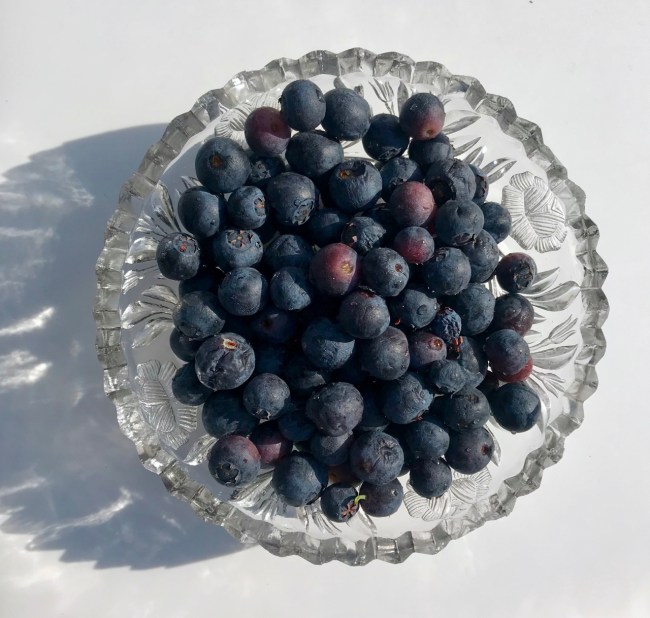 Blueberries and bilberries are the same, right? Wrong. Blueberries found in our European supermarkets all-year round are cultivated highbush blueberries, juicy and light or green inside. The blue berries found in the Northern European forests are bilberries. These are the ones that stain your fingers and tongue when you eat them straight from the bush.
 This blue marble