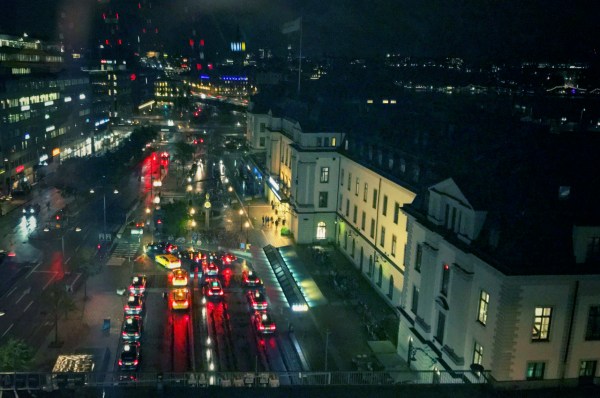
 It is dark and stormy over Stockholm tonight. Work laptops fuming over cups of steaming tea.
(Stockholm, Sweden; September 2018)

It is dark and stormy over Stockholm tonight. Work laptops fuming over cups of steaming tea.
(Stockholm, Sweden; September 2018)
 Fall has arrived in Denmark. A few heathers still flower on the moor in the backs of the town. This moor is scattered with cattle gates and fences, but I never see the animals. Not even horses from the nearby stable.
Jogging down the trail I hit beach sand from time to time, even if I am an hour or more from both the Atlantic Ocean and the Baltic Sea. Jutland, the peninsula of Denmark, is old seafloor turned into moorland. Instead of fish swimming around there are now mainly people walking their dogs. And me in my brand-new trail shoes.
(Brande, Denmark; August 2018)

They shut the road through the woods
Seventy years ago.
Weather and rain have undone it again,
And now you would never know
There was once a road through the woods
Before they planted the trees.
It is underneath the coppice and heath,
And the thin anemones.
Only the keeper sees
That, where the ring-dove broods,
And the badgers roll at ease,
There was once a road through the woods.Yet, if you enter the woods
Of a summer evening late,
When the night-air cools on the trout-ringed pools
Where the otter whistles his mate,
(They fear not men in the woods,
Because they see so few.)
You will hear the beat of a horse’s feet,
And the swish of a skirt in the dew,
Steadily cantering through
The misty solitudes,
As though they perfectly knew
The old lost road through the woods.
But there is no road through the woods.(Rudyard Kipling)
 (Loviisa, Finland; August 2018)
 Ever wished you could do this and try that and go there – without any of the wishes ever coming true? Why do we spend more time dreaming than making dreams reality? Why do we speak of wishes “coming true” instead of “being made true”?
I wrote the above three years ago, but it stands true today. And September 2017, one year ago, my Day Zero challenge came to a close. In January 2015 I set out to accomplish 101 things in 1001 days. Did I accomplish them all? No, because I listed quite a few major bucket list items to choose from, such as let go of past grief, learn a new language, and undertake major trips. But I accomplished 56/100, with another 6 items marked “in progress”. And I managed to visit the French Riviera not 1 time but 3 times, and same goes for practicing yoga on Bali. I found I loved those two places so much I kept going back. Perhaps without the Day Zero challenge I would still not know exactly what I have been missing out on.
Was it worth it? For sure. Otherwise I would probably not have spent a rainy day in bed in my PJs, watching movies and learning to knit socks. Or taken a ride in a hot-air balloon. Or accomplished some financial goals. Or traveled to Bali or trekked on the Everest Base Camp trail.
Life is not a rehearsal. You are the star of your show, every day, regardless of whether you are up for it or not. Trust me, the past few years I have mainly not been up for it. Yet life has happened anyway. It tends to do that, every day. We can choose to either drift down-current, or rig the sails, list our goals as bearings, and use life’s unpredictability and impermanence to change what we wish changed, and do what we always dreamed of doing.
So list your goals and begin doing instead of dreaming. For inspiration, here are my completed goals. And by the way, I am, too: already working through a 101 Goals, Vol. 2.
(Brande, Denmark; September 2018. Photo from Skeleton Coast, Namibia; July 2017)
 “Apologies for the sudden lift.” The captain’s voice shot down through the intercom of the cabin. “We had to go around as there was another plane on the runway.”
My new home airport has only one runway. It is a major airport, but a major provincial airport. You can see this also from the rows and rows of cars and rental cars in the park: here one does not get far by public transport or taxi.
Staying in Denmark will also mean hello SAS Gold and then Diamond status, and good-bye Finnair Platinum. While I consider this a downgrade, I look forward to significant upgrades in my work-life balance. Traveling 1-3 days a week means the remaining work days I can roll out of bed and sit down by the laptop half an hour later, with ample time for a relaxed morning. No need to pick out business wear or lipstick or do my hair, unless I have a video conference. No need to commute in the morning rush hour, or to rush home via a stock-full grocery store (because we aim to shop weekly).
Working from home means 2 precious hours more time for myself, every day. I am beginning to like the concept of living nearby a provincial airport. (Billund, Danmark; August 2018)
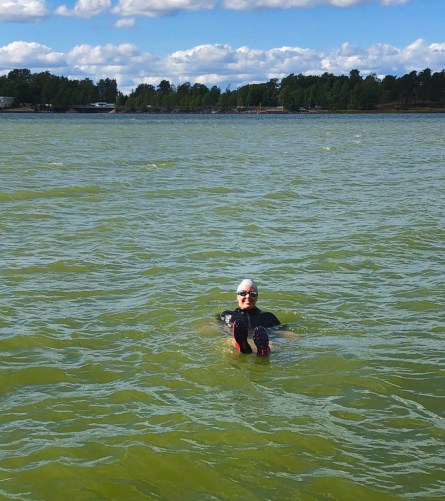 One beautiful August morning, there I was, bobbing in between two scraggy islets in the outer archipelago of Stockholm, wearing sneakers, wetsuit, goggles, swim cap, and a colored team t-shirt. A drone circled above us and there were camera people in the water, too. Along with about 350 other colleagues, like groups of colored ants clawing away at the water, drifting from shore to shore.
Swimrun means swim and run. No time to change gear in-between. The original swimrun is 41 km on this same group of islands, although we only completed a 9 km course. And it was more than many of us ever dreamed they would accomplish. Some were 60 years old, you see. Others were scared of swimming in open water. And quite a few were nervous about running such a long distance. But everybody had a buddy and a tow rope for pulling a tired swimmer, and it was not uncommon to see people pushing their colleague in the back, making running just a tiny bit lighter.  The company I work for aims to have a healthy workforce. The local Nordic managing director takes things a notch further. This year it was the swimrun. A few years back nearly 300 of us climbed a mountain in Norway. We have also biked around Skagen in Denmark, spent an entire day outside in a snow mobile suit in -27C in Lapland (some of us got cold burns), and gone horseback riding on Iceland.
And so the entire company swam and ran between the islets of Utö in Sweden, pushing, pulling, and coaching each other until we crossed the finish line, one team at a time. Because it was never about winning a race against anyone else except for ourselves and our prejudices about our own capabilities and performance. And quite a few witnessed their own minds reset to new levels of at-minimum-achievement. (Utö, Sweden; August 2018)
 Above the clouds, 33,000 ft up, it is easier to obtain a new perspective of things. Not because it is easier to look down on the Earth, but because I am stuck in an airplane seat for nearly 12 hours straight, en route from Singapore to Helsinki.
When I first visited Bali in 2015, I reflected on pain and how people could ever just move on. In 2016 the reflections were on the process and how many miles were still ahead before I would pull through to the other side of a disruption in my life that began as far back as 2011.
For me, travels are not only luxury me-time, but times of significant personal growth and reflection. On 2014 on Crete I stopped and stood still for the first time in 3 years. I slept more than I had in 3 years, too. So much I believed I was in severe ill-health. I was simply tired after years of pain and running.
Working with the inside and slowly turning attention outward took the best of 6 years. And this year I received a proper kick in the behind by the Universe. A year earlier I had decided that I would stay abroad during the time the apartment in Helsinki was undergoing replumbing works, along with the entire co-op building. Bathrooms torn out and apartments out of use for months.
Be careful for what you ask for, as the Universe may give it to you but not always exactly the way you imagined it. And so I return back home just to do my travel laundry, stash summer clothes away in a box, pack a suitcase with fall clothes and business wear, and head out through the door to another part of the world, to another adventure. (Bali, Indonesia; August 2018)
 In the middle of all this beauty and silence it is difficult to remember what day it is, or when the day of departure arrives. And how does one confirm a flight’s departure time or check in, when there is no internet miles around?
The ladies at our retreat office advised me of an internet café down in the village, and the route to this village. “Hati-hati” (“be careful”), one said. “Of what?” I asked, alarmed. “Dogs? Other people?” But she only smiled, saying the walk was no more than 15 minutes.
I began to walk down the narrow road between the rice paddies, and passed a few small villages. Dogs, I thought. If a dog were to attack me here, or out between the villages, who would help me? I do not look local or smell local, and no local person walks. Everybody rides a scooter. I have been bitten by a Balinese dog before so hiding my fear of them is not possible, no matter how loud I yell back at them.
I passed three very placid dogs, and began to relax. Then a European man on a scooter drove by me, stopped, and asked if I needed a ride. He drove me all the way to the internet warung, which proved to be not 15 but a 25 min walk away. The Balinese ladies at the office have probably never crossed the entire distance on foot.
The warung was a local haunt, with a little kitchen, a television, and a couple of grimy couches. The lovely owner behind the counter gave me wifi access in exchange for a large bottle of water, which I quite needed.
A few minutes later I was up to date: flights still on track, no new major aftershocks or deaths on Bali or Lombok after the quake earlier in the month, but over 400 dead, and thousands left homeless. My week at the retreat had been calm and quakeless. No more than a day later I would be reminded of how fortunate I was: the same night, hours after my departure, there would be another proper shake that frightened people on Bali and would have flattened things on Lombok, had there been anything left to flatten. Hati-hati, dear survivors on Lombok.
When I was about to head back to the retreat, up the hill and through the villages, the wife of the warung-keeper asked if she could give me a ride. She was busy cooking, but she did not like to see me walk. Hati-hati, she said. Clearly wandering around the village roads was not a thing to do here. I accepted, the wife convinced her husband to drive me up with his scooter, and I offered a fair price for the ride.
On my return I met an American woman at the office. She looked restless. It turned out she had approached the office ladies with the same request: wifi to check in on a flight, just a little while after I did. She had began to walk down but had not got past the first village where she met not one but two growling dogs blocking her way. The owner of the dogs was leaving on a scooter but did not want to give her even a short ride past the house of the dogs. She asked him to control his dogs, unaware that Bali dogs belong to a house, not a master. He had duly advised her not to try to pass the dogs on the road, and driven away leaving her alone with the beasts. She was forced to turn around and walk back.
I was lucky. And despite how much I distrust the safety of scooters and motorbikes on Bali (at least in my hands!), I know first-hand that I dislike dog bites even more. Hati-hati of dogs on Bali if you visit.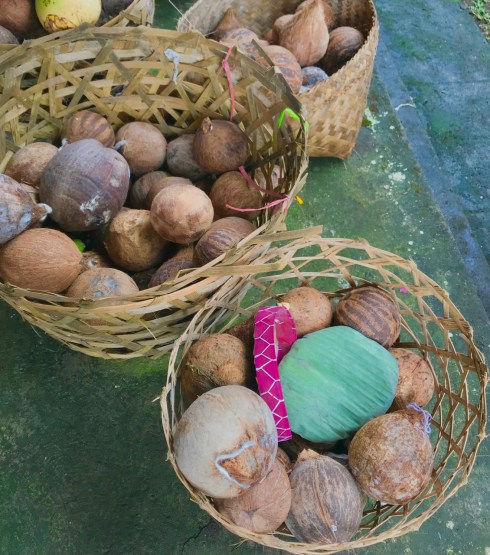 (Near Batu Karu, Bali, Indonesia; August 2018)
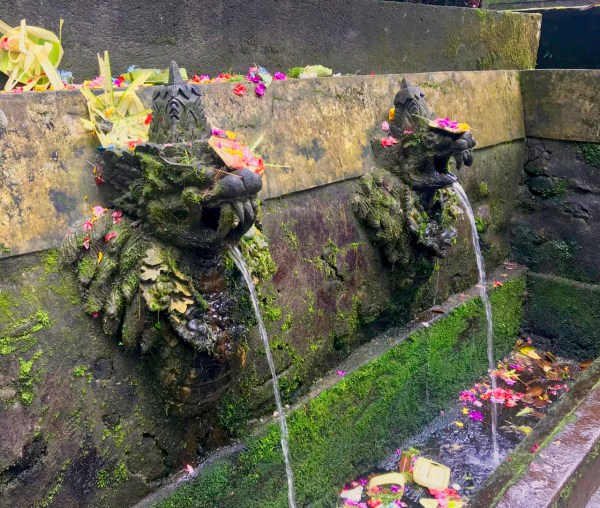
 On Bali, every building has a place and every item, even a flower placed, has significance. Balinese homes are built according to a certain layout, and so are towns. The underlying logic is that upstream means pure where as the further downstream you go, the dirtier becomes the use of the water or a place. And on an island littered with volcanoes, the highest upstream one can go is to the flank of the volcano.
  Thus, the temple for the god Brahma (pura puseh) is best located on the highest end of the village, facing a sacred volcano (usually Mt Agung). In the middle of the village one can find a pura desa, the temple for Vishnu and for local village deities. And in the lower end of the village, preferably furthest away from a sacred volcano and most often near the cemetery, lies a pura dalem, the temple of Shiva and death (and rebirth).
  The sea is a frightening might and requires special attention. Thus sea temples are special (like Tanah Lot and Uluwatu). On the island, water is sacred and necessary for the Balinese, especially for rice cultivation. Water temples are special, too. Like the “temple by the lake”, Danu Bratan; as well as the Batukaru temple, located on the foothills of the eponymous volcano.
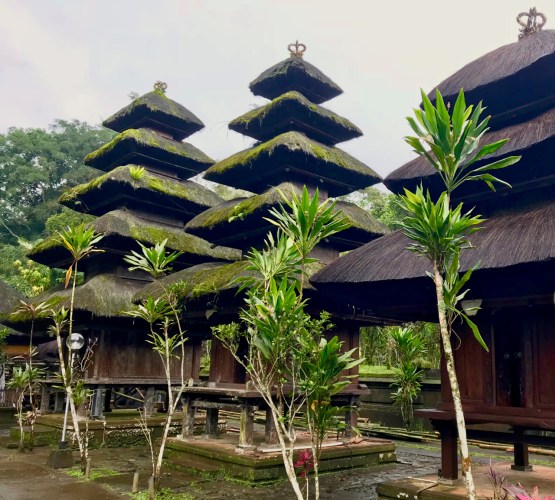 Our little bemo minivan drove a bunch of us curious tourists up to the doors of the temple. We were fortunate: it was open for non-worshipers.
Not every temple on Bali has a job to shield the island from evil. Only nine most sacred temples have this all-important task. Also, it is not every day an important temple renews the roofs of its pagodas, the meru. Thus a celebration will be in order – once the ladies are finished with putting the last touches of palm fiber on the new roofs. Tomorrow there will be curries, barbeques, fresh fruit, and coconuts: a real feast.
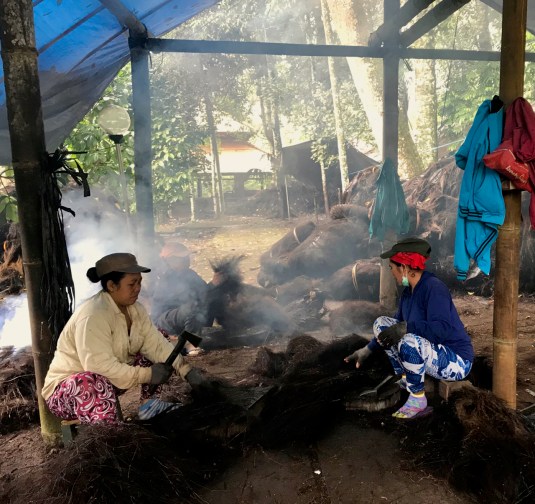 (Pura Luhu Batukaru, Tabanan, Bali, Indonesia: August 2018)
 This morning a little bemo minivan took us to the nearby hot springs. After all, the silent retreat sits on the slope of a sleeping volcano, but a volcano nonetheless.
The group split into two hot pools, and I claimed the third pool to myself. As we lay soaking in hot geothermal water that slowly dyed us all carrot orange, swimwear included, I could not help but notice how loud some of the retreat guests were, now that they were allowed to speak. Our calm and firm yoga teacher was full of energy. A solitary young lady was full of loud jokes and one-liners. After easing in to the social world for an entire hour in my solo pool, I finally joined the group to participate in the conversation.
We humans are social creatures. But we often forget that “social” simply means that we need each other to thrive; it does not imply constant chatter. I am an extravert and I obtain energy from being around people who inspire me. I must remember that “being around” does not always need to equal “chatting with”. “Silence is better than unmeaning words”, said the antique Greek mathematician and philosopher Pythagoras (who by the way ran his school like a silent retreat).
 (Near Batu Karu, Bali, Indonesia; August 2018)
 This blue marble