
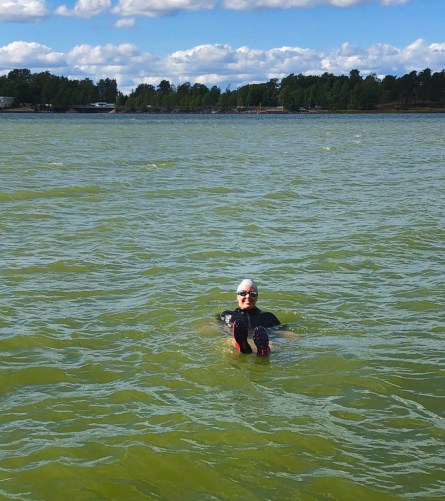
 One beautiful August morning, there I was, bobbing in between two scraggy islets in the outer archipelago of Stockholm, wearing sneakers, wetsuit, goggles, swim cap, and a colored team t-shirt. A drone circled above us and there were camera people in the water, too. Along with about 350 other colleagues, like groups of colored ants clawing away at the water, drifting from shore to shore.
Swimrun means swim and run. No time to change gear in-between. The original swimrun is 41 km on this same group of islands, although we only completed a 9 km course. And it was more than many of us ever dreamed they would accomplish. Some were 60 years old, you see. Others were scared of swimming in open water. And quite a few were nervous about running such a long distance. But everybody had a buddy and a tow rope for pulling a tired swimmer, and it was not uncommon to see people pushing their colleague in the back, making running just a tiny bit lighter.  The company I work for aims to have a healthy workforce. The local Nordic managing director takes things a notch further. This year it was the swimrun. A few years back nearly 300 of us climbed a mountain in Norway. We have also biked around Skagen in Denmark, spent an entire day outside in a snow mobile suit in -27C in Lapland (some of us got cold burns), and gone horseback riding on Iceland.
And so the entire company swam and ran between the islets of Utö in Sweden, pushing, pulling, and coaching each other until we crossed the finish line, one team at a time. Because it was never about winning a race against anyone else except for ourselves and our prejudices about our own capabilities and performance. And quite a few witnessed their own minds reset to new levels of at-minimum-achievement. (Utö, Sweden; August 2018)
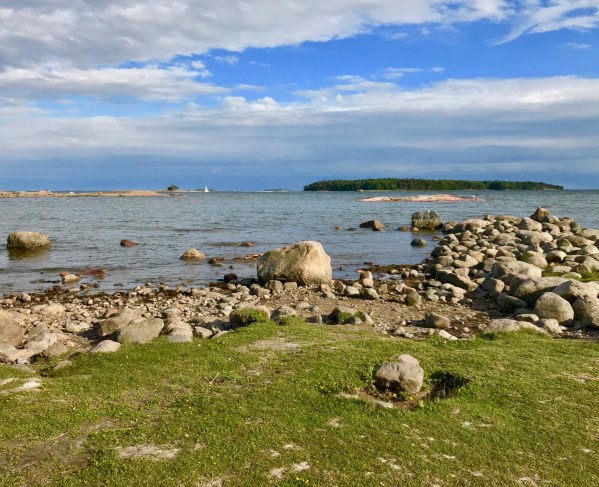 Dear Lauttasaari island, you have been good to me. You have been my safe haven for years. A place to hide and to just stare at the (mostly windy) sea.
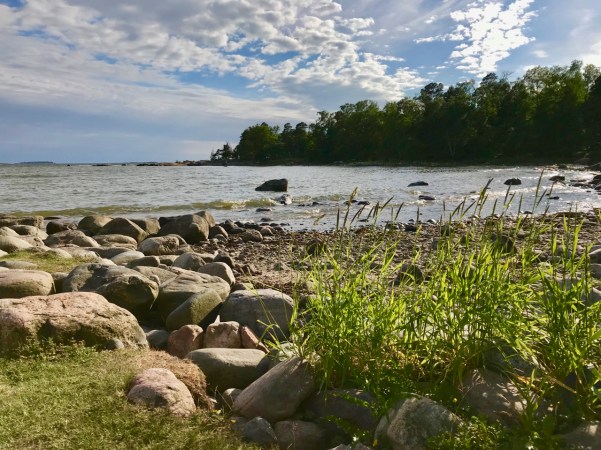 Dear Lauttasaari, I will miss your sea, sunshine, and the vast open space. The ships leaving for various Baltic port cities, and the sound of broken ice blocks floating on the water in spring.
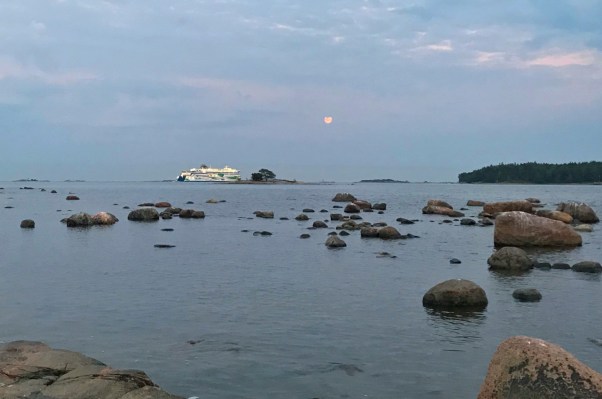 (Helsinki, Finland; August 2018)
 Above the clouds, 33,000 ft up, it is easier to obtain a new perspective of things. Not because it is easier to look down on the Earth, but because I am stuck in an airplane seat for nearly 12 hours straight, en route from Singapore to Helsinki.
 (Bali, Indonesia; August 2018)
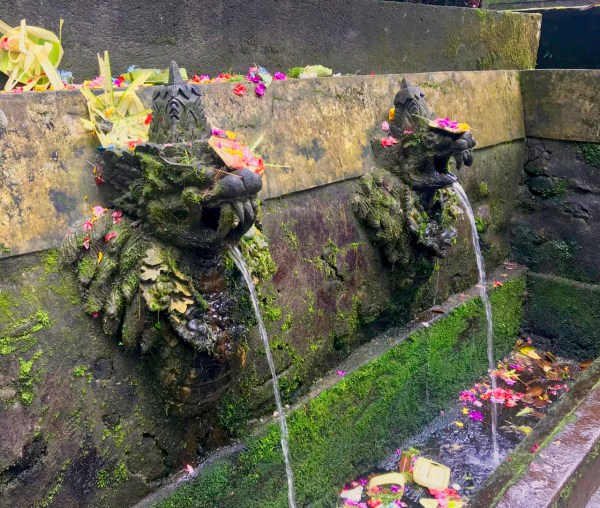 In the middle of all this beauty and silence it is difficult to remember what day it is, or when the day of departure arrives. And how does one confirm a flight’s departure time or check in, when there is no internet miles around?
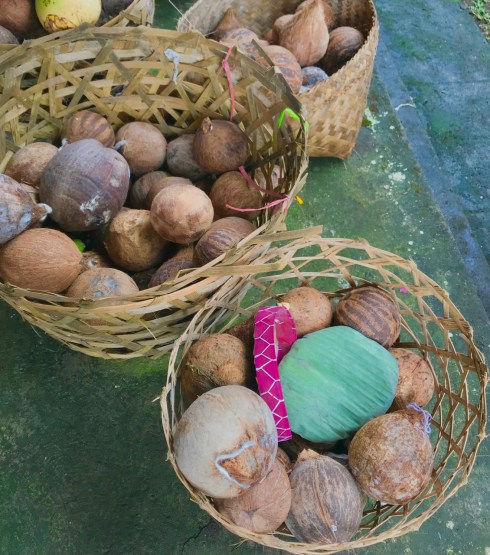 (Near Batu Karu, Bali, Indonesia; August 2018)
 On Bali, every building has a place and every item, even a flower placed, has significance. Balinese homes are built according to a certain layout, and so are towns. The underlying logic is that upstream means pure where as the further downstream you go, the dirtier becomes the use of the water or a place. And on an island littered with volcanoes, the highest upstream one can go is to the flank of the volcano.
  Thus, the temple for the god Brahma (pura puseh) is best located on the highest end of the village, facing a sacred volcano (usually Mt Agung). In the middle of the village one can find a pura desa, the temple for Vishnu and for local village deities. And in the lower end of the village, preferably furthest away from a sacred volcano and most often near the cemetery, lies a pura dalem, the temple of Shiva and death (and rebirth).
  The sea is a frightening might and requires special attention. Thus sea temples are special (like
 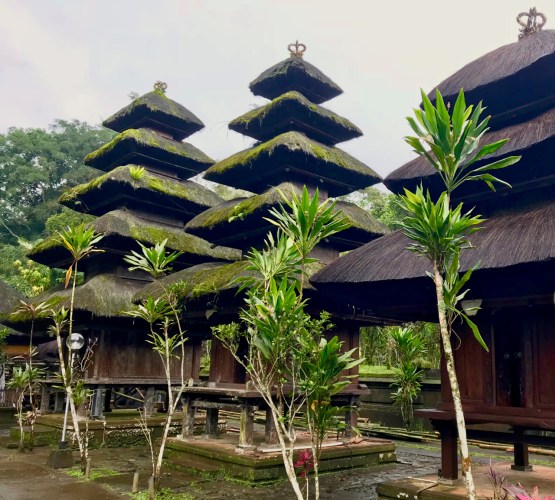 Our little bemo minivan drove a bunch of us curious tourists up to the doors of the temple. We were fortunate: it was open for non-worshipers.
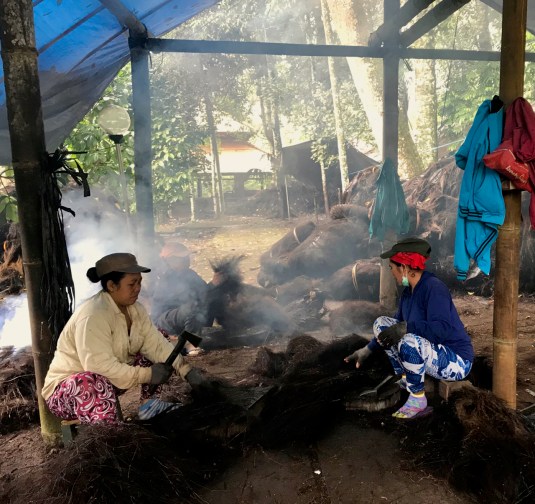 (Pura Luhu Batukaru, Tabanan, Bali, Indonesia: August 2018)
 This morning a little bemo minivan took us to the nearby hot springs. After all, the silent retreat sits on the slope of a sleeping volcano, but a volcano nonetheless.
 (Near Batu Karu, Bali, Indonesia; August 2018)
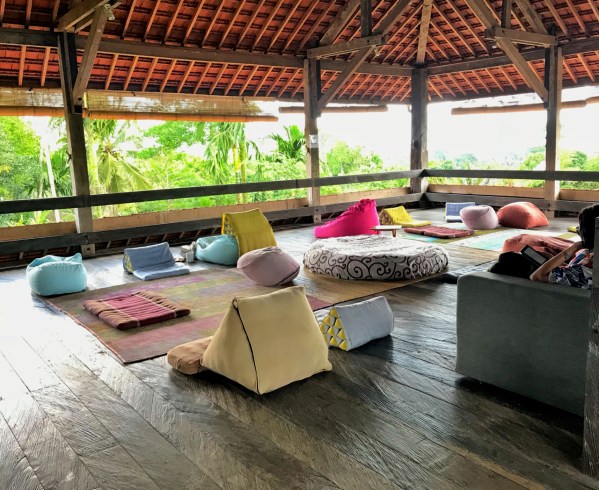 Silence comes so easily. There is no need to read while eating. Everybody seems to prefer looking out into the jungle. I am lounging on the airy top floor of the main lodge, on a beanbag on the floor. There are couches and cushions and more beanbags, and an entire library of books to read. A handful of guests are digesting their dinner with me. Nobody makes a sound, except for the tokee that just woke up in the ceiling, and the rooster that seems to prefer sunset over sunrise in announcing his presence to the world. The first frogs just started their concert.
 (Near Batu Karu, Bali, Indonesia; August 2018)
 Last night there was a New Moon ceremony: agnihotra. The entire silent retreat sat in a large circle around a ceremonial fire, thirty faces lit up by the warm glow of the flames. We chanted a verse of giving things up to the fire. Over and over again for probably an entire hour. I lost track of time as I stared into the bowl of flicking flames.
 (Near Batu Karu, Bali, Indonesia; August 2018)
 I had jungle greens for lunch. Ferns and some local shoots unknown to me. They were placed out in a big, beautiful, green bouquet. One brews one’s own tea from fresh herbs stuck in pots of water. Usually the herbs are featured in a guide hanging from the wall. Sofar, only once have I been unlucky enough to brew tea out of something incredibly bitter.
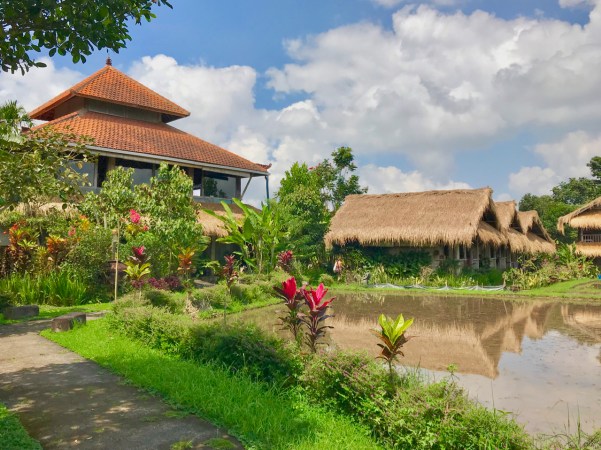 The jungle is loud still at 5.30 am when the gong wakes me up for morning meditation. At 6 am the light changes to an otherworldly, soft purple and the animals of night leave their shift, one by one: an owl quietens, followed by the other night birds, and finally the cicadas. Just the next moment, a day bird picks up where its nocturnal colleagues left off: one loud, confident whistle, without a moment’s doubt that the sun will soon rise. The bird’s rival (or friend?) answers. And the day begins.
 (Near Batu Karu, Bali, Indonesia; August 2018)
 This blue marble