
 Busy. Warm. Crowded. Brightly lit. This is a Donostian pintxo bar on a Wednesday or Thursday night, the night of pintxopote. The waiters (all men sweat over the counter (although thankfully not onto the pintxos). Sangria and cider flow, and I am the only solo guest.
I wonder how long I get to keep my corner table. Pintxopote is a bar-crawl tradition from the recent economic recession in Spain, where Basque bars enticed locals to spend money outdoors, by offering a pintxo and a small drink for 2-3 euro. In San Sebastián old town it is on Wednesdays, and in Gros on Thursdays. A “pintxo” is a tapa, usually on bread. A “pote” is a drink in Basque.
The pintxos are good but oil, bread, and cheese are a killer combination for dinner every day. Literally. I wish pintxos would include a side salad. I doubt the Basques eat vegetables in any other form than cooked, grilled, or pickled.
Time to crawl back out into the fresh air to find a nice seaside café for a nightcap.
(San Sebastián, and photo from Getaría, Spain; August 2019)
 Oh, such a change: from wheat noodles and sauce, lard on rye bread, and very few non-meat options to an abundance of antipasti, tapenade, bread, and cheeses. Fresh gelato. Wonderfully fat green olives. Aioli. Salvation.
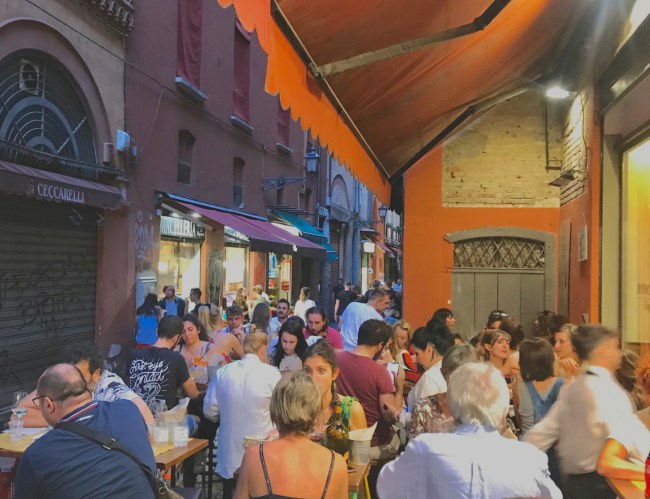 I find myself exposed to several “food capitals” this summer: I am still in San Sebastián, the city with the most Michelin stars; and writing about the food capital of Italy: Bologna. What else can one say but “go there and eat everything that’s put in front of you”? It is bound to be a success.
  (Bologna, Italy; July 2019)
 Himbeeren, Blaubeeren, Brombeeren. The best you can get in the summer, if strawberries are not available. Or perhaps, even if they were available.
 Whisked into hot almond milk, curcumin latte is the warmth of the sun in a cup. This one comes with ginger, cinnamon, and black pepper for extra heat. Heat is good, not only in the winter, but also as a digestive for people whose bellies burn with a slow flame, like me.
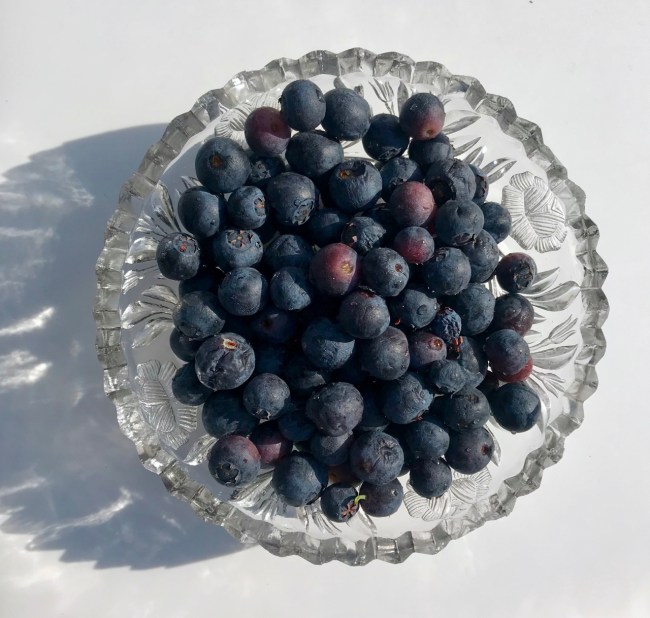 Blueberries and bilberries are the same, right? Wrong. Blueberries found in our European supermarkets all-year round are cultivated highbush blueberries, juicy and light or green inside. The blue berries found in the Northern European forests are bilberries. These are the ones that stain your fingers and tongue when you eat them straight from the bush.
 Hetvägg (”hot wall”). With marzipan. Just like it used to be for hundreds of years. While most people in Finland prefer their bun dry in hand, mine definitely likes hot milk better.
 Apologies for the food photo, but I am on Bali (yes, again). Thus this will not remain as the only one from my stay. You see, the healthy, locally produced (and mostly raw) food trend is on another level here.
 There are no holes in Swiss cheese in its proper form: melted into a fondue pan, and mixed with white wine and a hint of garlic. In this form it is solid, warming energy on a cold winter’s day. Fat and carbs galore (because oh, all the bread served!).
 Les Halles in Zurich is not like Les Halles in Paris. Its is much better. Sure, you get Moules (mussels) there, too, but the feeling is that of a food hall and not of a modern shopping center.
 (Zurich, Switzerland; February 2018)
 The laskiaispulla (FIN), or fastlagsbulle (Swedish dialect in FIN), fastelavnsbolle (NO) or semla (SE) is one hell of a calorie bomb: sweetbread carved out to harbor a clump of juicy, bitter-almond tasting marzipan (or raspberry jam for the heretics), with a cloud of whipped cream on top. But what else do you want on a cold February Shrove Tuesday when the body craves for energy?
 This blue marble