 Last day of class today: this girl has Fin(n)ished Spanish. We played hangman, or rather, nuestra profesor’s version where the poor guy or gal is forced down steps into an ocean full of sharks.
Two weeks have improved my Spanish speaking skills by leaps and bounds. When I arrived I was able to understand slow and clear conversation, and I knew all of A1 level grammar. Now I am better at picking up spoken Spanish, and my poor brain does not require quite as much computing before it manages to spit out a sentence. Whether that sentence is entirely correct is up to chance, but at least speed to output has improved quite much. A2 level is mainly past tenses and future tenses, and will be difficult to master at home without the constant drilling of a live small group setting. I may need to come back here to get a hold of it.
My housemate came clomping home at 5 am this morning, from pintxopote (pintxo and drink for 2.50 euros all over town). Her alarm went off at 8 am – and kept going off at regular intervals until I left for school. I quite liked the modern classical music sound of her alarm but could not understand how one can sleep through it. Then again, if one does not wake up to one’s alarm, it is probably healthier to just catch up on sleep. And she did show up for the second half of the class – well done housemate.
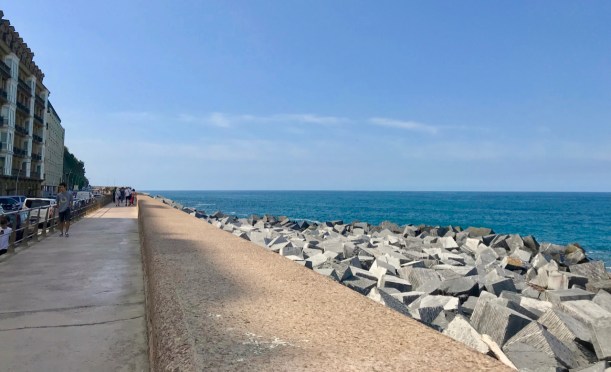
I spent the afternoon writing on a bench behind mount Urgull, overlooking the promenade and the sea. It is the only place in the city without a bar, since the pop-up bar opened on top of mount Urgull. This promenade is also one of the few open spaces without houses, as well, and people come here to take in the fresh sea airs and watch the waves. At least daytime. Night time is probably quite the adventure. Oh, and quite a few locals come out here to fish with line and rod. Sardines, perhaps?
I quite like the cityscape of San Sebastián. It is just the people I am out of sync with: the hours the stores are open are the hours I am either in class or busy with something else. Lunch time, when I would rather shop, they are closed for siesta (this is of course beneficial for my budget). The lack of healthy early café breakfasts is a problem, especially between yoga class and school start. The late lunches are a problem: if one must skip breakfast, why can’t one be served lunch anywhere by noon the latest? The way-too-late dinners (starting at 8 pm) are a problem because I need to be in bed by 10.30 if not sooner, and asking my body to digest food while sleeping means more fat stored where I do not want it to be stored. The elbowing tactics in pintxo bars and the lack of quiet cafés and lounges to read and write in is also a challenge.
Perhaps if I lived here and were less dependent on food services I might quite like San Sebastián’s lifestyle. After all, beach, yoga, good food (other than pintxos) and outdoors is not a bad combination.
(San Sebastián, Spain; August 2019)

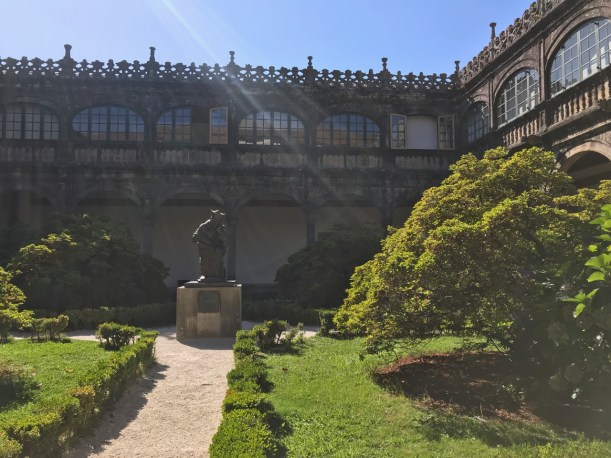 Born in 1495, the university of Santiago de Compostela is one of the oldest still functioning universities in the world. Initially it was the local archbishop Fonseca who thought that knowledge should be properly cultivated in his local hoods. And so he opened his swanky family palace to serve students and education. That was obviously not good enough as he ended up founding an entire university. The Fonseca college is still functional today – and a charming place to visit.
 Tired trekkers stumble into the main cathedral square from a side street. In twos, threes, and sometimes alone they throw down their packings, with scallop shells on string tinkling, before seating themselves on the cold cobblestones. Dusty shoes come off. Hats are pushed back. Many lie down for a nap in the shade. As the day grows warm the square fills up with exhausted pilgrims who have made it all the way.
 The Camino de Santiago, or the Way of St James, ends in front of the Santiago de Compostela cathedral. Why do people walk for weeks, often all the way from the South of Spain, Portugal, or France, to sit down on a church square in a small Spanish city? It is hardly to go inside to worship what is believed to be the remains of the saint James. Perhaps some walk in order to rediscover their Christian faith. Or to just jump off from the daily squirrel wheel to reflect on life and bearings. And perhaps some do it for health, because one can only earn the certificate of the compostela after walking for at least 100 km, on an official route. And the popular route from France, across the Pyrenees, is around 800 km of step-after-step.
  Walking the Camino requires organizing, following the route, staying at official lodges overnight, and collecting stamps on a pilgrim’s passport. And choosing the right season and route, as the number of pilgrims has more than doubled in the past 10 years. Now it easily tops 300,000 pilgrims per year – and everybody needs to eat and sleep somewhere every day.
 (Santiago de Compostela, Spain; September 2019)
 Next to
  And the food. Who knew. While I am on a nearly vegan diet at home, in Santiago I devoured mussels in all shapes and sizes, freshly made with garlic, butter, and herbs. And octopus. And fried green pimiento peppers. And cheeses. And wonderful Ribeiro region white wines.
 Santiago de Compostela is home only to some 100,000 inhabitants so it is walkable. And probably very liveable, as well. Twenty-four hours in this city was not quite enough and so this lovely place certainly goes on my “cities to return to” list.
 In the middle of the forest there was a crystal clear river, straddled by an old stone bridge. There was river water welling up through a small fountain in the stone wall. And an ancient, weather-blackened monastery. Absolutely in the middle of nowhere. I hear it is more than a thousand years old.
 As I stood on the tiny inner courtyard overlooking the Eume river valley I could not help but wonder how and why sites for monasteries were once chosen. Was it the result of a spiritual experience of the founder, on-site? Or simply strategic, to keep an eye on the locals? In any case it must have been incredibly difficult to start from scratch, and not just carry up and install the granite bricks, but to create an infrastructure with water and food delivery to uphold survival of sometimes dozens of monks.
 (San Xoán de Caaveiro, Fragas do Eume, Spain; September 2019)
 September is still summer in Spain. Even in the fragas, the old-growth forests of the cool, rainy Northwest. Walking in a fraga is like walking in a fairytale forest overgrown with old oaks, chestnuts, and ferns; with mosses covering the trunks and and lichens dangling from the branches.
  The water is pure and cool. I heard the Eume river is home to hordes of trout. This is probably what much of the Atlantic coastal forests looked like, before the industrial revolution. Fortunately bits and pieces are still conserved in Galicia.
 (Fragas do Eume; Spain; September 2019)
 There does not seem to be much light in old Galician houses, what with small windows half-covered by wooden frames. But the way they are built, like old monastery walls out of thick rocks by masonry, they will probably last for a very long time. I have seen old ruins still standing, without any mortar holding the stone bricks together. Certainly helpful in a climate with wind, rain, and snow most of the year round.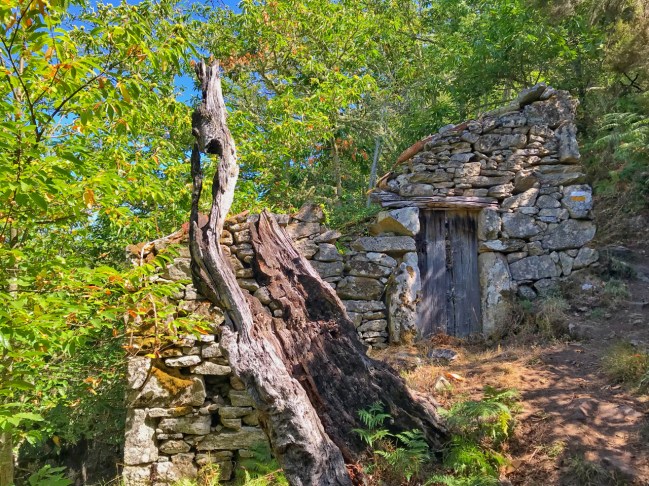
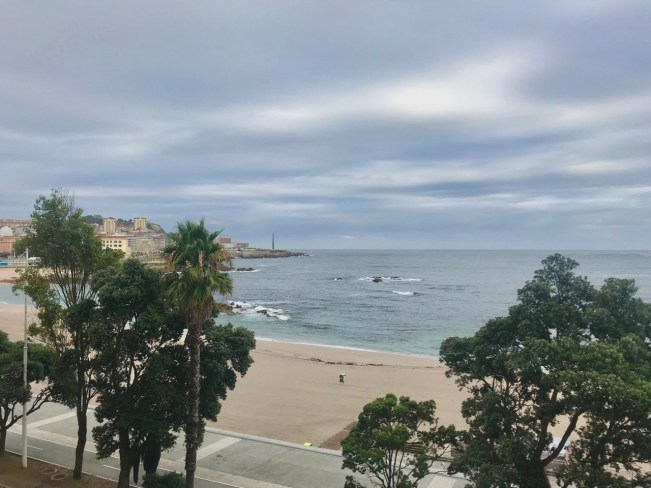 Wind, Sunday walkers and runners, a deserted beach, and overcast skies. A Coruña is supposed to be a nice town (when the sun shines). Certainly the beach is white and long enough. And if one loves Zara’s fashion (alas, their clothes don’t fit my body), this is the hometown of the brand. Maybe another time for me.
 Me duele la rodilla. My knee hurts. Quite a lot, actually. I could hardly get up into my high princess bed last night. The Dominican el profesor de Zumba (i.e. a young, curly-haired, unprofessorial instructor) took us all through a whirlwind hour-long zumba class in a fiesta del barrio (or neighborhood party) last night in a nearby town.
 The Spanish preterite tense is not my friend. How can poder become puste, and venir vino? Vino, as in wine. Really.
 This blue marble